Sopra Steria - Notice of meeting 2026
-
-
2026 Combined General meeting
This document is a free translation into English. It is not a binding document. In the event of a conflict in interpretation, reference should be made to the French version, which is the authentic text.
The English PDF and digital version of the 2025 Universal Registration Document and the Notice of Meetings are available on the Sopra Steria website : https://www.soprasteria.com/26gm
-
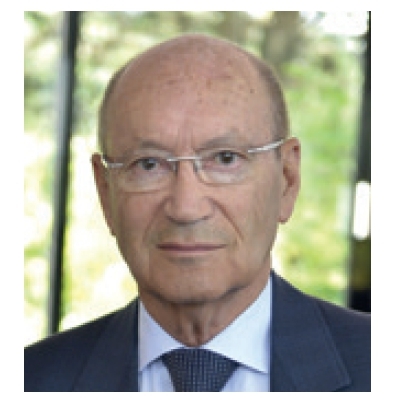
Chairman’s message
“When I consider the development of artificial intelligence, I see additional growth opportunities for our business.”
The final part of financial year 2025 saw our business return to growth. After seven consecutive quarters of low or negative revenue growth, this is an encouraging development for the coming period.
Furthermore, our business outlook for 2026 is once again positive across most of our geographies and vertical markets.
As regards performance, we have moved into 2026 on a solid foundation. Although the operating margin on business activity declined slightly in 2025, it remained close to 10%, while free cash flow returned to its normative level and the pre-tax return on capital employed remained above 20%.
The Group thus has a strong balance sheet with little debt and, consequently, plenty of room for manoeuvre.
The environment in which we operate presents major challenges. From the political and geopolitical arena to energy and technology, they are all likely to impact our markets, our organisation, our skills and our models.
For example, the development of generative and agentic AI will have far-reaching implications both for how we operate and for the content of the services we deliver to our clients. We are readying ourselves for these changes with determination. We have made integrating AI into our production methods – for all our employees – a top priority.
We are supporting our clients as they adopt these new tools – which can boost efficiency and add value – to manage their processes.
The opportunities thus unlocked are likely to give rise to new needs and drive new investment in technology. So, when I consider the development of artificial intelligence, I see additional growth opportunities for our business.
Ever since it was established nearly 60 years ago, the Group has always succeeded in adapting to changes in its environment. Embracing emerging and transformative technologies is part of our DNA. Our entrepreneurial culture and agile organisation have enabled us to make decisive choices that have made Sopra Steria what it is today: a European leader in consulting and digital services, with a particular edge when it comes to sovereignty issues.
We bring a clear-eyed view of the transformations that are underway. We are committed to proactively adapting the Group, and our decisions will continue to prioritise a long-term vision to ensure that our corporate plan creates lasting value.
-
1. Agenda and fomalities governing participation in the General Meeting
-
1. Agenda
The shareholders of Sopra Steria Group are invited to attend the Combined General Meeting to be held on Wednesday, 20 May 2026, at 2:30 p.m., at Pavillon Dauphine, Place du Maréchal de Lattre de Tassigny, 75116 Paris (France), to vote on the following agenda.
- 1) Approval of the parent company financial statements for financial year 2025;
- 2) Approval of the consolidated financial statements for financial year 2025;
- 3) Appropriation of earnings for financial year 2025 and setting of the dividend;
- 4) pproval of disclosures relating to the compensation of company officers mentioned in Section I of Article L. 22-10-9 of the French Commercial Code, in accordance with Section I of Article L. 22-10-34 of the French Commercial Code;
- 5) Approval of the fixed, variable and exceptional items of compensation making up the total compensation and benefits of any kind paid during the financial year ended 31 December 2025 or allotted in respect of that period to Pierre Pasquier, Chairman of the Board of Directors;
- 6) Approval of the fixed, variable and exceptional items of compensation making up the total compensation and benefits of any kind paid during the financial year ended 31 December 2025 or allotted in respect of that period to Cyril Malargé, Chief Executive Officer (from 1 January to 8 October 2025);
- 7) Approval of the fixed, variable and exceptional items of compensation making up the total compensation and benefits of any kind paid during the financial year ended 31 December 2025 or allotted in respect of that period to Xavier Pecquet, Chief Executive Officer (from 8 October to 31 December 2025);
- 8) Approval of the compensation policy for the Chairman of the Board of Directors;
- 9) Approval of the compensation policy for the Chief Executive Officer;
- 10) Approval of the compensation policy for Directors for their service;
- 11) Decision setting the total annual amount of compensation awarded to Directors for their service at €700,000;
- 12) Reappointment of Pascal Daloz as a Director for a term of office of four years;
- 13) Reappointment of Noëlle Lenoir as a Director for a term of office of four years;
- 14) Authorisation to be granted to the Board of Directors to trade in the Company’s shares up to a maximum of 10% of the share capital;
- 15) Authorisation to be granted to the Board of Directors to retire any shares that the Company may have acquired and to reduce the share capital accordingly;
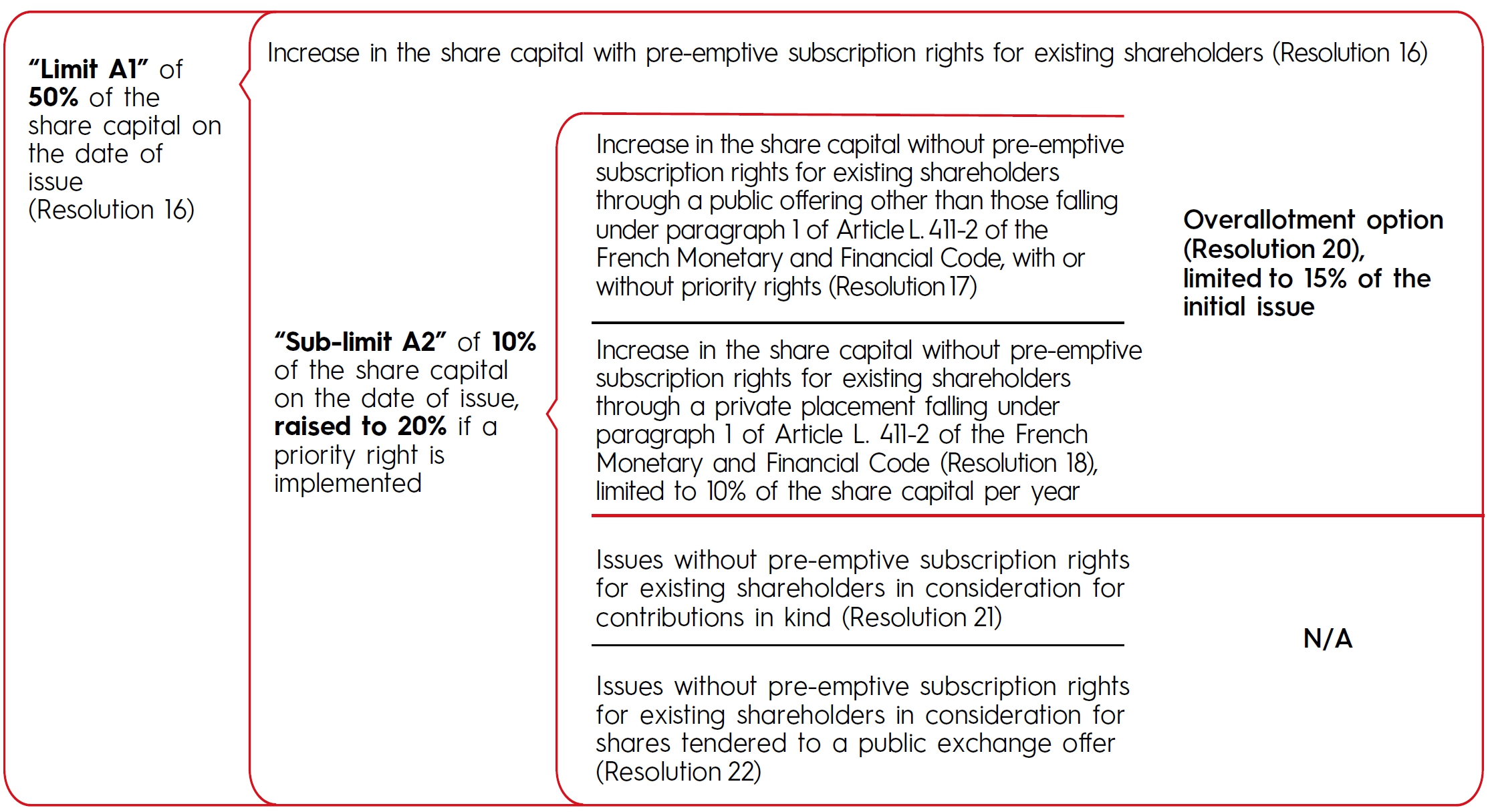
- 16) Delegation of authority to be granted to the Board of Directors to issue ordinary shares and/or other securities giving access to the Company’s share capital and/or the share capital of its subsidiaries, with pre-emptive subscription rights for existing shareholders, subject to an upper limit of 50% of the share capital;
- 17) Delegation of authority to be granted to the Board of Directors to issue ordinary shares and/or other securities giving access to the Company’s share capital and/or the share capital of its subsidiaries, through public offerings (excluding offerings pursuant to paragraph 1 of Article L. 411-2 of the French Monetary and Financial Code), without pre-emptive subscription rights, subject to an upper limit of 20% of the share capital, or 10% of the share capital where no priority is granted;
- 18) Delegation of authority to be granted to the Board of Directors to issue ordinary shares and/or other securities giving access to the Company’s share capital and/or the share capital of its subsidiaries, by means of a public offering provided for under paragraph 1 of Article L. 411-2 of the French Monetary and Financial Code, without pre-emptive subscription rights, subject to an upper limit of 10% of the share capital per year;
- 19) Delegation of authority to be granted to the Board of Directors to determine the issue price for ordinary shares and/or other securities giving access to the Company’s share capital and/or the share capital of its subsidiaries, subject to an upper limit of 10% of the share capital per year, in connection with a capital increase without pre-emptive subscription rights;
- 20) Delegation of authority to be granted to the Board of Directors to increase, with or without pre-emptive subscription rights for existing shareholders, the number of ordinary shares and/or other securities giving access to the share capital to be issued, subject to an upper limit of 15% of the amount of the initial issue;
- 21) Delegation of authority to be granted to the Board of Directors to issue ordinary shares and/or other securities giving access to the Company’s share capital and/or the share capital of its subsidiaries, without pre-emptive subscription rights, in consideration for contributions in kind, subject to an upper limit of 10% of the share capital;
- 22) Delegation of authority to be granted to the Board of Directors to issue ordinary shares and/or other securities giving access to the Company’s share capital and/or the share capital of its subsidiaries, without pre-emptive subscription rights, in consideration for shares tendered to a public exchange offer, subject to an upper limit of 10% of the share capital;
- 23) Delegation of authority to be granted to the Board of Directors to increase the share capital through the capitalisation of premiums, reserves, earnings or any other item eligible for capitalisation;
- 24) Authorisation to be granted to the Board of Directors to allot existing or new free shares to employees and/or company officers of the Company and/or affiliated companies, subject to an upper limit of 1.2% of the share capital, entailing the waiver by the shareholders of their pre-emptive subscription right;
- 25) Delegation of authority to be granted to the Board of Directors to increase the share capital, without pre-emptive subscription rights for existing shareholders, via issues to persons employed by the Company or by an affiliated company, subject to enrolment in a company savings plan, up to a maximum of 2% of the share capital;
- 26) Amendment to Article 14 of the Articles of Association concerning the consideration of gender parity in the appointment of Directors representing employee shareholders;
- 27) Amendment to Article 16 of the Articles of Association concerning the option for the Board of Directors to vote in writing or electronically (written consultation) for certain decisions;
-
2. Procedures governing participation in the General Meeting
Sopra Steria Group’s share capital is made up of 20,547,701 shares. Double voting rights are allocated to all fully paid-up shares that are proved to have been registered in the name of the same shareholder for at least two years.
Every shareholder has the right to participate in the General Meeting, regardless of the number of shares held.
In accordance with Article R. 22-10-28 of the French Commercial Code, the only shareholders allowed to take part in the General Meeting or to be represented by proxy are those able to prove their status by showing that their shares are held in accounts in their name, or in the name of their authorised financial intermediary, no later than the fifth business day preceding the General Meeting, i.e. by Wednesday, 13 May 2026 at 0.00 a.m. (Paris time):
- for holders of directly registered (nominatif pur) or intermediary-registered (nominatif administré) shares: in registered share accounts;
- for holders of bearer shares: in bearer share accounts kept by the authorised intermediary responsible for managing the account, the Securities Account Holder.
Any shareholder who has already submitted their remote voting and proxy form (the Combined Form) may sell all or a portion of their shares up to the date of the General Meeting.
However, only sales completed before the fifth business day preceding the General Meeting, i.e. before Wednesday, 13 May 2026 at 0.00 a.m. (Paris time), will be taken into consideration. Only in such cases, the Securities Account Holder is required to send notification of the sale and provide the information necessary to cancel the vote or to change the number of shares and votes corresponding to the vote.
No share transfers completed after the fifth business day preceding the General Meeting, i.e. after Wednesday, 13 May 2026 at 0.00 a.m. (Paris time), irrespective of the means employed, are to be taken into consideration, notwithstanding any agreement to the contrary.
Société Générale Securities Services is the centralising agent for the General Meeting. Requests submitted by post to the centralising agent must be addressed to Société Générale Securities Services – Service des Assemblées, CS 30812, 44308 Nantes CEDEX 3 (France).
Shareholders who are able to do so are encouraged to give priority to the use of the secure Votaccess platform. This platform allows them to quickly and securely select their means of participation in the General Meeting.
The secure Votaccess platform will be open from Thursday, 30 April 2026 at 9.00 a.m to Tuesday, 19 May 2026 at 3.00 p.m. (Paris time).
Holders of directly registered or intermediary-registered shares will need to sign in to the https://sharinbox.societegenerale.com website, then click on the “Replay” button in the “General Meeting” box on the homepage, and finally click on “Participe” to access the secure Votaccess platform.
- Holders of directly registered shares will need to use their usual access code to activate their Sharinbox By SG Markets account. On the Sharinbox welcome page, shareholders will find all information necessary to guide them through the process. If the shareholder has already activated their account using their email address as their username, their access code is not required, and they can use this email address to log in. Shareholders will have received their password by post when opening their registered account with Société Générale, or by post over the past few days. If this has not yet been done, shareholders activate their account so as to benefit from the latest version of authentication.
If a shareholder losses or forgets their password, they follow the procedure online on the authentication page.
- Holders of intermediary-registered shares will need to log in using the access code and password provided for this purpose by Société Générale Securities Services.
- Holders of bearer shares will need to log in to their Securities Account Holder’s website, using their usual access code and password, then access the secure Votaccess platform by following the on-screen instructions. Holders of bearer shares are recommended to contact their Securities Account Holder to find out whether access to this service is subject to any specific terms and conditions of use.
Shareholders are encouraged to log in to the secure Votaccess platform as soon as it opens, and in any event before the day before the General Meeting.
- 1. attending the General Meeting in person;
- 2. voting remotely prior to the General Meeting;
- 3. appointing as their proxy:
- the Chairman (or if a shareholder does not name a proxy holder in a proxy form submitted to the Company), it being specified that in such a case, the Chairman of the General Meeting shall vote in favour of proposed resolutions submitted for approval by the Board of Directors, and against any other proposed resolutions,
- another shareholder, their spouse, the partner with whom they have entered into a pacte civil de solidarité (PACS, the French civil union contract), or any other individual or legal entity of their choosing under the conditions set out in Articles L. 225-106 and L. 22-10-39 of the French Commercial Code.
Pursuant to Article R. 22-10-28 III of the French Commercial Code, all shareholders who, having requested their admission card, have voted remotely or appointed a proxy, may no longer opt for any other means of participation.
Shareholders who wish to attend the General Meeting in person must bring proof of their identity and their admission card.
Shareholders may request an admission card online on the secure Votaccess platform by following the on-screen instructions after having logged in as described above in Section B. “Means of participation in the General Meeting”/ “Centralisation of the General Meeting – Use of the secure Votaccess platform”.
- Holders of directly registered or intermediary-registered shares must ensure their request for an admission card is received before Monday, 18 May 2026 at 12.00 noon (Paris time) by Société Générale Securities Services, using the Combined Form and the prepaid envelope attached to the notice of meeting.
- Holders of bearer shares must ask their Securities Account Holder to send them an admission card. Société Générale Securities Services must receive all requests by the Securities Account Holder no later than Monday, 18 May 2026 at 12.00 noon (Paris time). If, despite having submitted a request, holders of bearer shares have not received their admission card, they must ask their Securities Account Holder to provide them with a certificate of investment, which will allow them to prove their status as a shareholder to be admitted to the General Meeting.
Shareholders who arrive on the date of the General Meeting without an admission card or a certificate of investment are responsible for contacting their Securities Account Holder and requesting to be sent the certificate of investment required to attend the General Meeting.
On the day of the General Meeting, the certificate of investment shall be accepted either in print or electronic format, provided that, for the latter format, the shareholder is able to send it to the email address that will be provided upon arrival at the venue.
Shareholders may submit their voting instructions online on the secure Votaccess platform by following the on-screen instructions after having logged in as described above in Section B. “Means of participation in the General Meeting”/ “Centralisation of the General Meeting – Use of the secure Votaccess platform”.
- Registered shareholders must fill out and sign the Combined Form attached to the notice of meeting and send it back using the prepaid envelope to Société Générale Securities Services.
- Holders of bearer shares must:
2) send the completed signed Combined Form together with their voting instructions to their Securities Account Holder. The Securities Account Holder is responsible for sending the Combined Form, together with a certificate of investment, directly to Société Générale Securities Services – Service des Assemblées, CS 30812, 44308 Nantes CEDEX 3 (France).
In order to be taken into account, Combined Forms must be received by Société Générale Securities Services no later than Monday, 18 May 2026 at 12.00 noon (Paris time).
Shareholders may appoint a proxy or rescind a proxy appointment online on the secure Votaccess platform by following the on-screen instructions after having logged in as described above in Section B. “Means of participation in the General Meeting”/“Centralisation of the General Meeting – Use of the secure Votaccess platform”.
If and only if their Account Holder has not joined the Votaccess system, holders of bearer shares can send an email to the following address: assembleegenerale@soprasteria.com. The message must specify the full name and address of the principal shareholder, as well as those of the proxy appointed or whose appointment is rescinded. Holders of bearer shares must ask their Securities Account Holder to send Société Générale Securities Services a certificate of investment to prove their status as a shareholder.
Holders of directly registered or intermediary-registered shares and holders of bearer shares shall use the Combined Form, following the instructions detailed in Section 2. b) on voting remotely by post.
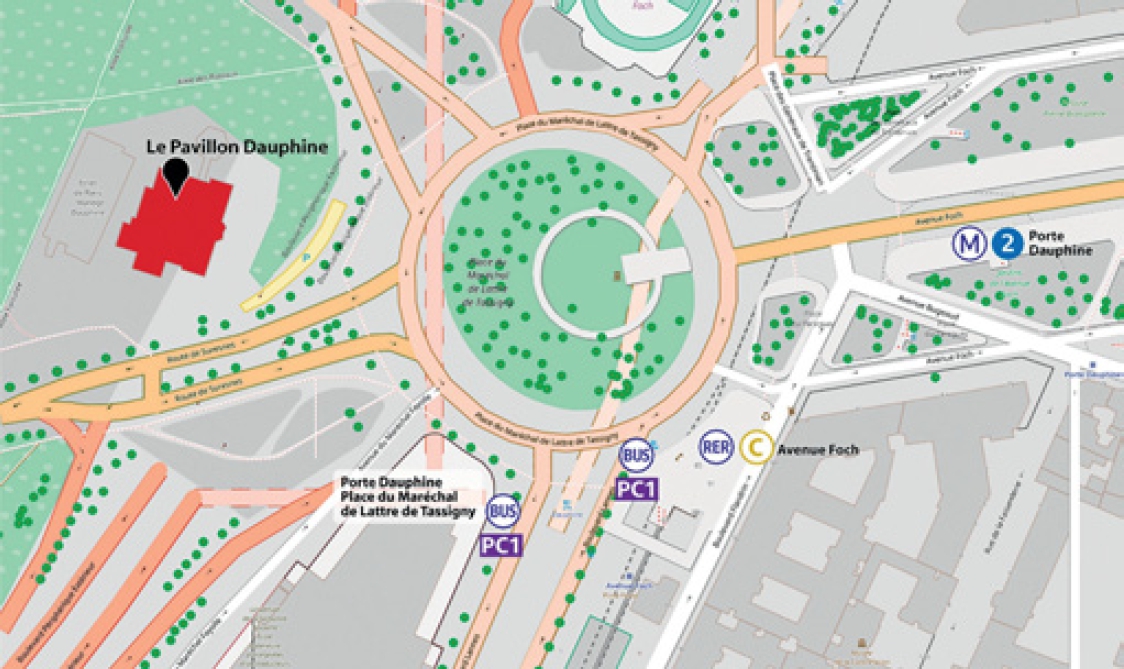
Pavillon Dauphine
Place du Maréchal de Lattre de Tassigny 75116 Paris
BY RAIL
Metro: line 2 - Porte Dauphine
RER: line C - Foch
BY BUS
Bus: PC1 - Porte Dauphine
BY CAR
Coming from the inner ring road, take “Porte Dauphine exit”
2.3. Procedure for exercising the right to add items of business or proposed resolutions to the agenda
Requests made by shareholders fulfilling the legal requirements to include items of business or proposed resolutions on the agenda must be sent to Sopra Steria Group’s registered office, in accordance with the conditions set forth in Article R. 225-71 et seq. of the French Commercial Code, by registered letter with proof of receipt, or by email to the following address: assembleegenerale@soprasteria.com, and received no later than the 25th day preceding the General Meeting, i.e. 25 April 2026, and must be sent no more than 20 days and must be sent no more than 20 days after the notice of meeting publication date of 13 March 2026, i.e. 2 April 2026. The reasons for their submission must be clearly stated and they must be accompanied by a deposit certificate for a securities account in the name of the shareholder (attestation d’inscription en compte).
Any such items of business or proposed resolutions will be included on the agenda of the General Meeting and posted on the Company’s website, https://www.soprasteria.com/26gm, in accordance with Article R. 22-10-23 of the French Commercial Code. The examination by the General Meeting of items of business or proposed resolutions included on the agenda by shareholder request remains subject to the submission by the authors of the request of newly issued deposit certificates for their securities under the same accounts by the fifth business day preceding the General Meeting, i.e. Wednesday, 13 May 2026 at 0.00 a.m. (Paris time).
All shareholders have the right to submit written questions. To be acceptable, these questions must be sent to the Chairman of the Board of Directors at the Company’s registered office, by registered letter with proof of receipt or by email to assembleegenerale@soprasteria.com no later than the fourth business day preceding the General Meeting, i.e. by Wednesday, 13 May 2026. In order to be considered, questions must be accompanied by a deposit certificate for a securities account in the name of the shareholder (attestation d’inscription en compte).
In accordance with the laws in force, a single answer may be provided in response to multiple written questions that share the same content.
All written questions submitted by shareholders and the answers provided will be posted in the section dedicated to General Meetings on the Company’s website, at the following address: https://www.soprasteria.com/26gm.
Pursuant to applicable legal and regulatory provisions, all documents that must be made available to shareholders in connection with General Meetings will be accessible on the Company’s website at the following address: https://www.soprasteria.com/26gm no later than the twenty-first day preceding the General Meeting, i.e. by Wednesday, 29 April 2026.
Furthermore, with a view to modernising communication with shareholders, Decree No. 2026-94 of 13 February 2026 has amended certain rules relating to corporate communications procedures. Consequently, Article R 225-76 of the French Commercial Code requires companies to provide additional information on their websites and, as such, companies are no longer required to send preliminary documents to shareholders holding registered shares if these documents are published online.
Prior notice of the Combined General Meeting was published in the Bulletin des Annonces Légales Obligatoires dated 13 March 2026.
The official notice will be published in the Bulletin des Annonces Légales Obligatoires and in the Eco des Pays de Savoie newspaper on 1 May 2026.
In accordance with Article R. 22-10-29-1 of the French Commercial Code, a live audiovisual webcast of the entire General Meeting will be available on the day of the Meeting, in the General Meeting section of the Company’s website: https://www.soprasteria.com/" shareholders-meetings. A recording of the General Meeting will be available no later than seven (7) working days after the date of the Meeting and for at least two (2) years from the date of its publication on the General Meeting section of the Company’s website: https://www.soprasteria.com/26gm or by scanning the QR code:
-
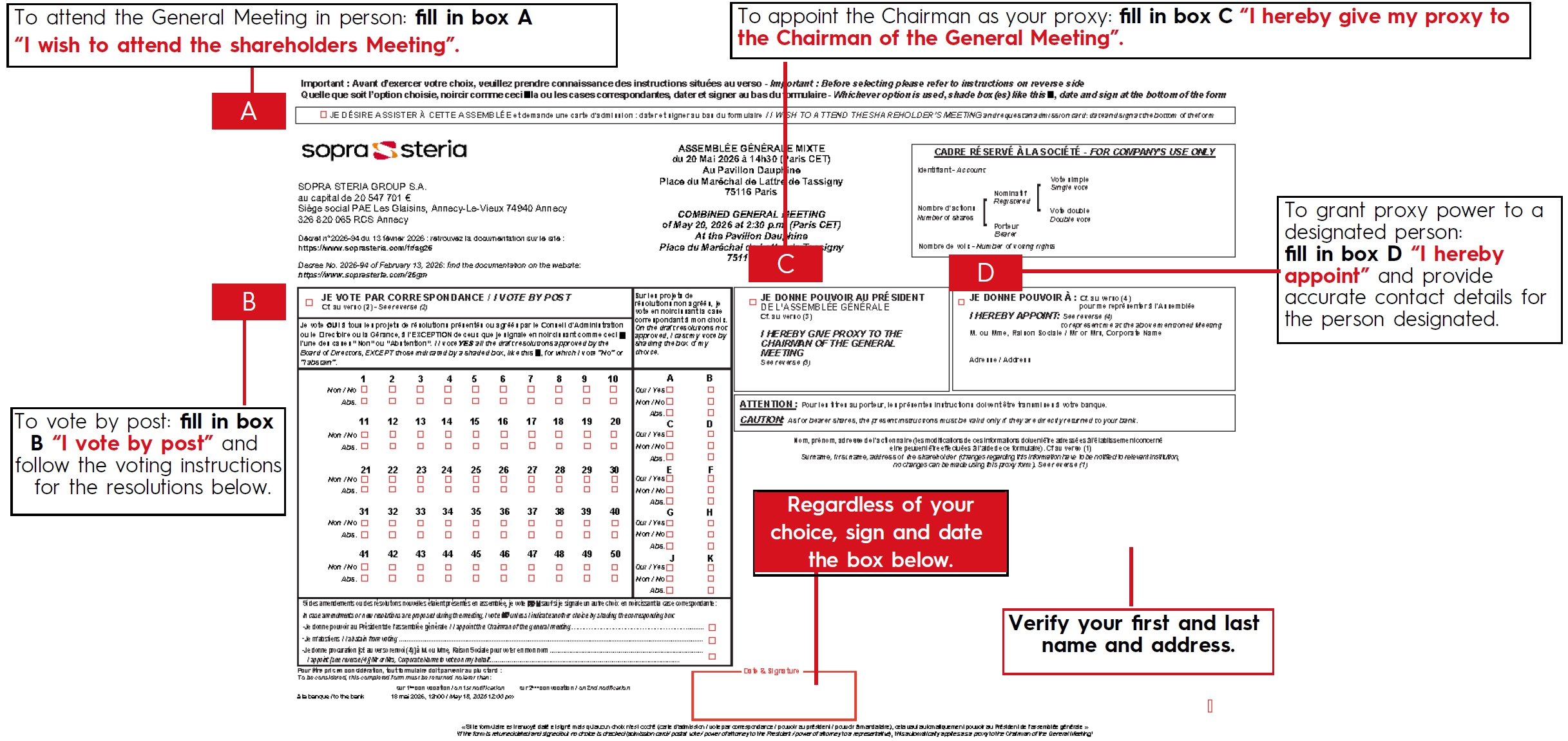
3. Instructions for filling out the voting form
- 2. To vote by post: fill in box B [I am voting by post], each numbered box corresponding to the draft resolutions presented by the Board of Directors and appearing in the notice of meeting. Then complete as follows:
- to vote “FOR”, leave the boxes empty;
- to vote “AGAINST” on any of these proposed resolutions, fill in the individual boxes corresponding to the resolutions;
- to vote “ABSTAIN” on any of these proposed resolutions, fill in the individual boxes corresponding to the resolutions.
Any shareholder may be represented by his or her spouse, the partner with whom he or she has entered into a pacte civil de solidarité (PACS, the French civil union contract), another shareholder or any other private individual or legal entity of his or her choice.
The form must be filled in, signed, dated and sent back as indicated to the following address: Société Générale Securities Services – Service des Assemblées – CS 30812, 44308 Nantes CEDEX 3 (France).
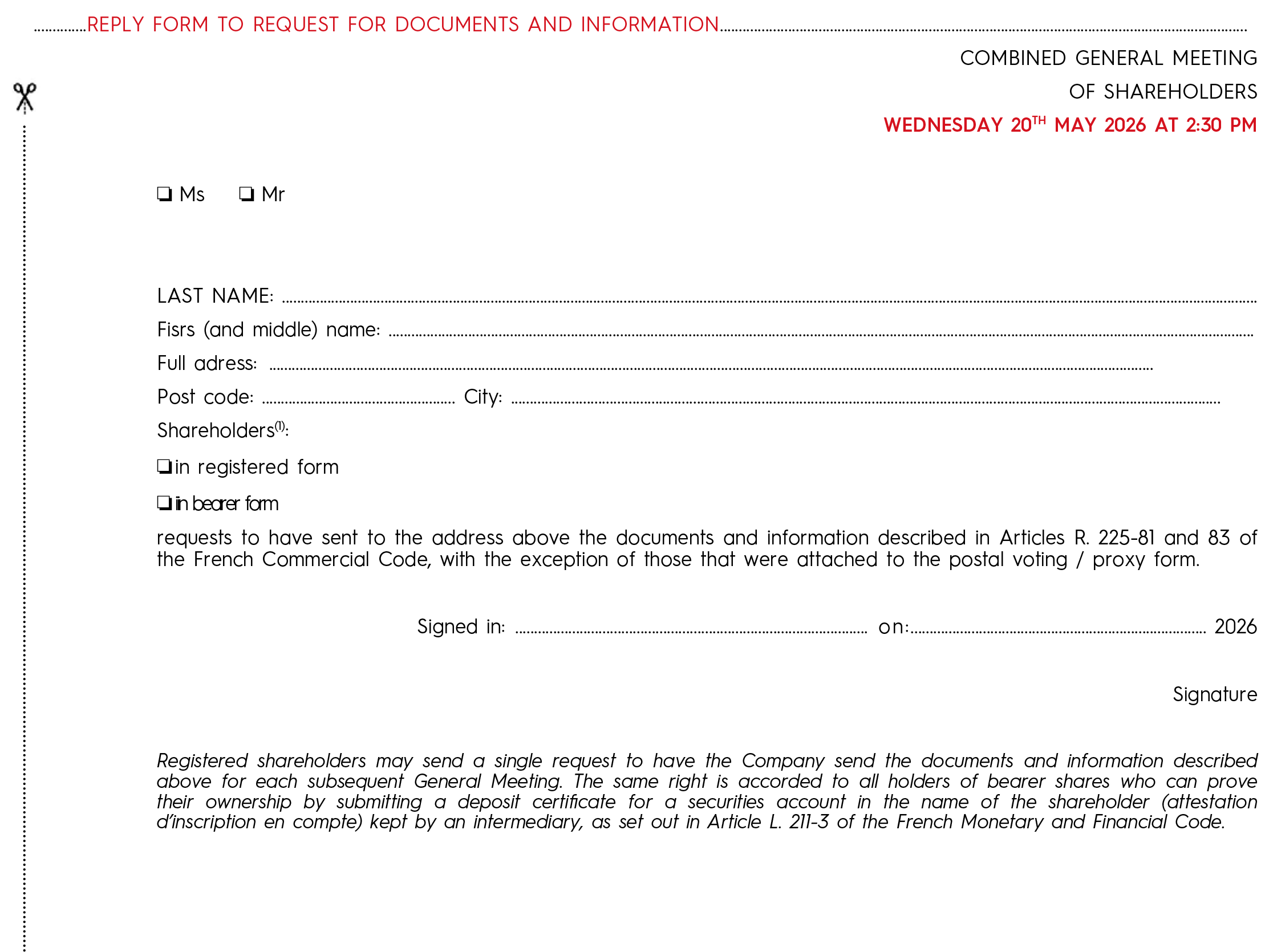
Request for documents and informations
COMBINED GENERAL MEETING OF SHAREHOLDERS
Wednesday 20th May 2026 at 2:30 PM
Pursuant to Article R. 225-88 of the French Commercial Code, from the time that notice of a General Meeting is given until the fifth day (inclusive) before the meeting, any shareholder (owning registered shares or showing proof of ownership of bearer shares) may use the form below to ask the Company to send the documents and information described in Articles R. 225-81 and 83 of said Commercial Code.

Send this form to:
SOPRA STERIA GROUP
For the attention of Lima Abdellaoui
Or by postal mail:
6 Avenue Kleber, 75116 PARIS
Or by email at:
-
1. Activities and Strategy
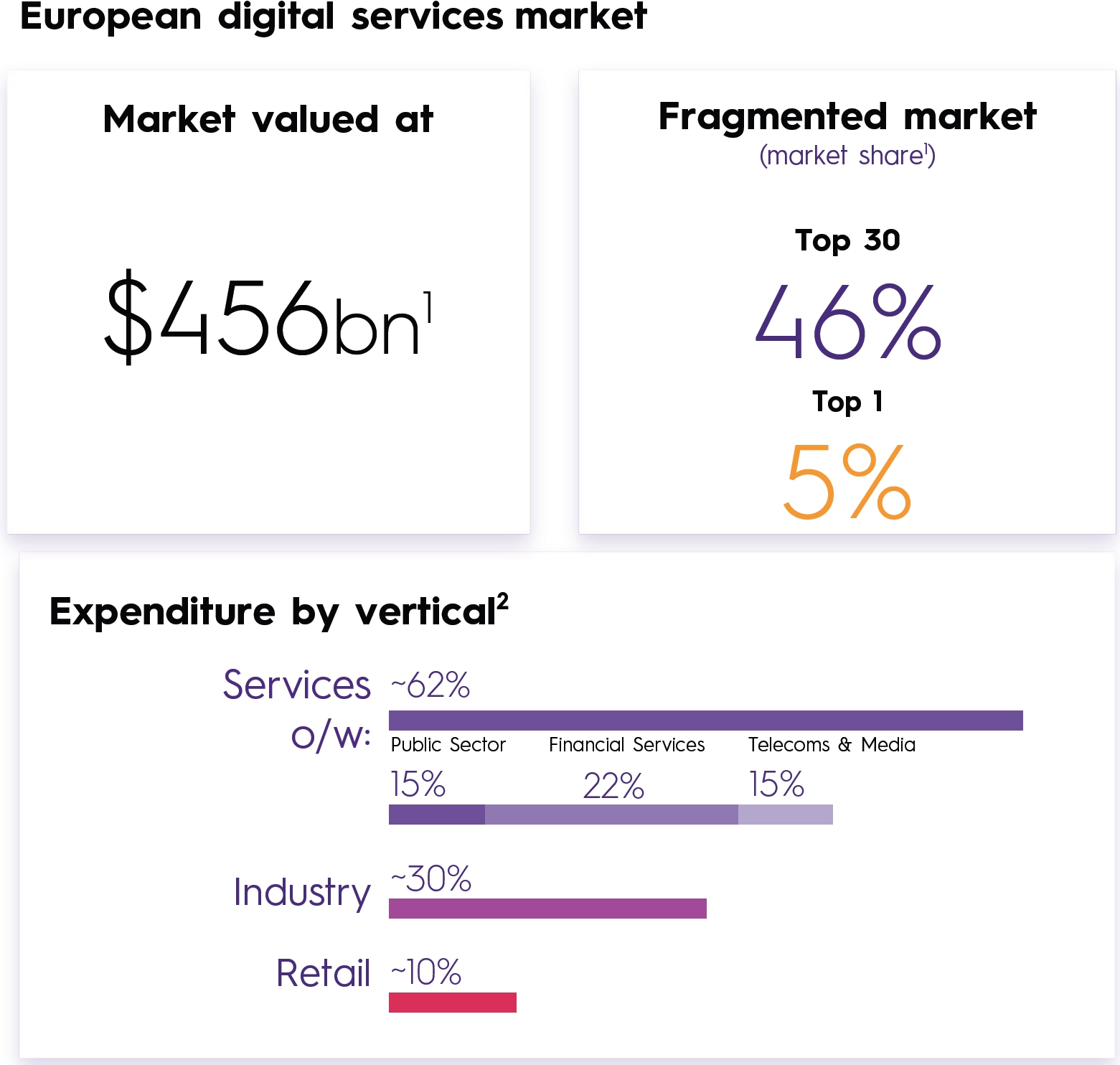
Sopra Steria, a major European digital services group, is a trusted alternative to the global tech giants. The Group harnesses cutting-edge technology to help address the challenges facing industry and society. With the pace of innovation growing ever more rapidly, there is rarely just one single, obvious solution to a given challenge.
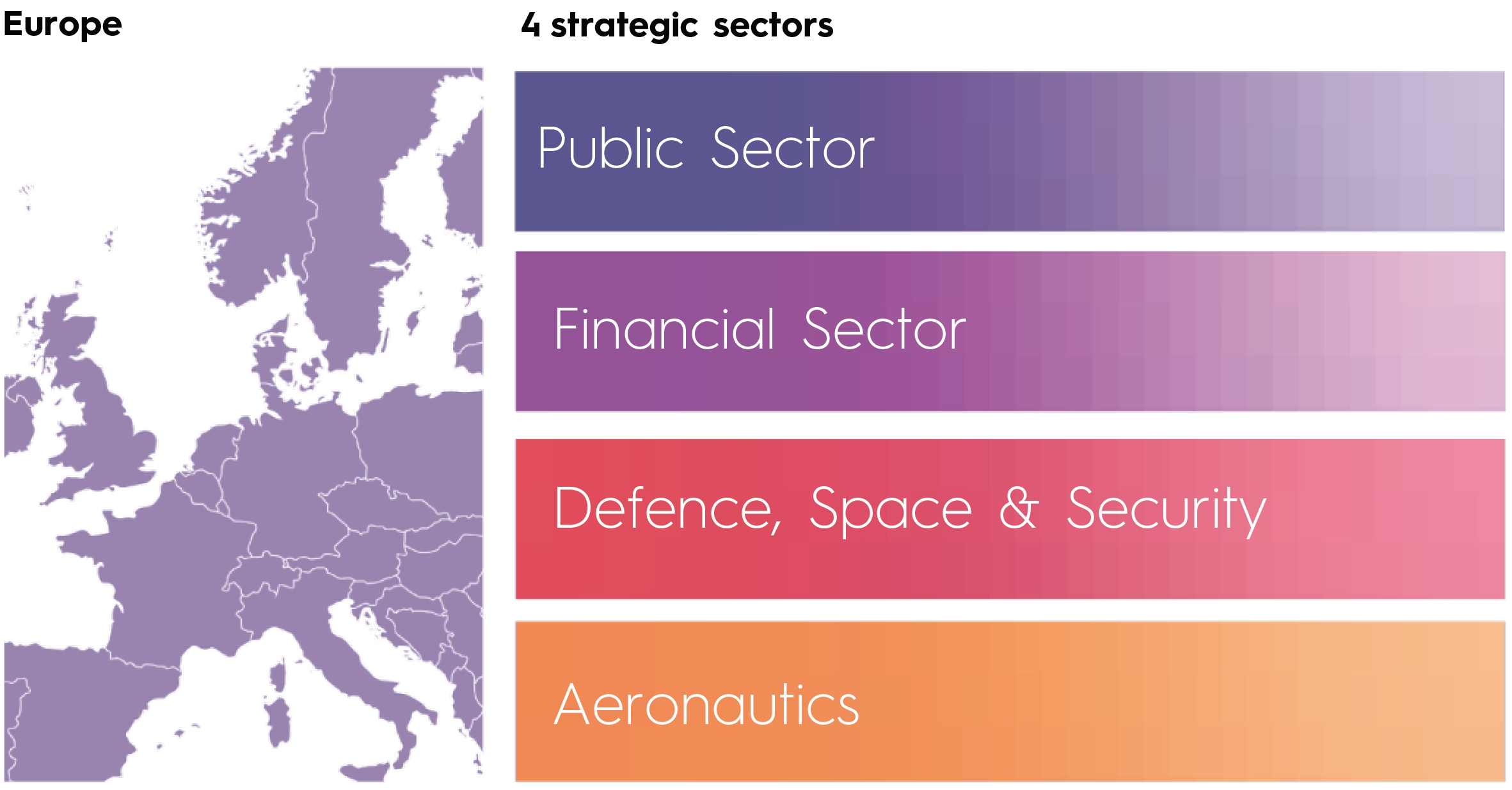
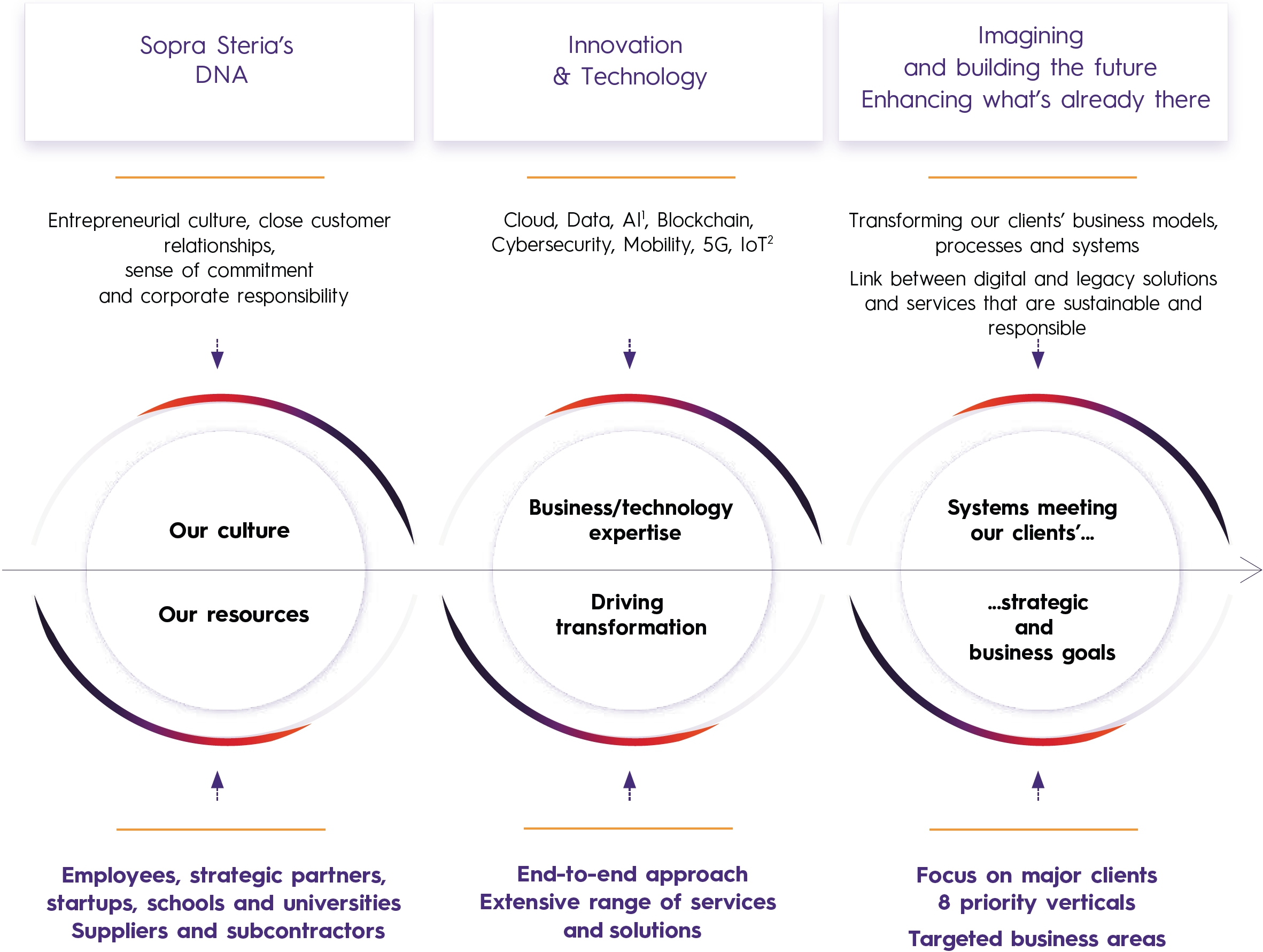
Sopra Steria is keen to establish itself as a European leader in digital services and position itself as a trusted, credible European alternative to global operators. The Group is developing and strengthening its foothold in four strategic markets (Public Sector, Financial Services, Defence & Security, Aeronautics & Space), where issues relating to sovereignty and responsible digital technology are becoming increasingly critical in Europe. To this end, it focuses on delivering high value-added solutions and an industrial and sustainable approach to implementing technology. The Group aims to act and innovate in such a way as to be able to influence how its stakeholders make use of technology.
Decision to focus on delivering high value-added services and solutions. Ambition to influence how digital technology is used Industrial & sustainable approach to implementing technology
Sopra Steria aims to be a major European player in digital transformation, playing an active role in helping build a sovereign digital Europe and helping large businesses and organisations in Europe remain competitive and grow.
The Group enables them to make the best use of digital technology to innovate, transform their activities (business as well as operating models), protect their strategic interests and optimise their performance.
Sopra Steria champions an ambitious, value-creating vision that brings together employees, clients, shareholders and partners, with world-class business performance underpinned by the values and goals of responsible digital technology.
- control over its independence and a business philosophy that goes beyond financial performance to recognise the social importance of being a responsible employer and corporate citizen;
- operating as a digital transformation professional, underpinned by a comprehensive range of services and solutions that combines an in-depth understanding of business- and sector-specific priorities with cutting-edge expertise across the full spectrum of digital and emerging technologies. The Group offers clients expertise spanning the full spectrum of digital transformation: it advises (consulting), builds (integration), operates (DPS – formerly infrastructure management – and BPS) and secures (cybersecurity);
- working with clients to develop and secure Europe’s digital sovereignty. Sopra Steria is the partner of choice for digital sovereignty issues, implementing IT solutions that strengthen clients’ technological sovereignty and/or advising them on how to strengthen it;
- a focus on priority sectors and clients and leading positions in priority verticals (Financial Services, Aerospace, Defence & Security, Public Sector);
- providing expertise in digital technologies. The Group is continually investing in the exploration of new ideas and expertise in architectures, and in emerging digital, cloud and AI technologies and uses. Special efforts are being made to establish targeted partnerships with leading players in the digital ecosystem;
- an ambition of influencing the design, development and use of digital technology (as a catalyst and aggregator);
- a special drive to roll out responsible digital technology for projects that is more sustainable and more accessible;
- close relationships with employees, with people and the management approach at the heart of the Company’s strategy (promoting protection and trust; supporting human development; encouraging accountability by valuing high standards and critical thinking).
Lastly, the Group’s mission statement – formally adopted in 2019 – reflects both its values and its desire to help meet the Sustainable Development Goals of its stakeholders and society: “Together, building a positive future by putting digital to work for people.”
In order to securely position itself with client decision-makers at the business department level, the Group is continuing its move up the value chain in consulting, and confirms its medium-term target of continuing to develop its presence in this area. To do this, it is gradually developing a range of consulting services and capacity in all of the regions in which it operates, using a model that favours synergies with the Group’s other business lines. The Group’s plan is to establish and develop a European consulting capability specialising in business transformation through technology. The Group aims to help its clients define and deliver on the promises they make to their clients and employees by seizing opportunities offered by the ongoing digital and social transitions, in support of the Group’s strategy. The Group’s ambition is to be a powerful and widely recognised transnational consulting firm within Europe, at the cutting edge of innovation in technology and management, where business and technology intersect, offering tailored solutions designed to address specific business issues while honouring its clients’ culture and ESG policy.(1)
To ensure that the Group is recognised for its ability to secure and accelerate its clients’ transformation projects, the consulting strategy is based on four pillars that pave the way for successful transformation:
- Biztech: In our consultancy activities, focusing on the crucial aspects of how to integrate new with legacy and achieve rapid deployment.
- Human-first: Taking care to engage with and involve all stakeholders, giving clients and employees a say at every key stage, from design to implementation.
- Driven by AI: Giving our clients access to our multi-sector expertise, AI use cases and our experience with decision-makers who have successfully and securely deployed AI.
- 360° value: Using our clients’ proprietary data to assess the impact of their projects, not only in terms of return on investment, but also with regard to ESG and sovereignty.
Sopra Steria has successfully completed numerous digital projects. Its experience has allowed it to offer a holistic approach to digital transformation to the market, based on a series of best practices.
To step up its commitment to digital technology, the Group is continuing to invest with the following goals:
- being at the cutting edge of the market in all of its services and business models;
- strengthening its technology assets;
- transforming its operating models;
- educating all of its employees in digital culture, practices and skills;
- keeping an eye on the market in order to clarify its digital strategy and target the best digital partners.
We offer our clients expertise spanning the full spectrum of digital transformation: we advise (consulting), build (integration), operate (DPS – formerly infrastructure management – and BPS) and secure (cybersecurity).
The Group is upgrading its range of services and solutions in each of these business areas to leverage advances in digital technology in a number of key areas, thereby:
- harnessing the potential of cutting-edge technologies – analytics, smart machines, blockchain, IoT, augmented/virtual reality etc. – to benefit its clients through innovative applications. A particular focus is placed on AI, and in particular generative AI, through a large-scale programme launched in 2023 across all the Group’s geographies and involving all its business lines;
- driving its clients’ transformation from its current position: for example, the Application Management range has evolved to encompass the end-to-end transformation of processes and the corresponding modernisation of existing IT systems, including connecting digital technologies with legacy systems and migrating all or some of the IT system to the cloud;
- promoting new end-to-end approaches combining consulting and software: providing IT strategy support for large companies and public authorities, implementing digital continuity in industrial value chains, building service platforms, overseeing the cloud-based and digital transformation of information systems, etc.
The digitalisation of solutions and services and, more broadly speaking, changing client expectations, have led the Group to adapt its business models. The Group will thus be selling more and more solutions operated on behalf of clients and, in services, increasingly leveraging intellectual property (reusable components, implementation accelerators, etc.). It will thus generate more recurring revenue through its solutions, with less of a direct connection to the size of its workforce in services.
The Group is continually investing in the exploration of new ideas and expertise in architectures, and in emerging digital, cloud and AI technologies and uses, relying in particular on its teams of “digital champions” (experts led by the Group’s Chief Technology Officer).
At the same time, all necessary resources are being designed and put in place to rapidly develop and operate digital solutions on behalf of the Group’s clients that are natively designed to function in hybrid cloud environments:
- the Digital Enablement Platform (DEP), the technical foundation for building or modernising IT systems (designed to be able to interact with components of Amplify, the hybrid integration platform of 74Software [formerly Axway Software]), an industrial DevOps chain and an environment to capitalise on and search for reusable software components, a private cloud that can be extended to the main public clouds;
- implementation accelerators for new digital technologies (smart machines, AI/machine learning, blockchain, IoT, etc.);
- digital factories to enable the implementation of a range of services combining consulting and software (e.g. migrating information systems to the cloud).
In early 2023, the Group launched a massive initiative supporting the adoption of advances brought about by generative AI. The rAIse® programme aims to use AI to transform the Group’s practices, creating an end-to-end range of services and solutions for its clients and systematically building AI into its technology assets over the long term.
The Group is gradually changing the operating model for its services activities by incorporating a more matrix-based approach based on 3 main components:
- verticals supporting the Group’s sales capacity through the key account strategy and the development of vertical-specific services and solutions and sector-specific expertise;
- skill centres that scale up technological expertise, such as data, AI, cloud computing and SAP;
- corporate function that draws up the operating model and tailors it to each operating sector by defining common policies, steering operations and overseeing the transformation of the operating model.
To accompany its transformation, the Group is making a considerable effort to train its employees and managers:
- expanding its range of training: introductory and more advanced courses on all digital/data/AI/cloud technologies;
- training on new practices and new industrial environments;
- acculturation and upskilling in new business requirements related to responsible digital technology: training in the digital solutions put in place by the Group;
- digitalisation of training resources: virtual training rooms, in-house e-learning and access to MOOC-style learning platforms.
Numerous initiatives are being encouraged to promote and enhance innovation, such as the Group’s digital champions keeping an eye on technology advances and uses, innovation imperatives assigned to project teams, internal innovation competitions to develop new digital uses, hackathons open to clients and partners, as well as platforms for digital demonstrations, brainstorming, co-design, rapid development and technology intelligence open to clients, employees and partners (DigiLabs at all the Group’s major locations and a Next centre at its registered office), etc.
The rAIse® programme encourages the Group as a whole to experiment with the advances brought about by AI, and in particular generative AI. All entities are working towards being able to offer their clients AI-powered solutions, incorporating AI into their everyday practices and training all employees.
Special efforts are being made to establish targeted partnerships with leading players in the digital ecosystem by vertical and by major technology area (startups and niche players, institutions of higher education and research laboratories, top software development companies, hyperscalers, etc.). It is within this framework that a strategic partnership has been forged with 74Software (formerly Axway Software).
In order to ensure effective market intelligence, a collaborative startup observatory is made available to the Group’s teams of digital champions and all its managers.
In certain very specific cases relating to its strategy, the Group may directly or indirectly take equity stakes (through specialised funds) in recently launched startups that it considers the most innovative in the market, applying a corporate venturing approach.
To support its positioning goals, the Group is continuing its policy targeting specific vertical markets, key accounts and business areas in all countries where it operates.
There are eight priority verticals that currently account for the majority of revenue: Public Sector; Financial Services; Defence, Security & Space; Aeronautics; Energy & Utilities; Telecoms, Media & Entertainment; Transport; Insurance; and Retail.
For each vertical, the Group selects a small number of key accounts (fewer than 100 at Group level), focuses on a few different business areas in which it aims to secure a leading position and implements an inter-entity coordination system for the different countries and subsidiaries concerned.
Some of these verticals are considered particularly strategic. The Group has very clear strengths in several countries (broad position, IT and business expertise, replicable experiences etc.). The transformation needs of businesses, public authorities and ecosystems in place are considerable and rely on similar solutions from one country to the next. These verticals (Financial Services, Aerospace, Defence & Security, Public Sector) are eligible for corporate investment or external growth transactions.
In order to achieve its leadership objective in its targeted verticals and business areas, the Group mobilises the development efforts of its various entities to build end-to-end value propositions as well as ranges of business solutions designed to address its major clients’ business priorities.
The Group confirmed its target to continue to develop solutions in the fields of human resource management and property management (Sopra HR Software and Sopra Real Estate Software) as well as its activities in solution integration (specialised finance solutions). Efforts will continue to be focused on enriching the Group’s solutions, adapting them to cloud systems, leveraging API-based access to data and services, integrating new digital technologies, developing managed services, and expanding operations into new geographic markets.
The Group makes regular targeted acquisitions in order to enhance its range of services and solutions and its expertise, or to strengthen its position in certain regions. In this capacity, it will be able to carry out acquisitions of varying sizes.
Sopra Steria Group has gradually adopted multi-year strategic sustainability priorities that have been approved by its supervisory, executive and management bodies. These priorities reflect the close long-term ties between the Group’s positioning as a trusted alternative, its strategy and its financial and sustainability performance. Accordingly, the Group’s strategy and associated objectives have evolved to translate these priorities into practical action in each of its strategic action areas (see Section 1.3.1.2 of this chapter).
Following the double materiality assessment conducted in 2024 and confirmed in 2025, the Group has formalised an expanded definition of sustainability performance, highlighting its ties to strategy and the business model (see Chapter 4, Section 1.1.3.1 of the 2025 Universal Registration Document). Sopra Steria has thus strengthened its approach since 2024 in order to formalise and structure these ties, taking into account established strategic priorities and future objectives in relation both to strategy and to financial and sustainability performance.
This approach is intended to apply and adapt strategic sustainability priorities to key areas of the Group’s strategy, namely:
- large service groups, including consulting, integration services, digital platform services, cybersecurity and software products;
- clients’ principal sectors of activity, corresponding to Sopra Steria’s verticals;
- the Group’s main geographies, i.e. its countries and their territories (for example regions);
- value creation for key stakeholders: employees, clients and investors.
Sustainability matter(1) Strategic priority Environment [ESRS E1] Net-zero emissions: Continue along the trajectory for reducing greenhouse gas emissions from the Group’s direct activities. Sopra Steria employees [ESRS S1] Diversity and equal opportunities: Meet the imperatives of workplace gender equality, address diversity priorities and prevent all forms of discrimination. Maintaining and developing employee skills: Proactively meet clients’ and employees’ current and future needs. Social dialogue: Work with employee representatives to maintain constructive dialogue and negotiations in order to provide employees with appropriate working conditions and support the major changes affecting the Group. Health, safety and working conditions: Provide a secure working environment conducive to quality of life at work. Local communities [ESRS S3] Community engagement: Ratchet up the civic and social engagement of the Group and its employees to support the most vulnerable sections of society and foster digital inclusion. Business conduct [ESRS G1] Values and compliance: Place our values and ethical principles at the heart of our relationship with stakeholders and ensure the compliance of actions carried out by the organisation. Specific to digital services companies Protecting and securing operations: Safeguard the security of operations and the confidentiality of data by implementing robust frameworks, paying special attention to cybersecurity. Digital sovereignty: Provide sovereign cloud solutions and help strategically important public- and private-sector organisations in Europe to gain expertise in new technologies. Environmentally sustainable digital technology: Apply digital sustainability and sustainable design principles to the projects, solutions and services offered to our clients. Digital ethics: Design dedicated “ethical by design” digital programmes that are tailored to actual use cases and meet responsible digital technology criteria. Digital inclusion: Make digital technology as widely accessible as possible. Sopra Steria maintained this momentum in 2025 by strengthening its ability to identify, support and accelerate priority projects that contribute to the Group’s performance, in line with its strategy. This approach was reflected in specific decisions and initiatives, which are presented in detail in Chapter 4, Section 1.1.3.2 of the 2025 Universal Registration Document.
- (1) Based on the nomenclature of the Corporate Sustainability Reporting Directive (CSRD), as used in the Sustainability Report - see Chapter 4.
Sopra Steria has conducted a double materiality assessment,1 the outcome of which has confirmed the Company’s priorities, some of them long-standing, while providing a fresh perspective on the value chain.
These priorities reflect Sopra Steria’s identity, strategy and business model, which are intrinsically linked to the quality of its relationships with its partners and the role of digital technology in society.
- Climate change adaptation (ESRS E1)
- Reducing and mitigating the carbon footprint (ESRS E1)
- Resource and waste management (ESRS E5)
- Priority placed on training and skills (ESRS S1)
- Equal opportunities and diversity (ESRS S1)
- Employee protection and trust (ESRS S1)
- Social dialogue (ESRS S1)
- Solidarity and volunteering (ESRS S3)
- Regional presence (ESRS S3)
- Contribution to essential public services (ESRS S4)
- Business conduct and compliance (ESRS G1)
- Cybersecurity and digital sovereignty
- Developing responsible digital technology
1. Analysis conducted in accordance with the requirements of the Corporate Sustainability Reporting Directive (CSRD)
Sopra Steria is fully committed to managing its sustainability matters to ensure that it delivers as a responsible corporate citizen and meets its stakeholders’ expectations. The results achieved are testament to the Group’s tangible commitment to employees, the environment and society.
AI training programme for all employees totaling 31,537 hours of training, with 14,897 employees trained in 2025
New gender equality agreement signed for France (scope: “Unité Économique et Sociale” (economic and employee unit)) in January 2025 and new career management agreement in December 2025
Expanded SBTi Net-Zero strategy, which aims to achieve a 90% reduction in Scope 1+2 and Scope 3 greenhouse gas emissions by 2040, through various carbon reduction actions
Ongoing sustainable procurement programme, selecting suppliers committed to a more environmentally friendly approach
Roll-out of a sustainable transport plan aiming to reduce business travel and promote low-emissions transport options
Ongoing implementation of the “International Volunteer Days” volunteering campaign to encourage employees to get involved in community initiatives, with digital inclusion and education projects through the Group
Support and guidance for non-profit projects that promote digital inclusion through the Sopra Steria-Institut de France Foundation
Ongoing Sopra Steria Foundation educational programme in India promoting access to education, digital learning infrastructure, health and hygiene awareness as well as eco-responsible development
Development of charitable efforts in each country in order to achieve a collective impact tailored to specific local needs
Maintain the proportion of employees who have completed ethics training at over 90% and achieve an EcoVadis Ethics Score of over 80/100
-
2. Financial performance
“I joined Sopra Steria with the firm conviction that the Group has solid fundamentals, a key differentiator in its European positioning, and clear potential with regard to growth and profitability.
Financial year 2025 unfolded in a challenging environment. Against this backdrop, Sopra Steria’s return to organic growth in the fourth quarter, 18% growth in net profit attributable to the Group and robust cash flow reflect the resilience of our business model and our teams’ high-quality work. We currently have a solid presence in strategic sectors including defence, aeronautics, the public sector and financial services, and are ramping up in consulting as well as generative and agentic artificial intelligence. These positions are key levers to gradually improve our growth trajectory and margin.
Our solid balance sheet and moderate financial leverage also enable us to enter this new phase with disciplined capital allocation and selectivity in our investments.
We are approaching 2026 with a clear path: securing a lasting return to positive organic growth, improving our operating margin and maintaining a high cash flow, in line with our medium-term targets. Our priority is to drive long-term value creation for our shareholders and for all our stakeholders.”
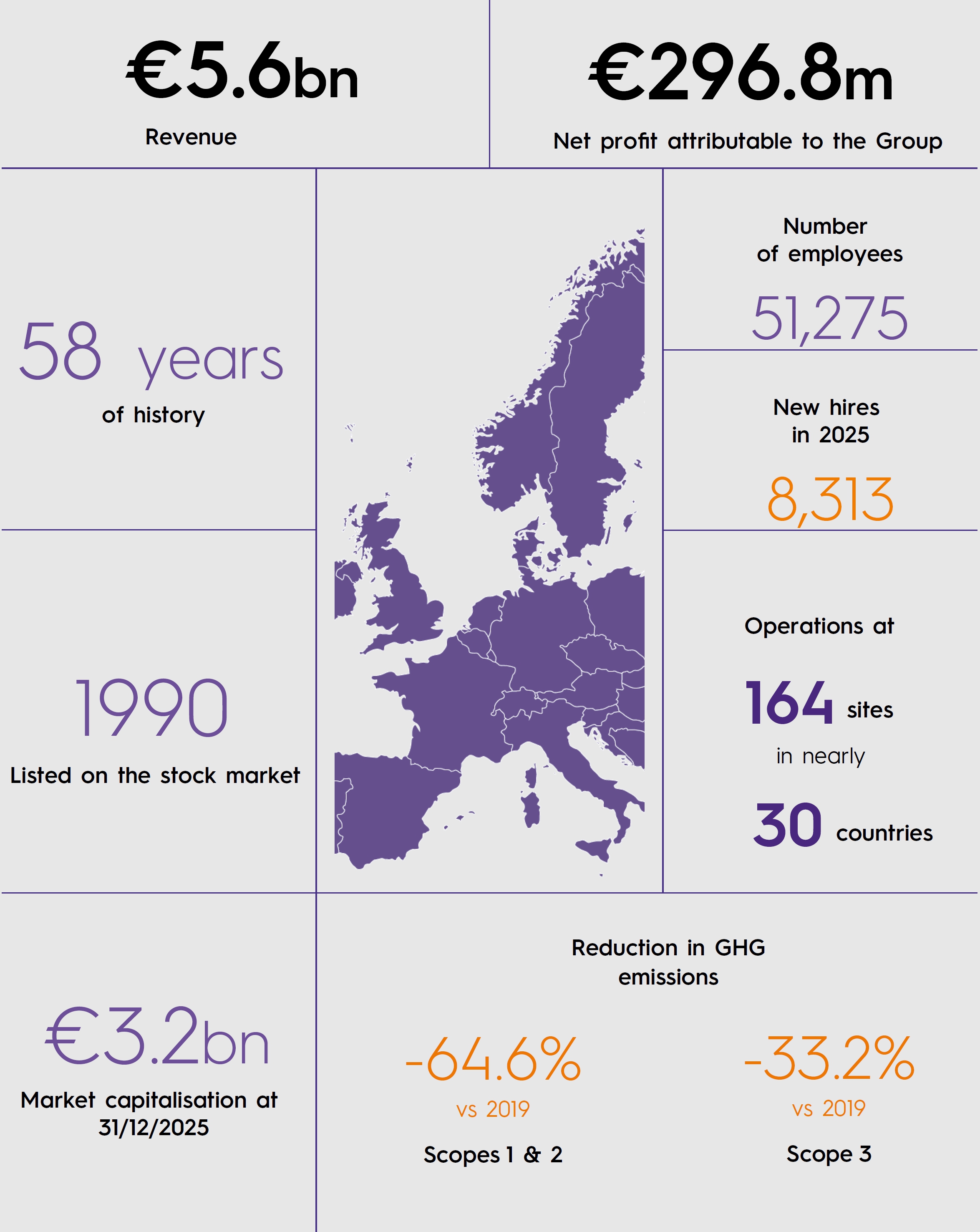
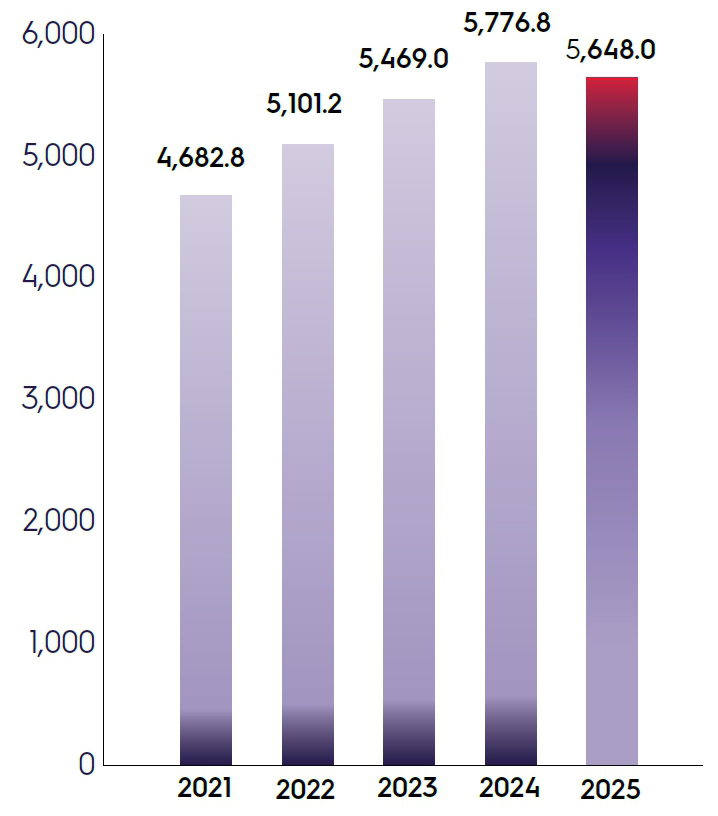
Consolidated revenue totalled €5,648.0 million, down 2.2% compared with 2024. Changes in scope had a €12.2 million positive impact (acquisitions of Aurexia and Neocase). Currency fluctuations had a negative impact of €15.0 million. At constant scope and exchange rates, the contraction in revenue was 2.2%. The scheduled conclusion of the SFT programme(1) had a 0.1-point negative impact.
- (1) Programme for Sparda banks: operation of system scheduled to end in 2026 following migration, as announced on 23 February 2023.
The fourth quarter saw a return to positive growth, with organic revenue growth of 1.8%. This performance was driven by a return to a positive trend in France and the United Kingdom and continuing positive momentum in Spain, Italy and Switzerland as the Financial Services sector expanded and business picked up in the Aeronautics, Defence, Space & Security and Public Sector verticals. The Public Sector vertical was particularly buoyant in France in the last quarter of the year. Consulting also confirmed its return to growth, with revenue growth quickening to 5.1% in the fourth quarter.
In 2025, the Group saw a sharp increase in business connected with the roll-out of generative and agentic AI for its clients. In the course of the year, the vast majority of the Group’s key accounts launched one or more AI projects involving Sopra Steria. In France, the number of clients who had launched AI projects rose by 44%. Furthermore, Sopra Steria succeeded in its bid for one of the most significant supplier approvals in the country to date. More specifically, the number of consultants in the AI for Business practice rose by 50% in 2025.
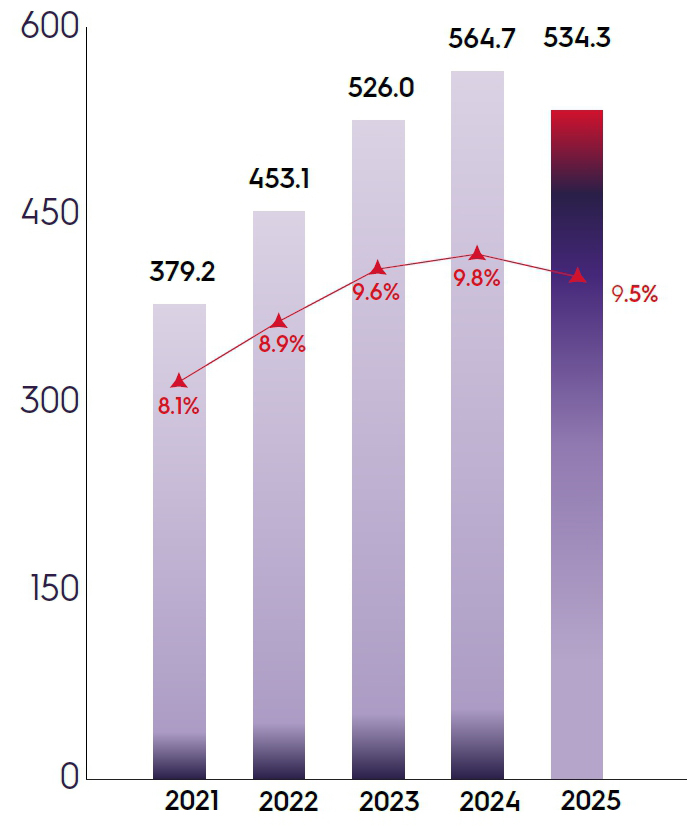
Operating profit on business activity came in at €534.3 million, giving an operating margin on business activity of 9.5% (vs 9.8% in 2024). This included a 0.3-point dilutive effect arising from higher social security contributions announced in France and the UK in early 2025.
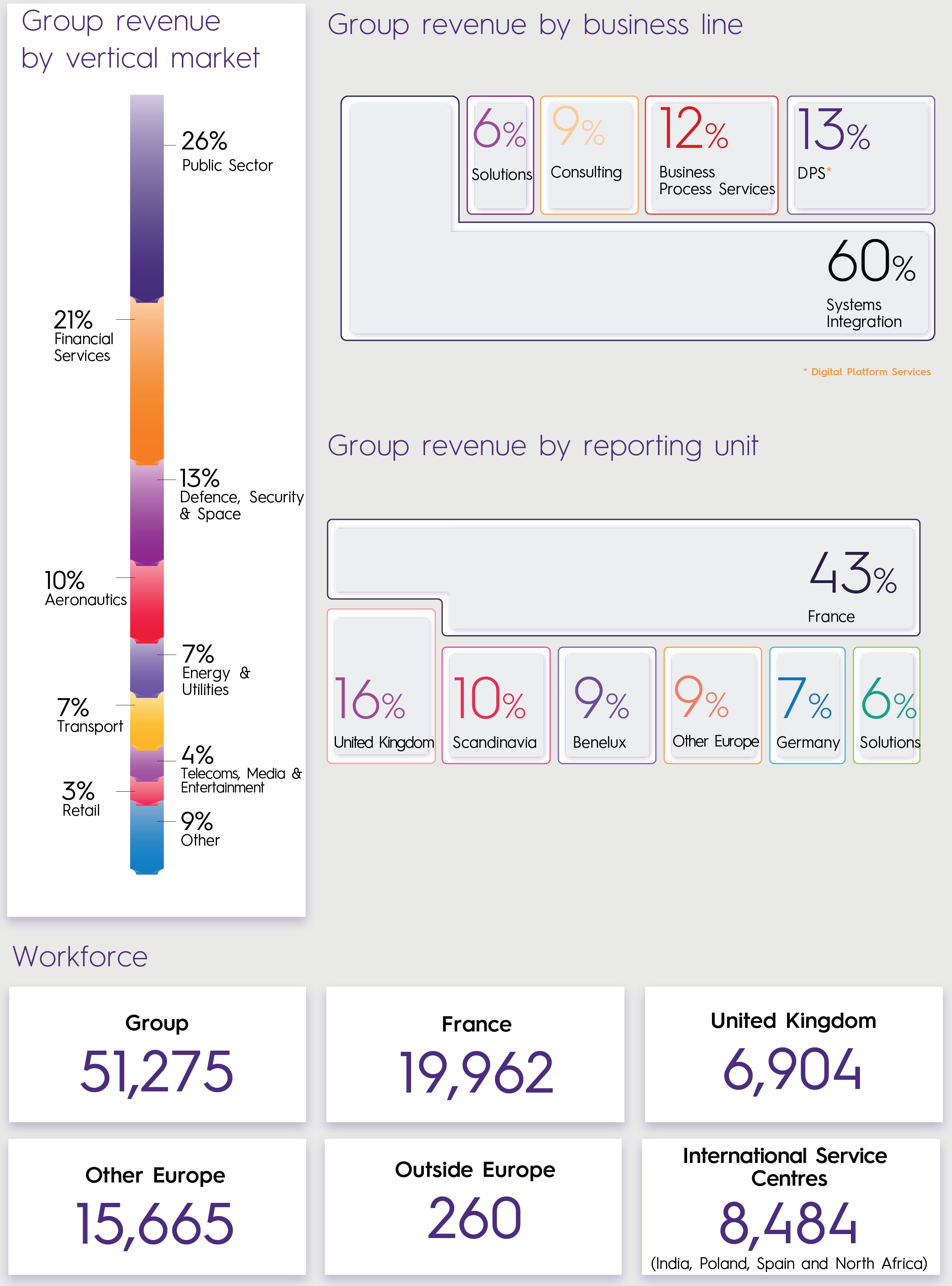
In France (43% of the Group total), revenue came in at €2,409.9 million, equating to negative organic growth of 1.5%. Following a 2.5% decline over the first nine months of the year, growth came in at 1.6% in the fourth quarter. This return to growth was driven by a clear improvement in business in the Aeronautics sector, strong momentum in the Public Sector and an upturn in growth in the Defence, Space & Security and Transport verticals. Consulting also improved significantly relative to the first nine months of the year, with revenue stable in the fourth quarter. The operating margin on business activity for the reporting unit came in at 9.0%, stable year on year, despite higher social security contributions affecting operating profit on business activity in 2025.
In the United Kingdom (16% of the Group total), revenue was €909.9 million, equating to negative organic growth of 4.3%. Following an 8.3% decline over the first nine months of the year, revenue surged 8.8% year on year in the fourth quarter, mainly thanks to strong growth in the NHS SBS and SSCL platforms and a significantly less challenging base effect. The operating margin on business activity for the reporting unit came to 9.6% (versus 12.1% in 2024).
In Europe (35% of the Group total), revenue decreased 2.8% on an organic basis (down 3.2% in the first nine months of the year) to €1,990.6 million. The scheduled conclusion of the SFT programme had a 0.2-point negative impact on the reporting unit in 2025. Business continued to grow in Spain, Italy and Switzerland in the fourth quarter, while trends in Germany, Scandinavia and Benelux were more or less in line with the first nine months of the year. The operating margin for the reporting unit came to 8.7% (versus 9.1% in 2024).
The Solutions reporting unit (6% of the Group total) posted revenue of €337.6 million, representing organic growth of 2.6%. The Human Resources Solutions business (which accounted for 64% of the reporting unit’s revenue) grew by 3.2%. The reporting unit’s operating margin on business activity came in at 16.7%, up 4.2 points from 2024. All the reporting unit’s businesses (Human Resources, Property Management and Specialised Lending Solutions) contributed to this improvement.
Profit from recurring operations came to €491.0 million (versus €514.9 million in 2024). It included a €20.5 million share-based payment expense (versus €17.3 million in 2024) and a €22.8 million amortisation expense on allocated intangible assets (versus €32.5 million in 2024).
Operating profit came in at €441.2 million (2024: €460.3 million) after a net expense of €49.8 million for “Other operating income and expenses” (compared with a €54.7 million expense in 2024).
The tax expense totalled €96.7 million, for an effective tax rate of 24.0%. The normative tax rate, excluding the exceptional additional tax in France, is estimated at around 25.0%.
Net profit/(loss) from associates amounted to a loss of €1.9 million (compared with a loss of €6.7 million in 2024).
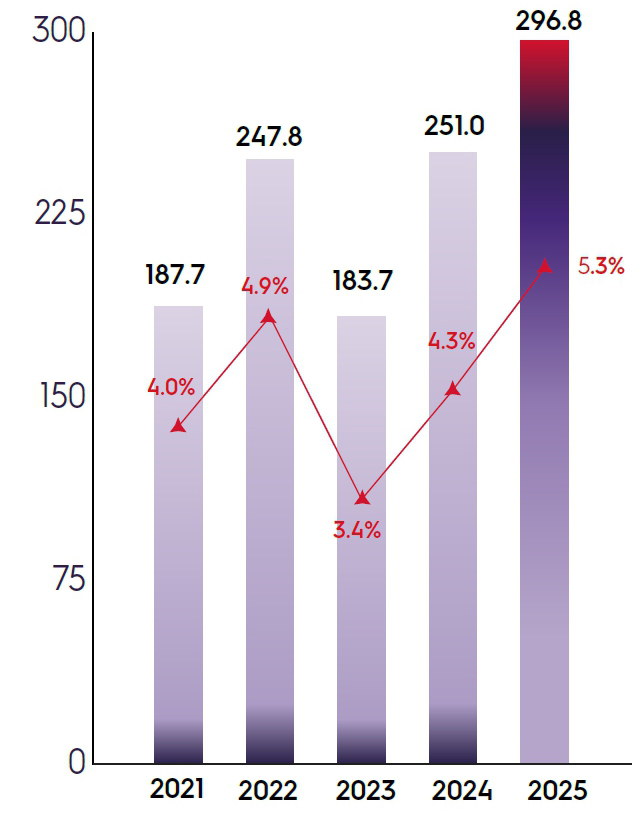
Consolidated net profit came in at €304.2 million, up 17.0%, and net profit attributable to the Group came to €296.8 million, up 18.3%, after deducting €7.4 million attributable to non-controlling interests.
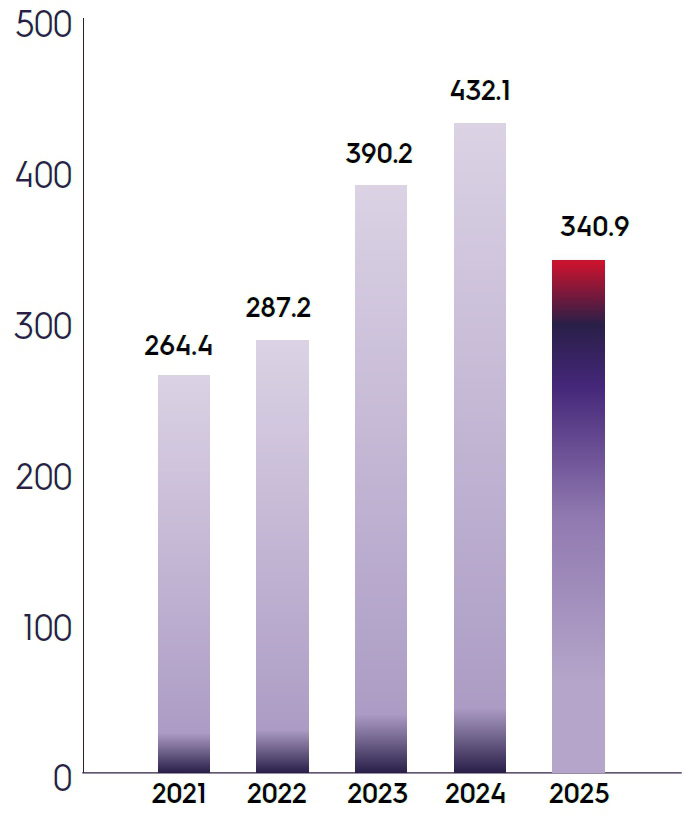
Free cash flow was strong at €340.9 million, equating to 6.0% of revenue (2025 guidance: “between 5% and 7%”). This translates into a conversion rate of operating profit on business activity into free cash flow of 63.8%. The working capital requirement came in at €274.2 million, compared with €271.1 million in 2024. The 2024 working capital requirement included approximately €45 million in early cash receipts.(1)
Net financial debt totalled €246.7 million, down 35.4% from its level at 31 December 2024. At that date, it was equal to 11.5% of equity and 0.45x pro forma EBITDA for 2025 (vs 0.61x in 2024) before the impact of IFRS 16 (with the financial covenant stipulating a maximum of 3x).
Return on capital employed (RoCE) before tax was once again above the medium-term target of 20%, at 20.4% (compared with 21.5% in 2024).
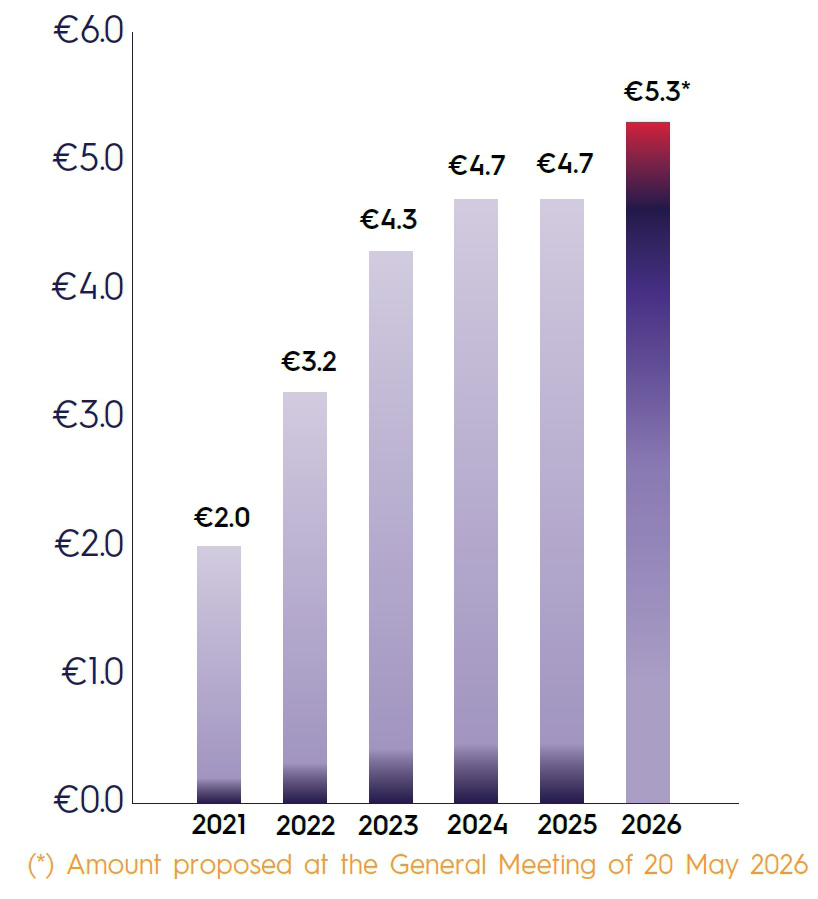
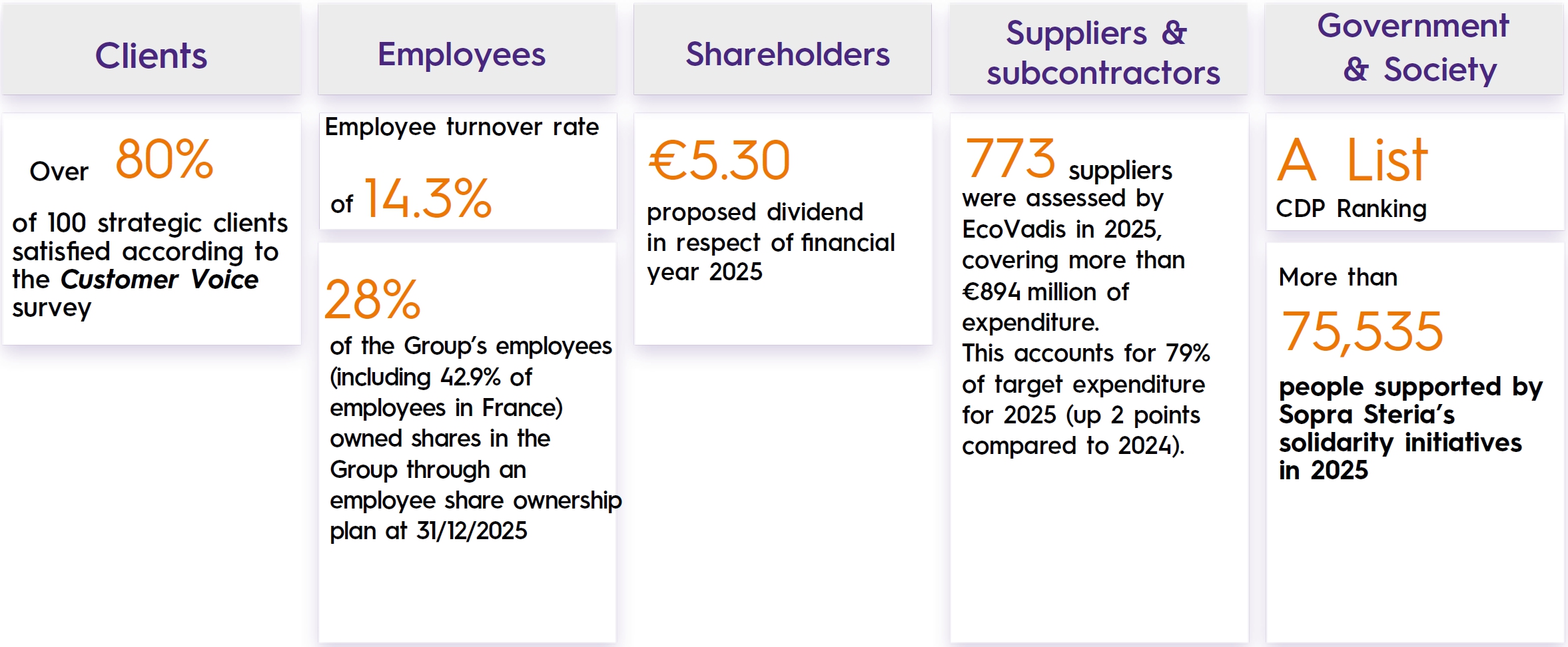
At the next General Meeting of Shareholders, to be held on Wednesday, 20 May 2026, Sopra Steria will propose the payment of a dividend of €5.30 per share(2) (vs €4.65 per share in respect of financial year 2024).
At end-December 2025, the Group’s headcount stood at 51,275(3) employees, compared with 50,988 at end-December 2024. This change was mainly due to the acquisitions of Neocase and Aurexia (which increased overall headcount by 230).
The headcount at international service centres totalled 8,484 employees, up 7.6% from 2024, with the proportion of total Group headcount represented by international service centres rising by 1 point to 16.5%.
Sopra Steria sees its contribution to society as sustainable, human-focused and purposeful, guided by the firm belief that making digital solutions work for people is a source of opportunity and progress.
With regard to the environment, CDP(5) confirmed in January 2026 that Sopra Steria had made its A List – recognising the world’s most transparent and most proactive companies combating climate change – for the 9th year in a row.
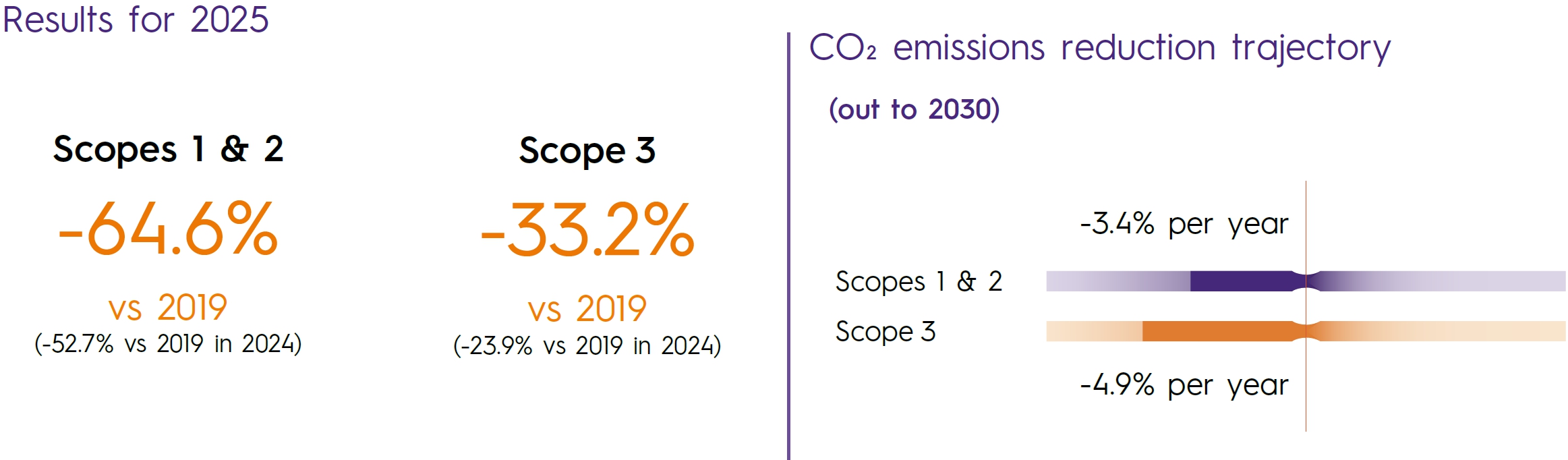
This recognition notably reflects the Group’s Net-Zero target(6) of achieving a 54% reduction in its greenhouse gas emissions from Scopes 1 & 2 and a 37.5% reduction for Scope 3 by 2030. As at end-December 2025, the Group had achieved a 64.6% reduction in Scope 1 & 2 emissions and a 33.2% reduction in Scope 3 emissions.
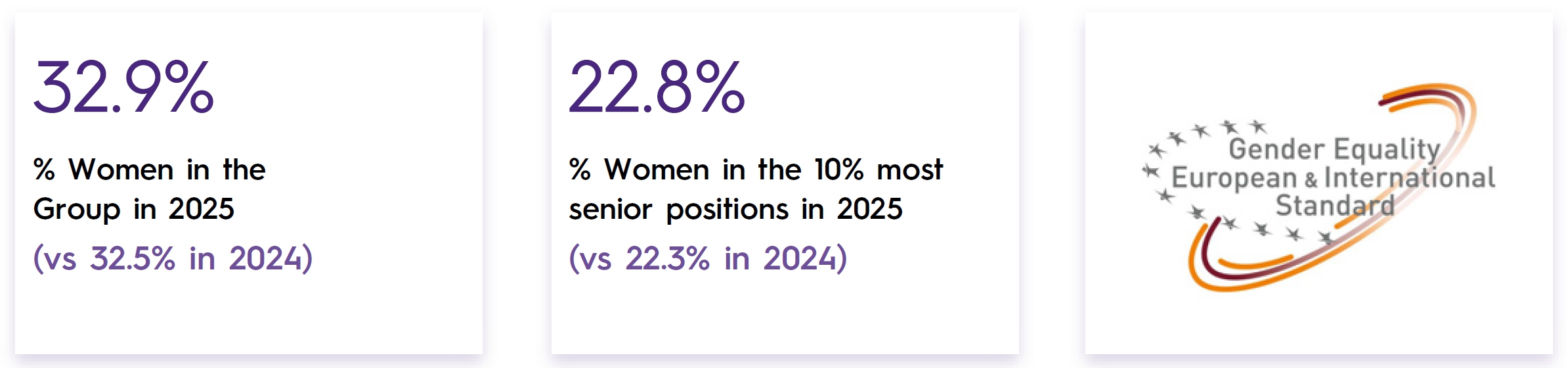
In the social arena, the proportion of women in the 3% most senior positions increased 1.0 percentage point in 2025 to 22.4%, while the proportion in the 10% most senior positions increased 0.5 points to 22.8%.
- Organic revenue growth of between 1.0% and 2.0%, including a non-recurring negative impact of around 2 points arising from the conclusion of the SFT programme(7)
- Operating margin on business activity of at least 9.5%
- Free cash flow of around 5% of revenue
- Organic revenue growth of between 2% and 5%
- Operating margin on business activity of between 10% and 11%
- Free cash flow of between 5% and 7% of revenue
- On 17 December 2025, Sopra Steria announced that it had entered into exclusive negotiations to acquire Starion and Nexova. This acquisition is aimed at creating a leading European industrial-scale player in sovereign and secure digital services for the space and cybersecurity sectors. With 700 employees and operations in 9 countries across Europe, Starion and Nexova expect to generate nearly €100 million in revenue in 2025.
- On 1 December 2025, Sopra Steria announced that it had finalised the acquisition – plans for which had been announced on 24 September 2025 – of Neocase, an innovative digital HR solutions firm, aimed at bolstering the Sopra HR business. Consolidated with effect from 1 December 2025, Neocase enables Sopra Steria to offer an end-to-end range of HR services for employees, with an optimal employee experience.
- On 2 May 2025, the Group completed its acquisition of Aurexia, a management consulting firm specialising in financial services. Aurexia was added to the Group’s scope of consolidation on 1 May 2025, and enables Sopra Steria to position itself as one of France’s leading management consultancies in the financial services sector, with over 400 consultants now dedicated to the sector in this country.
In 2025, €35.7 million was invested in infrastructure and technical facilities, compared with €43.5 million in 2024. Investments in facilities comprised the following:
- land and buildings: €1.1m (€0.2m);
- fixtures, fittings and furniture: €20.4m (€20.4m);
- IT: €14.2m (€22.9m).
- (1) The 2024 WCR included exceptional cash receipts totalling approximately €45 million arising from the scheduled conclusion of the SFT programme (see press release of 27 February 2025).
- (2) 20.55 million shares outstanding less 0.86 million bought back under the €150 million share buyback programme completed on 28 January 2025.
- (3) Workforce excluding interns, in accordance with the requirements of the CSRD. Including interns, the workforce totalled 51,237 at 31 December 2024 and 52,041 at 31 December 2023.
- (4) Employee turnover rate including top performers who left less than six months after they were recruited, in accordance with the requirements of the CSRD.
- (5) Every year, more than 24,800 companies and organisations around the world provide details on their environmental performance to CDP for independent assessment against its scoring methodology for the benefit of investors, purchasers and other stakeholders.
- (6) Target approved by the Science Based Targets initiative (SBTi) on 16 June 2023 and aligned with the aim of limiting the increase in the average global temperature to 1.5°C. Reduction targets versus 2019 baseline.
- (7) Programme for Sparda banks: operation of system scheduled to end in 2026 following migration, as announced on 23 February 2023.
(in millions of euros) Notes Financial year 2025 Financial year 2024 Revenue 4.1 5,648.0 5,776.8 Staff costs 5.1 -3,588.8 -3,611.7 External expenses and purchases 4.2.1 -1,342.6 -1,387.3 Taxes and duties -33.7 -42.8 Depreciation, amortisation, provisions and impairment -169.9 -186.8 Other current operating income and expenses 4.2.2 21.3 16.5 Operating profit on business activity 534.3 564.7 as % of revenue 9.5% 9.8% Expenses related to stock options and related items 5.4 -20.5 -17.3 Amortisation of allocated intangible assets 8.2 -22.8 -32.5 Profit from recurring operations 491.0 514.9 as % of revenue 8.7% 8.9% Other operating income and expenses 4.2.3 -49.8 -54.7 Operating profit 441.2 460.3 as % of revenue 7.8% 8.0% Cost of net financial debt 12.1.1 -21.1 -35.4 Other financial income and expenses 12.1.2 -17.3 -3.2 Tax expense 6.1 -96.7 -96.8 Net profit/(loss) from associates 10 -1.9 -6.7 Net profit from continuing operations 304.2 318.2 Net profit/(loss) from discontinued operations 2.2 - -58.3 Consolidated net profit 304.2 259.9 as % of revenue 5.4% 4.5% Non-controlling interests 14.1.5 7.4 9.0 NET PROFIT ATTRIBUTABLE TO THE GROUP 296.8 251.0 as % of revenue 5.3% 4.3% EARNINGS PER SHARE (in euros) NOTES Basic earnings per share 14.2 15.23 12.46 Diluted earnings per share 14.2 15.16 12.34 Basic earnings per share from continuing operations 14.2 15.23 15.36 Diluted earnings per share from continuing operations 14.2 15.16 15.21 Basic earnings per share from discontinued operations 14.2 0.00 -2.90 Diluted earnings per share from discontinued operations 14.2 0.00 -2.87 (in millions of euros) France United Kingdom Europe Solutions Not allocated Total: Group 2025 2024 2025 2024 2025 2024 2025 2024 2025 2024 2025 2024 Revenue 2,409.9 2,437.9 909.9 962.1 1,990.6 2,049.0 337.6 327.8 0.0 0.0 5,648.0 5,776.8 Staff costs -1,596.2 -1,595.4 -495.1 -508.3 -1,306.5 -1,315.3 -191.0 -192.7 0.0 0.0 -3,588.8 -3,611.7 External expenses and purchases -588.4 -583.8 -263.6 -280.2 -432.7 -476.0 -57.9 -47.3 0.0 0.0 -1,342.6 -1,387.3 Operating profit on business activity 217.1 220.4 87.4 116.9 173.4 186.4 56.7 41.0 0.0 0.0 534.8 564.7 % of revenue 9.0% 9.0% 9.6% 12.1% 8.7% 9.1% 16.8% 12.5% 0.0% 0.0% 9.5% 9.8% Profit from recurring operations 199.9 201.6 79.1 107.8 157.0 165.7 55.5 39.9 0.0 0 491.4 514.9 % of revenue 8.3% 8.3% 8.7% 11.2% 7.9% 8.1% 16.4% 12.2% 0.0% 0.0% 8.7% 8.9% Operating profit 183.7 182.1 74.9 100.7 129.6 128.5 53.5 38.0 0.0 11.1 441.6 460.3 % of revenue 7.6% 7.5% 8.2% 10.5% 6.5% 6.3% 15.8% 12.2% 0.0% 0.0% 7.8% 8.0% The “Not allocated” segment is used to reconcile the Group’s operating profit and in 2024 included the gain on disposal of Axway Software shares described in Note 2.2 for €11.1 million.
Under IFRS 8, segment information is based on internal management data used by the Chief Executive Officer, the company officer with ultimate responsibility for the Group’s operational decisions.
The Group organisational structure reflects both its businesses and the geographic distribution of its activities. The segments presented correspond to four reporting units:
- the “France” reporting unit, comprising activities in this geographic area in the fields of Consulting, Systems Integration, IT Infrastructure Management, Cybersecurity and Product Lifecycle Management (Cimpa), and those of CS Group and its subsidiaries;
- the “United Kingdom” reporting unit, comprising activities in this geographic area in the fields of Consulting, Systems Integration, IT Infrastructure Management, Cybersecurity and Business Process Services;
- the “Europe” reporting unit, encompassing segments with the same business model in terms of their clients, range of services and solutions, organisation and operating margin. It comprises the Consulting, Systems Integration, IT Infrastructure Management and Cybersecurity activities in European countries other than France and those in the United Kingdom (Germany, Belgium, Denmark, Spain, Italy, Luxembourg, the Netherlands, Norway, Sweden and Switzerland), including the Sopra Financial Technology GmbH banking services platform in Germany;
- the “Solutions” reporting unit, comprising the Human Resources and Real Estate Management Solutions businesses and those of Sopra Solutions.
ASSETS (in millions of euros) Notes 31/12/2025 31/12/2024 Goodwill 8.1 2,375.6 2,348.2 Intangible assets 8.2 233.6 238.5 Property, plant and equipment 8.3 125.8 148.7 Right-of-use assets 9.1 385.1 384.4 Equity-accounted investments 10 1.0 1.0 Other non-current assets 7.1 226.1 224.6 Retirement benefits and similar obligations 5.3 26.5 47.1 Deferred tax assets 6.3 104.6 115.1 Non-current assets 3,478.3 3,507.6 Trade receivables and related accounts 7.2 1,290.1 1,291.4 Other current assets 7.3 394.4 419.8 Cash and cash equivalents 12.2 511.8 423.4 Current assets 2,196.3 2,134.5 Assets held for sale -0.0 0.0 TOTAL ASSETS 5,674.6 5,642.2 LIABILITIES AND EQUITY (in millions of euros) Notes 31/12/2025 31/12/2024 Share capital 20.5 20.5 Share premium 531.5 531.5 Consolidated reserves and other reserves 1,536.7 1,375.4 Equity attributable to the Group 2,088.8 1,927.4 Non-controlling interests 59.0 57.1 TOTAL EQUITY 14.1 2,147.7 1,984.5 Financial debt – Non-current portion 12.3 520.5 616.7 Lease liabilities – Non-current portion 9.2 327.3 322.1 Deferred tax liabilities 6.3 45.1 42.0 Retirement benefits and similar obligations 5.3 201.4 199.7 Non-current provisions 11.1 45.3 88.3 Other non-current liabilities 7.4 24.8 19.4 Non-current liabilities 1,164.3 1,288.3 Financial debt – Current portion 12.3 238.1 188.8 Lease liabilities – Current portion 9.2 99.2 105.1 Current provisions 11.1 61.7 36.8 Trade payables and related accounts 349.2 354.2 Other current liabilities 7.5 1,614.5 1,684.5 Current liabilities 2,362.6 2,369.4 Liabilities held for sale -0.0 -0.00 TOTAL LIABILITIES 3,526.9 3,657.7 TOTAL LIABILITIES AND EQUITY 5,674.6 5,642.2 Alternative performance measures
- Restated revenue: Revenue for the prior year, expressed on the basis of the scope and exchange rates for the current year.
- Organic revenue growth: Increase in revenue between the period under review and restated revenue for the same period in the prior financial year.
- EBITDA: This measure, as defined in the Universal Registration Document, is equal to consolidated operating profit on business activity after adding back depreciation, amortisation and provisions included in operating profit on business activity.
- Free cash flow: Net cash from operating activities; less investments (net of disposals) in property, plant and equipment, and intangible assets; less lease payments; less net interest paid; and less additional contributions to address any deficits in defined-benefit pension plans.
- Operating profit on business activity: This measure, as defined in the Universal Registration Document, is equal to profit from recurring operations adjusted to exclude the share-based payment expense for stock options and free shares and charges to amortisation of allocated intangible assets.
- Profit from recurring operations: Operating profit before other operating income and expenses, which includes any particularly significant items of operating income and expense that are unusual, abnormal, infrequent or not foreseeable, presented separately in order to give a clearer picture of performance based on ordinary activities.
- Basic recurring earnings per share: This measure is equal to basic earnings per share before other operating income and expenses net of tax.
- Return on capital employed (RoCE): (Profit from recurring operations after tax + Profit from equity-accounted companies) / (Equity + Net financial debt).
- Downtime: Number of days between two contracts (excluding training, sick leave, other leave and pre-sales) divided by the total number of business days.
(in thousands of euros) 2025 2024 2023 2022 2021 Financial position at year-end ■ Share capital 20,548 20,548 20,548 20,548 20,548 ■ Number of shares issued 20,548 20,548 20,548 20,548 20,548 ■ Number of bonds convertible into shares 0 0 0 0 0 Results of operations for the year ■ Revenue excluding VAT 2,061,629 1,984,730 1,965,561 1,891,556 1,717,658 ■ Profit before tax, depreciation, amortisation and provisions 193,445 -50,886 753,383 230,059 174,360 ■ Corporate income tax -222 -16,567 -30,407 -16,032 -15,468 ■ Profit after tax, depreciation, amortisation and provisions 280,545 176,642 31,709 167,666 156,867 ■ Amount of profit distributed as dividends 95,547 95,547 88,355 65,754 Earnings per share ■ Earnings per share after tax but before depreciation, amortisation and provisions 9.43 -1.67 38.14 11.98 9.24 ■ Earnings per share after tax, depreciation, amortisation and provisions 13.65 8.60 1.54 8.16 7.63 Dividend paid per share 4.65 4.65 4.30 3.20 Employee data ■ Number of employees 13,241 13,377 13,438 13,336 13,236 ■ Total payroll 734,301 737,166 714,752 684,774 665,161 Amount paid in respect of employee benefits (social security, employee discounts, etc.) 346,377 343,682 348,989 317,064 300,241 -
3. Our mission, values and sustainability report
Technology serves as a gateway to infinite possibilities. As fascinating as this never-ending stream of innovations is, it also raises questions as to what is actually behind the frantic race for novelty and change. Solutions are never straightforward or obvious, and there is certainly never just one way of doing things.
At Sopra Steria, our mission is to guide our clients, partners and employees towards bold choices to build a positive future by putting digital technology to work in service of humanity.
Beyond technology, we set great store by collective intelligence, in the firm belief it can help make the world a better place.
Together, we are building a highly promising future by delivering tangible benefits: sustainable solutions with positive impacts that take full account of interactions between digital technology and society. There’s still so much more we can achieve together.
At Sopra Steria, we strive to create a stimulating, group-oriented environment inspiring free thinkers to engage in open, frank discussions. Our goal is to foster the development of skills and entrepreneurship in a community driven by a desire for collective success.
Putting customer
service firstRespect for others Taking positive action We make a commitment to our clients over the long term to enhance their performance and enable them to reach the next level by leveraging our specialised knowledge of their business sector and innovative technologies. Our core belief is that our collective endeavour makes us stronger, and that by working together we can find the best solutions. That’s why we always listen carefully to and forge close relationships with our clients, partners and employees. We want to make innovation deliver results for as many people as possible and offer sustainable solutions with a positive impact that responsibly and ethically shape interactions between digital technology and society. Professional excellence Collective mindset Openness and curiosity We offer our visionary, integrated approach and our broad range of expertise to help guide our clients, partners and employees towards bold choices and convert opportunities into tangible, sustainable results. We believe collective intelligence, harnessing team spirit and each individual’s talents, can help drive positive change and make the world a better place in a sustainable manner, exceeding what technologies alone can do. We encourage a bold, curious and accountable approach to explore new avenues and employ innovative new technologies that can deliver transformative changes for everyone’s benefit. The digital revolution has triggered a radical transformation in our environment. It is speeding up changes in our clients’ business models, internal processes and information systems.
In this fast-changing environment, we bring our clients new ideas and support them in their transformation by making the most effective use of digital technology.
Sopra Steria provides end-to-end solutions to address the core business needs of large companies and organisations, helping them remain competitive and grow, supporting them throughout their digital transformation in Europe and around the world.
Embedding
consulting into our
value propositionExpanding in
digital platform
managementRamping up
in next-generation
technologies…Comprehensive response to our clients’ transformation needs Cloud and associated infrastructure services Cloud Data AI Emerging technologies Stepping up
in cybersecurity…and solutions Prevention
Protection
Detection & ResponseSAP S/4 HANA
ServiceNow
Salesforce -
4. Governance
The Company has identified nine key competencies that it would like to be represented within the Board of Directors.
Top 5 areas of expertise and experience on the Board of Directors Other skills and experience represented in the Board of Directors • Knowledge of the digital and consulting sectors, ability to promote technological innovation
• International teams and organisations
• Finance, risk management and control
• Human resources and social dialogue (CSR)
• Mergers and acquisitions
• Knowledge of one of the Group’s main verticalmarkets
• Entrepreneurial experience
• CEO of a major group
• Environmental and climate-related issues (CSR)
• Social issues (CSR)
• Operational experience within Sopra Steria Group
Members at 25 February 2026
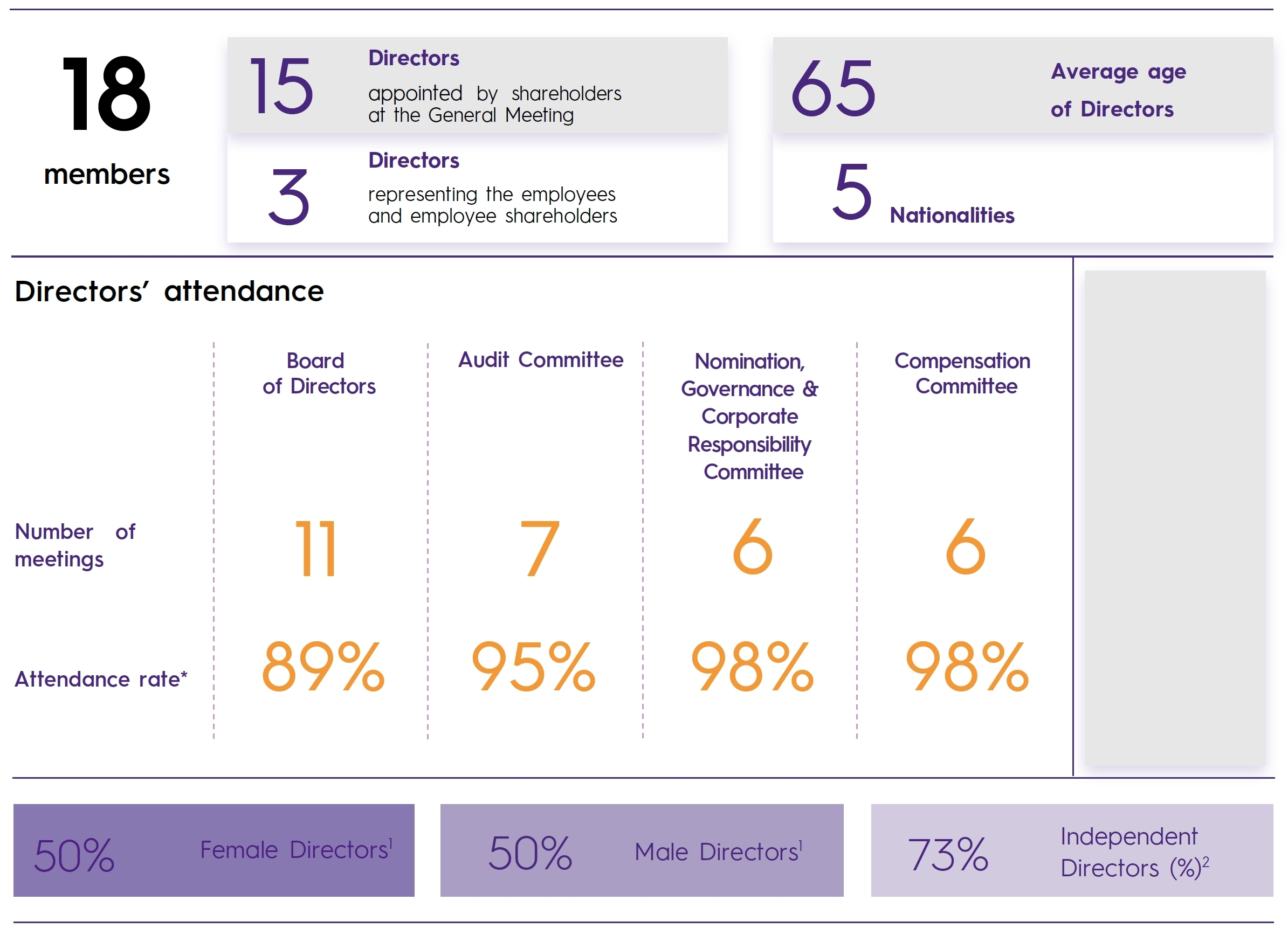
1. 8/16 women – 8/16 men
2. 11/15 Board members qualify as independent based on the AFEP-MEDEF Code’s requirementsSee Chapter 3 of the 2025 URD for more information On 19 June 2012, the Board of Directors voted to separate the roles of Chairman and Chief Executive Officer. This decision has since been confirmed at each appointment or reappointment of an executive company officer, most recently on 10 December 2025. This separation of duties remains the best way of addressing the Group’s strategic and operational priorities. Given the close relationship between the Chairman of the Board of Directors and the Chief Executive Officer, there is close collaboration and an ongoing dialogue between them. The current governance structure therefore helps streamline management of the Company. It means that the Group is able to act as quickly as needed and ensures decisions are taken with due care, while taking into account strategic priorities.
The Chairman is tasked with managing strategy, while the Chief Executive Officer is responsible for operations.
- guides the Group’s strategy;
- assists Executive Management with the transformation of the Group;
- oversees investor relations and manages the Board’s relations with shareholders.
- makes proposals on the Group’s strategy in agreement with the Chairman;
- supervises the implementation of decisions adopted;
- ensures the operational management of all Group entities.
The Nomination, Governance & Corporate Responsibility Committee conducts an annual review of the succession plans for the Chairman of the Board of Directors and the Chief Executive Officer so any unforeseen vacancies can be dealt with appropriately. As part of this process, it meets with the Chairman of the Board of Directors. It makes sure the plans cover existing requirements and the Group’s culture. It assesses the relevance of any proposed changes.
uccession planning for the role of Chairman was incorporated into the formal assessment of the Board of Directors decided upon in 2025.
In connection with the renewal of his term of office, the succession plan for the Chairman of the Board of Directors was reviewed and approved by the Nomination, Governance & Corporate Responsibility Committee, then by the Board of Directors at its meeting on 25 February 2026. It distinguishes between the case of an unforeseen vacancy in the role and that of a vacancy arising from the Chairman’s term of office coming to an end.
The plan is aimed not only at ensuring continuity in the role but also, beyond that, at optimising decisions from an overall perspective taking into account the situation, the Group’s needs, and interactions among the various governance bodies. The goal is to ensure that the Board of Directors is always in a position to be able to choose the candidate best suited to the context.
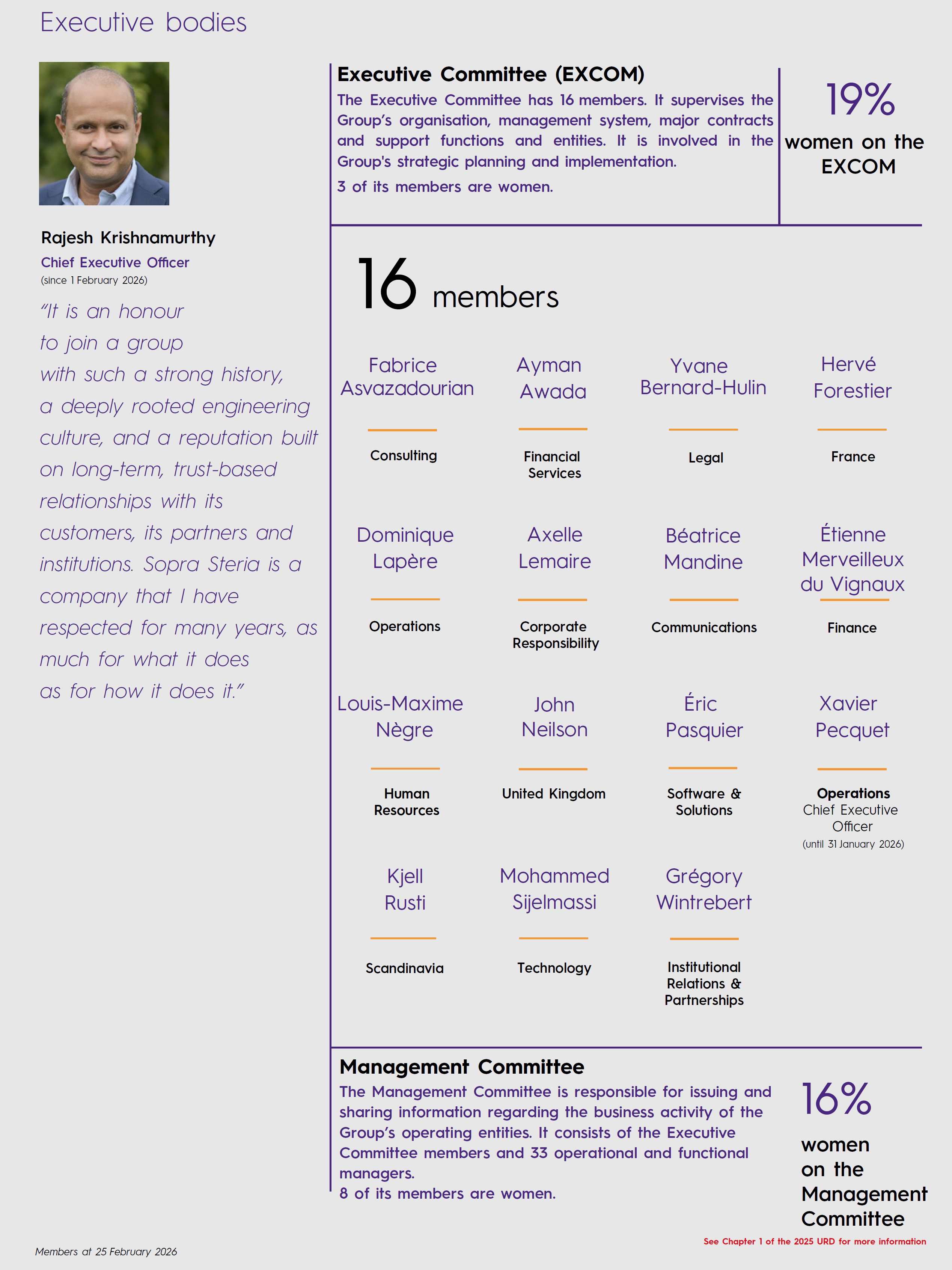
In 2025, the established succession plan in the event of an unforeseen vacancy in the position of Chief Executive Officer was implemented without modification following the resignation of the Chief Executive Officer, Cyril Malargé, on 8 October. The Board of Directors, at a meeting convened the same day, appointed Xavier Pecquet as Chief Executive Officer until the arrival of a new Chief Executive Officer recruited from outside the Group.
The Committee also debates action to be taken in the short and medium term in view of reappointments and expiring terms of office. In this context, the issue must be approached from a different angle: consideration is given not only to ensuring the continued functioning of each governance body but also, beyond that, to optimising decisions from an overall perspective taking into account the situation, the Group’s needs, and interactions among the various governance bodies. The goal is to ensure that the Board of Directors is always in a position to be able to choose, for each role, the candidate best suited to the situation and the environment.
This aspect was incorporated into the formal assessment of the Board of Directors decided upon in 2025.
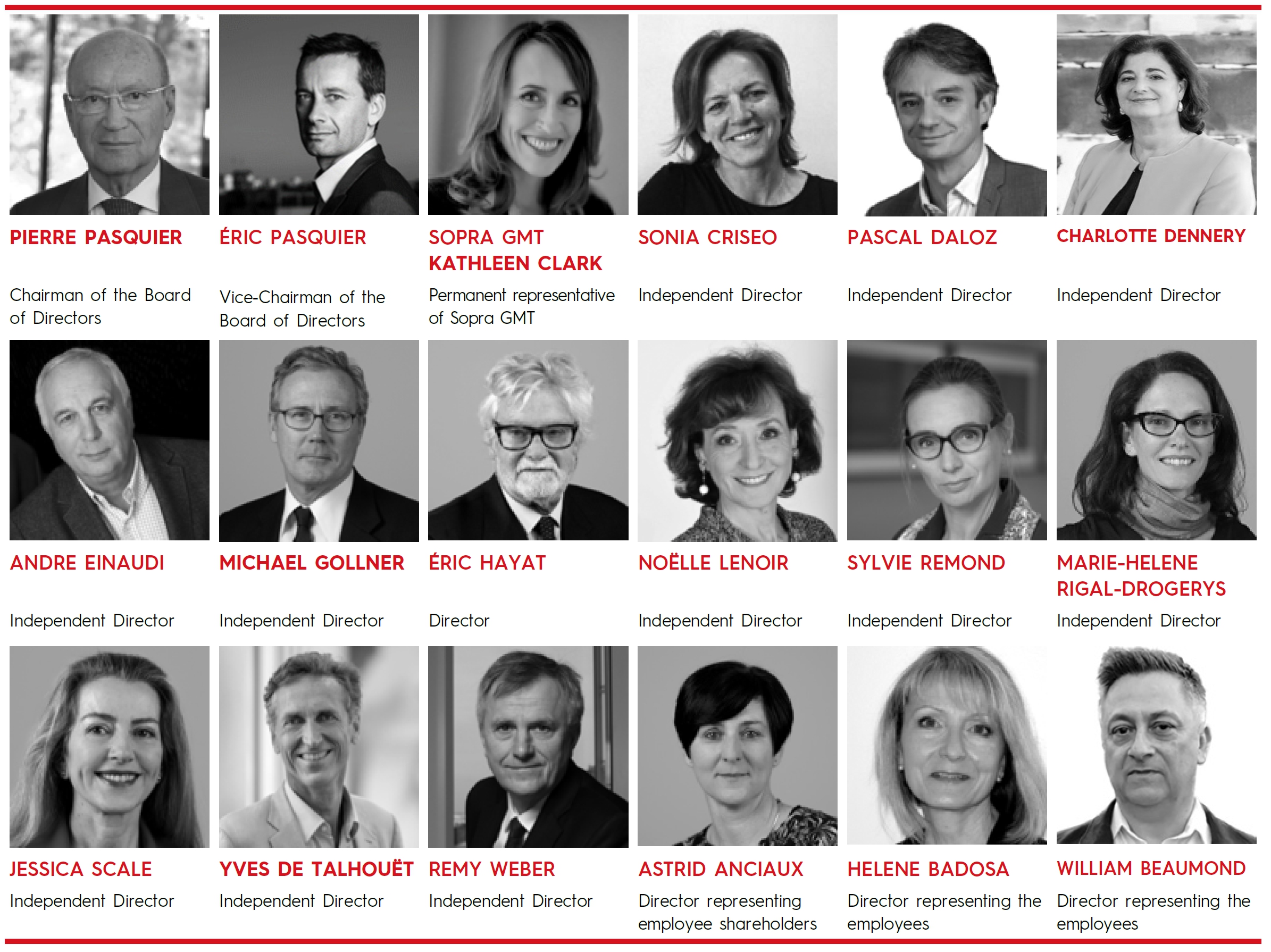
Pierre Pasquier currently serves as Chairman of the Board of Directors. He carried out activities on a full-time basis throughout the year. This included overseeing the work of the Board and other assignments entrusted to him.
The Chairman’s assignments include the governance of strategy, acquisitions and the Board of Directors’ relations with shareholders. He is involved in several areas that are key to the Group’s future and transformation (HR, digital and industrial transformation; key organisational and operating principles; employee share ownership; promotion of Group values and compliance). This list of key matters is approved following consultation with the Chief Executive Officer.
The Chairman is responsible for maintaining balance between the Group’s various stakeholders: shareholders, employees and the community. He ensures that the Group’s social and environmental priorities are properly taken into account.
In crisis situations, the ability to prioritise issues, uphold the Group’s values, and consider its options from a longer-term perspective thanks to the commitment provided by the core shareholder is absolutely critical.
The various matters placed under the Chairman’s responsibility require thorough knowledge of operational realities. Close relations with the Chief Executive Officer and the members of the Executive Committee facilitate information-sharing. This facilitates effective coordination on:
- decisions required for the implementation of the medium-term strategic plan and the Group’s transformation;
- monitoring of the implementation of such decisions over the long term.
- the roles defined in the internal rules and regulations of the Board of Directors;
- compliance with the respective prerogative powers of the Chairman of the Board of Directors and the Chief Executive Officer;
- a very good fit between the holders of the two positions;
- a mutual trust-based relationship.
In carrying out all of his assignments, the Chairman seeks out advice from former executives and may draw on certain resources across the Group.
He is also supported by a permanent team at Sopra GMT, the holding company that manages and controls the Group. This company was established by the founders of Sopra Steria Group. More than 75% of its share capital is held by members of the two family groups. A financial investor acquired a stake alongside the founders to enable the implementation of Sopra Steria Group’s strategic refocusing project in 2024. Sopra GMT’s sole activity is to provide strategy, advisory and support services to the two companies in which it holds an ownership interest. Its non-current assets consist exclusively of its equity stakes in those companies.
Of the five Sopra GMT employees, four of them have spent much of their careers with Sopra Steria Group. This team has therefore gained knowledge of the Group, its main managers and its organisational structure that an external service provider could not have. Its position within Sopra GMT means this team has an outside perspective and greater independence. These resources enhance the Board of Directors’ ability to oversee the smooth running of the Company.
The team was initially formed when 74Software(1) was spun off. It performs duties for Sopra Steria Group and 74Software, in which Sopra Steria Group still retains an ownership interest of 11%. Sopra GMT provides both companies with its support and ensures synergies and best practices are implemented.
The members of this team carry out duties not undertaken by Sopra Steria Group: oversight of acquisitions, corporate secretarial affairs for the Board of Directors and its Committees. They may also assist Sopra Steria Group’s functional divisions. They are also active participants in various steering committees (acquisitions, corporate responsibility and sustainable development, internal control, internal audit, employee share ownership). They may join working groups tackling key issues for the Company. They provide the benefit of their technical expertise and an independent opinion.
The costs rebilled by Sopra GMT comprise the portion of payroll and related operating costs for employees assigned to the tasks performed for Sopra Steria Group. They also comprise, under the same conditions, any external expenses incurred by Sopra GMT (such as specialised advisors’ fees). As such, this organisational method does not increase the expenses borne by Sopra Steria Group. If the assignments handled by Sopra GMT’s employees were not entrusted to them, they would need to be allocated again within Sopra Steria Group.
Pierre Pasquier’s compensation at Sopra GMT reflects his oversight of the assignments performed by the Sopra GMT team for Sopra Steria Group and 74Software(1). His compensation is not rebilled to these two companies.
Sopra Steria Group charges Sopra GMT fees for providing premises, IT resources, and assistance from the Group’s functional divisions as well as providing appropriate expertise for Sopra GMT’s assignments.
The work performed by this team and the principle for the rebilling to the Company of the costs incurred are covered in a framework agreement for assistance. The General Meeting approved the implementation of this related-party agreement. The Board of Directors reviews it annually.
Around 85% of Sopra GMT’s total operating expenses are rebilled. The remaining 15% comprises the expenses arising from Sopra GMT’s own internal operations. Expenses are rebilled on a cost-plus basis including a 7% margin. By definition, Sopra GMT generally records a small operating loss. The annual breakdown varies according to the respective needs of Sopra Steria Group and 74Software(1). On average, since 2011, two thirds of the amounts rebilled have concerned Sopra Steria Group.
The Board of Directors reviewed the implementation of this agreement at its meeting on 22 January 2026. It unanimously agreed to maintain the previously granted authorisation for the current financial year. The members of the Board of Directors associated with Sopra GMT (Pierre Pasquier, Éric Pasquier and Kathleen Clark) did not take part in the discussion or vote on this decision.
Cyril Malargé resigned from his position as Chief Executive Officer on 8 October 2025. On the same day, a small team was established under the leadership of Xavier Pecquet, a member of the Group’s Executive Committee, who was appointed Chief Executive Officer, to oversee the transition until the assumption of duties of the new Chief Executive Officer. Throughout this period, this team – comprising Xavier Pecquet, Dominique Lapère (Chief Operating Officer), and Louis-Maxime Nègre (Head of Human Resources) – worked in close coordination with Éric Pasquier, Vice-Chairman of the Board of Directors and Managing Director of Sopra GMT. Drawing on its experience and in-depth knowledge of the Group, the team was fully involved in managing the operations and continuing the implementation of the Group’s strategy. To this end, it was supported by the Group’s executive bodies and management.
- (1) Following the acquisition of Sopra Banking Software, the shareholders of Axway Software voted on 6 December 2024 to change the company’s name to 74Software (with 74Software continuing to use Axway Software as one of its trademarks).
On 11 December 2025, the Board of Directors appointed Rajesh Krishnamurthy as Chief Executive Officer, with effect from 1 February 2026, on the recommendation of the Nomination, Governance & Corporate Responsibility Committee.
To formulate its recommendation, each Committee member met with the two leading candidates selected by the Chairman of the Board of Directors and the Chairwoman of the Committee. Following consultation with Sopra GMT, these two candidates were presented to the Committee, bringing the search process – which had been conducted with support from a specialised consultancy from a broad pre-selected pool of candidates – to a close.
The Committee members commended the quality of both proposals. They highlighted the candidates’ personalities, experience, knowledge of the sector and skills, and concluded that both were capable of performing the role of Chief Executive Officer in the context of Sopra Steria Group. They chose to recommend the appointment of Rajesh Krishnamurthy. The Board of Directors, unanimously approved this recommendation.
The Chief Executive Officer has authority over the entire Group. He directs, administers and coordinates all of its activities. To this end, he is supported by the Group’s Executive Committee and its Management Committee. These Committees comprise key operational and functional managers from Sopra Steria Group and its subsidiaries as well as the Chief Executive Officer.
The Chief Executive Officer has the broadest possible powers to act in all circumstances in the name of Sopra Steria Group SA, the parent company of Sopra Steria Group. He/she represents the Company in its dealings with third parties.
Certain decisions relating to strategy implementation and internal organisation require prior approval by the Board of Directors or its Chairman. Decisions “that are highly strategic in nature or that are likely to have a significant impact on the financial position or commitments of the Company or any of its subsidiaries” are defined in the internal rules and regulations of the Board of Directors (see Chapter 8, “Additional information” of the 2025 Universal Registration Document, page 396).
On the date at which the 2025 Universal Registration Document was published, the Board of Directors had 18 members with the right to vote. The General Meeting appoints 15 Directors and elects the Director representing employee shareholders. Two Directors appointed by the employee representative bodies represent the employees.
The reappointment of two current Directors will be proposed at the General Meeting to be held on 20 May 2026 (see the summary of resolutions in Chapter 3, “Draft resolutions submitted to the Shareholders’ Meeting” of this document). The Directors concerned are as follows:
Collectively, the members of the Board of Directors and the Chief Executive Officer hold around 20% of the Company’s share capital and 30% of its voting rights.
Owing to their professional experience as well as activities pursued outside the Company, the members of the Board of Directors have all acquired expertise in the area of management and some of them also have expertise in the Company’s business sector.
- any conflict of interest affecting the exercise of their duties and responsibilities;
- any family relationship with another member of the Board of Directors, with the exception of Éric Pasquier, who is related to Pierre Pasquier;
- any conviction during the last five years in relation to fraudulent offences;
- been incriminated and/or been the focus of an official public sanction issued by statutory or regulatory authorities, nor barred by a court from serving as a member of a supervisory board, board of directors or other management body of an issuer or from taking part in the management or conduct of an issuer’s business affairs at any point during the past five years;
- been involved in any bankruptcy proceedings or been subject to property sequestration during the last five years as a member of a board of directors, a management body or a supervisory board.
Furthermore, there are no service agreements binding the members of governing and management bodies to the issuer or to any one of its subsidiaries that provide benefits upon the termination of such agreements.
Attendance at meetings in financial year 2025 Name Nationality Number of
shares
ownedNumber of
directorships
at listed
companies
(outside the
Group)Start of
current
termDate
current
term of
office endsYears of
service
on the Board*Board of
DirectorsAudit
CommitteeNomination,
Governance &
Corporate
Responsibility
CommitteeCompensation
CommitteePierre Pasquier (M) 90*; ECO**
Chairman of the Board of Directors
FRA 108,113 1 21/05/2024 AGM 2028 57 100% 100% Éric Pasquier (M) 54*; ExCo**
Vice-Chairman of the Board of Directors
FRA 10,271 0 21/05/2024 AGM 2028 11 100% 100% Sopra GMT, represented by Kathleen Clark (W), 58*; NSP**
Chairwoman of the Nomination, Governance & Corporate Responsibility Committee
USA/FRA 4,035,669 1 21/05/2024 AGM 2028 11 100% 100% 100% Sonia Criseo (W) 54; ID**
Director
IRL 10 0 21/05/2025 AGM 2029 2 91% 100% Pascal Daloz (M) 56*; ID**
Director
FRA 25 1 24/05/2023 AGM 2026 2 45% 80% Charlotte Dennery (W) 60*; ID**
Director
FRA 1 0 21/05/2025 AGM 2027 - 57% André Einaudi (M) 70*; ID**
Director
FRA 100 0 01/06/2022 AGM 2026 5 73% 80% Michael Gollner (M) 67; ID**
Director
USA/GBR 2,100 1 24/05/2023 AGM 2027 7 82% 86% Éric Hayat (M) 84*; NSP**
Director
FRA 33,230 0 21/05/2024 AGM 2028 11 100% 100% Noëlle Lenoir (W) 77*; ID**
Director
FRA 101 0 01/06/2022 AGM 2026 5 91% 100% Sylvie Rémond (W) 62*; ID**
Chairwoman of the Compensation Committee
FRA 152 0 24/05/2023 AGM 2027 10 100% 100% 100% Marie-Hélène Rigal-Drogerys (W) 55*; ID**
Chairwoman of the Audit Committee
FRA 100 1 21/05/2024 AGM 2026 11 100% 100% Jessica Scale (W) 63*; ID**
Director
FRA/GBR 10 0 24/05/2023 AGM 2027 9 100% 100% Yves de Talhouët (M) 67*; ID**
Director
FRA 10 0 21/05/2025 AGM 2029 3 73% 100% Rémy Weber (M) 68*; ID**
Director
FRA 10 1 21/05/2025 AGM 2029 2 91% 100% Astrid Anciaux (W) 60*; E**
Director representing employee shareholders
BEL 2,574 0 21/05/2025 AGM 2029 11 91% Hélène Badosa (W) 67*; E**
Director representing the employees
FRA 0 0 27/06/2024 AGM 2028 7 100% 100% William Beaumond (M) 62*; E**
Director representing the employees
FRA 0 0 11/07/2024 AGM 2028 1 100% * Age as at 31/12/2025, rounded down to the nearest year.
** Acronyms: ECO: Executive Company Officer; ExCo: member of the Executive Committee (salaried); NSP: Non-Salaried Position; ID: Independent Director; E: Employee.
At 31 December 2025, the average length of service on the Board of Directors was nine years. The percentage of Independent Directors who had been sitting on the Board of Directors for less than six years was 64%.
CHANGES IN THE COMPOSITION OF THE BOARD OF DIRECTORS AND ITS COMMITTEES SINCE THE START OF FINANCIAL YEAR 2025 Departures Appointments Reappointments Board of Directors Charlotte Dennery (21/05/2025) Sonia Criseo (21/05/2025)
Yves de Talhouët (21/05/2025)
Rémy Weber (21/05/2025)
Audit Committee Nomination, Governance & Corporate Responsibility Committee Éric Hayat (30/01/2025)
Jessica Scale (30/01/2025)
Pascal Daloz (30/01/2025)
Pierre Pasquier (30/01/2025)
Rémy Weber (30/01/2025)
Compensation Committee Sonia Criseo (30/01/2025)
André Einaudi (30/01/2025)
Strategy Committee Éric Pasquier (22/01/2026) The Nomination, Governance & Corporate Responsibility Committee plays a central role throughout the four phases of the selection process for Independent Directors. The same process applies to Directors who are not independent as defined by the AFEP-MEDEF Code from Phase 3 as set out below.
Phase 1. This is the needs analysis phase. The Committee identifies the dates at which Directors’ terms of office end and reviews the possibility of reappointing them. It takes into account the objectives of the diversity policy and the skills required. It accommodates imperatives arising from compliance with the law and with the Code of Corporate Governance. This analysis is undertaken for the Board of Directors itself and its committees. It focuses on the needs due to arise first and makes projections for the years ahead.
Phase 2. A list of potential candidates is drawn up based on the needs identified. This list is made up of the following:
- by members of the Nomination, Governance & Corporate Responsibility Committee;
- by members of the Board of Directors more generally;
- names put forward by recruitment firms;
- names proposed by Executive Management;
- unsolicited applications received by the Company.
The Chairwoman of the Nomination, Governance & Corporate Responsibility Committee approves the list of potential candidates. A file is put together based on publicly available information about the candidates.
After reviewing this file, the Nomination, Governance & Corporate Responsibility Committee decides which candidates to contact and meet.
Phase 3. Members of the Nomination, Governance & Corporate Responsibility Committee arrange meetings with the selected candidates. At their meetings, the Committee’s members compare their opinions. For each candidate, the Committee endeavours to assess the depth of their experience and how closely it fits the Company’s needs. What the candidates would bring to the Board from a diversity perspective and their motivation are also considered. Lastly, the Committee checks their availability, whether they have any conflicts of interest, and whether they meet the independence criteria in the Code of Corporate Governance.
It ensures that gender balance is maintained within the future Board of Directors. More generally, it ensures that the composition of the future Board of Directors complies with applicable requirements. Additional actions are agreed upon as necessary to complete the list of candidates.
- is made aware of the findings of the previous phases;
- discusses the candidates put forward by the Nomination, Governance & Corporate Responsibility Committee;
- decides which candidates will be put to the vote at a General Meeting of Shareholders.
In the specific case of Directors representing the employees and the Director representing employee shareholders, the Company decided to launch an extensive call for applications across the Group.
As regards Directors representing the employees, the Company opted for the following methods of appointment from the various options available under Article L. 225-27-1 of the French Commercial Code:
- the first Director representing the employees shall be appointed by the trade union that won the most votes in the first round of elections to the Works Council of the Company and its direct and indirect subsidiaries having their registered offices in France;
- and the second Director representing the employees shall be appointed by the European Works Council.
The General Meeting of Shareholders elects the Director representing employee shareholders from among the candidates put forward by employee shareholders. After reviewing the candidates, the Nomination, Governance & Corporate Responsibility Committee may recommend that the Board of Directors support an appointment resolution to be put to the shareholders at a General Meeting. Gender balance is taken into account when deciding whether to support a candidate. An amendment to the Articles of Association is proposed at the General Meeting of Shareholders to ensure that this balance is more effectively considered from the nomination stage. The candidate elected is the one whose appointment resolution gains the required majority and the most votes, in the event of multiple candidacies.
The goal of the Board of Directors’ diversity policy is to bring together the perspectives, skills and experience required for effective collective decision-making. It aims to meet the needs and reflect the characteristics of the Group while remaining a reasonably sized team. Each of its members must show good judgement and foresight, and uphold the ethical conduct standards expected of a Director.
The impact on diversity and the integration of future Directors is considered every time a proposal is made to appoint Directors. The Nomination, Governance & Corporate Responsibility Committee plays a key role in this regard.
Diversity is typically assessed using measurable metrics related to gender equality, age and nationality.
With regard to gender equality, the Company aims to continue moving towards gender equality to the greatest extent possible. Each gender should account for at least 40% of the Directors. It is actively seeking to achieve gender equality in its Board’s specialised committees.
Women currently account for eight of the sixteen appointments made at the General Meeting (50%). Three of the four standing committees are chaired by a female Director. Five of the six female Independent Directors are members of at least one committee.
Age is not a criterion that is considered. The Company has not set a minimum or maximum age requirement for directorships. However, the Articles of Association (Art. 14) limit the proportion of Directors aged over 75 to one third. The average age of the members of the Board of Directors is 65 (at 31/12/2025). Three out of 18 Directors are over 75 years old.
Given the international dimension of the Group’s business, it is considered desirable to have foreign nationals sitting on the Board of Directors. As far as possible, Directors who are foreign nationals come from or live in countries in which the Group operates or is seeking to develop business (France, United Kingdom, Benelux). Countries recognised for their technological and digital industries are also represented on the Board of Directors (United States, Ireland). To attract Directors living outside France, the internal rules and regulations of the Board of Directors permit Directors to take part in meetings using videoconferencing or conference call systems, and the Company can cover their travel costs. Furthermore, an adjustment to the method used to apportion compensation among Board members has been agreed to better reflect the constraints on foreign Directors. This consists of adding an additional 20% weighting to attendance at meetings of the Board and its committees for Directors living outside France. This does not apply to Directors who carry out their work within the Group. Five out of 18 Directors hold citizenship from a country other than France.
In relation to gender equality in senior management positions, the results achieved and, where necessary, any proposed corrective measures, are described in Section 3.1.5.1, “Action plans related to ‘Equal opportunities and diversity’” of Chapter 4, “Sustainability Report” in the 2025 Universal Registration Document (pages 186 to 187).
At its meeting of 28 January 2021, the Board of Directors, pursuant to the AFEP-MEDEF Code and at the proposal of Executive Management, set two objectives for 2025, namely to achieve the following:
- 30% women on the Group Executive Committee;
- 20% women in the two highest echelons of the organisation (Levels 5 and 6) across the Group.
Noting that 20.1% of Level 5 and 6 positions were held by women at 31 December 2023, the Board of Directors approved Executive Management’s proposal that this target be increased to 22%.
At its meeting of 25 February 2026, the Board of Directors noted that the objective of reaching 30% women on the Group Executive Committee had not been met but that the target proportion of women in Level 5 and 6 positions had been exceeded (coming in at 22.4%) at the end of the observation period, which had been maintained at 31 December 2025.
- to present an action plan to achieve the objective of 30% women in senior management positions, in accordance with legal requirements to more quickly achieve gender equality and economic empowerment for women;
- to propose an ambitious and realistic new objective for Level 5 and 6 positions, to be achieved by 31 December 2030.
These objectives will be published on the Company’s website as soon as they have been approved by the Board of Directors.
It is also a priority for the Board of Directors to have a diverse range of skills. The Company has identified nine key competencies that it would like to be represented within the Board of Directors. These skills and areas of experience are as follows:
- Knowledge of the digital sector and consulting, and the ability to promote technological innovation: This expertise will have been gained at a digital services company, software vendor or consulting firm, or in an industry sector focused on technological innovation in B2B services. In some cases, it is complemented by an in-depth understanding of key priorities related to artificial intelligence and cybersecurity.
- Knowledge of one of the Group’s main vertical markets: This expertise flows from knowledge of the digital services requirements in one or more of the Group’s main markets. Ideally, it will have been gained working for a client of the Group or one of its competitors. It may also be acquired through long sales experience in one of these markets.
- Entrepreneurial experience: Entrepreneurial experience will have been gained by starting up or taking over an industrial or commercial business and through contact with the various stakeholders (clients, employees, lending shareholders, suppliers, authorities).
- CEO of a major group: This presupposes past or current experience as a non-salaried executive company officer (Chairman, CEO or Deputy CEO) of a company established in more than one country or that employed more than 25,000 people.
- Finance, control and risk management: This expertise requires professional experience gained in finance, audit or internal control or as an executive company officer. In some cases, it may encompass “specific expertise in matters related to finance, accounting or statutory audit of the financial statements” within the meaning of Article L.823-19 of the French Commercial Code.
- Corporate social responsibility:
- – Human resources and social dialogue: This expertise requires professional experience gained in human resources, either in a company or as an external consultant, in institutions, industry bodies, trade unions or public benefit organisations or while holding a corporate office.
- – Environmental and climate-related issues: This expertise presupposes familiarity with institutions, non-governmental organisations or public benefit organisations and expertise in handling climate-related and environmental issues from a business perspective.
- – Social issues: This expertise presupposes familiarity with institutions, industry bodies, trade unions or public benefit organisations and expertise in handling social issues from a business perspective.
- International dimension: This indicates skills in cross-cultural management combined with being versed in more than one culture, working as an expatriate or holding corporate office in an international group.
- Mergers and acquisitions: This experience is gained through involvement in external growth transactions as an executive company officer or professional (development director, investment banker, legal or financial advisor).
- Operational experience within Sopra Steria Group: This experience presupposes long-standing current or past service within Sopra Steria Group, as an employee or equivalent, and in-depth knowledge of the Group, its culture, its working practices and its management. A corporate office of at least four years in a company recently acquired by the Group may also be taken into consideration.
It should be noted that the Directors’ skills are of course not limited to the key competencies set out above, particularly those sought in candidates presented at the General Meeting. The Board of Directors brings together a broad range of skills, some of which are highlighted in bold in the Directors’ biographies presented in Section 1.2.8, “Detailed presentation of the members of the Board of Directors” of Chapter 3, “Corporate Governance” in the 2025 Universal Registration Document (see pages 71 to 88).
EACH OF THESE 9 KEY AREAS OF EXPERTISE AND EXPERIENCE ARE CURRENTLY REPRESENTED ON THE BOARD OF DIRECTORS BY SEVERAL DIRECTORS (SEE TABLE BELOW): Key competencies Representation of key competency* 

















5. Knowledge of the digital and consulting sectors, ability to promote technological innovation 

6. Knowledge of one of the Group’s main vertical markets
7. Entrepreneurial experience 
8. CEO of a major group 
9. Finance, risk management and control
10. CSR • Human resources and social dialogue
• Environmental and climate-related issues
• Social issues
11. International teams and organisations
12. Mergers and acquisitions
13. Operational experience within Sopra Steria Group
● = Competency represented by up to one third of the Directors
●● = Competency represented by at least one third but less than half of the Directors
●●● = Competency represented by at least half of the Directors
Representation of key competency Audit Committee
(3 members)Nomination, Governance &
Corporate Responsibility
Committee
(7 members)Compensation Committee
(7 members)1. Knowledge of the digital and consulting sectors, ability to promote technological innovation ●● ●●● ●●● 2. Knowledge of one of the Group’s main vertical markets ●● ●●● ●●● 3. Entrepreneurial experience ●● ● ●● 4. CEO of a major group ●●● ● 5. Finance, risk management and control ●●● ●●● ● 6. CSR • Human resources and social dialogue ●●● ●● • Environmental and climate-related issues ●● ● ● • Social issues ●● ● ●●● 7. International teams and organisations ●●● ●●● ●●● 8. Mergers and acquisitions ●●● ●●● ●●● 9. Operational experience within Sopra Steria Group - ●● ●●● ● = Competency represented by up to one third of the Directors
●● = Competency represented by at least one third but less than half of the Directors
●●● = Competency represented by at least half of the Directors
In addition to these 9 key areas of expertise and experience, given Sopra Steria Group’s ownership structure, the Nomination, Governance & Corporate Responsibility Committee also considers experience of corporate governance within family-owned listed companies to be of benefit to potential Board members. Such experience promotes the use of key strengths and harnesses an understanding of the challenges faced by family-owned companies in pursuit of sustainable and profitable growth. It is primarily gained through serving as a corporate officer or senior manager in a company – either listed or with a broad shareholder base – whose main shareholder is either an individual or a family. The family shareholder must hold at least 10% of the voting rights and either run the company or have the ability to choose who runs it.
- A Director representing the employees was appointed on 27 June 2024 by the trade union that won the most votes in the first round of elections to the Works Council of the Company. This Director is Hélène Badosa, a member of the Compensation Committee.
- A Director representing the employees was designated on 11 July 2024 by the European Works Council. This Director is William Beaumond.
- Astrid Anciaux was reappointed as a Director representing employee shareholders at the General Meeting of Shareholders on 21 May 2025 for a term of office of four years.
The Nomination, Governance & Corporate Responsibility Committee also monitors the proportion of Independent Directors on the Board.
Eleven Directors are considered independent by the Board of Directors. They account for over 73% of Directors appointed by the shareholders at a General Meeting.
A procedure has been laid down for selecting Independent Directors (see Section 4.1.2.2 of this chapter).
Every year, the Nomination, Governance & Corporate Responsibility Committee and then the Board of Directors review the status of each member of the Board of Directors with respect to the requirements for Independent Directors set out in Article 10 of the AFEP-MEDEF Code of Corporate Governance for Listed Companies:
- an employee or executive company officer of the Company;
- an employee, executive company officer or director of a company that the Company consolidates;
- an employee, executive company officer or director of the parent company or of a company consolidated by that parent company.
Must not be an executive company officer of a company in which the Company directly or indirectly holds a directorship, or in which an employee appointed as such or an executive company officer of the Company (currently serving or having served within the preceding five years) holds a directorship.
- of material importance to the Company or Group; or
- a material portion of whose business is transacted with the Company or Group.
The quantitative and qualitative criteria used to formulate its opinion (continuity, economic reliance, exclusivity, etc.) are detailed in the Annual Report.
Must not have been a Director of the Company for more than 12 years. Directors lose their Independent Director status on the 12th anniversary date of their appointment.
A non-executive company officer may not be considered independent if they receive their variable compensation in cash, shares or any other payment linked to the performance of the Company or the Group.
Directors representing major shareholders of the Company or its parent company may be considered independent if these shareholders do not have full or partial control of the Company. However, if the relevant major shareholders hold more than 10% of the share capital or of voting rights, the Board, based on a report by the Nomination, Governance & Corporate Responsibility Committee, considers as a matter of course the Directors’ independent status with regard to the composition of the Company’s share capital and any potential conflicts of interest.
Criteria (1) Sonia
CriseoPascal
DalozCharlotte
DenneryAndré
EinaudiMichael
GollnerNoëlle
LenoirSylvie
RémondMarie-
Hélène
Rigal-
DrogerysJessica
ScaleYves de
TalhouëtRémy
WeberRequirement 1: Employee or executive company officer in the past five years 

Requirement 2: Cross-directorships Requirement 3: Material business relationships Requirement 4: Family ties Requirement 5: Statutory Auditor Requirement 6: Term of office of over 12 years Requirement 7: Non-executive company officer Requirement 8: Major shareholder -
(1)
In this table,
 represents
an independence requirement that is met and
represents
an independence requirement that is met and  an independence
requirement that is not met.
an independence
requirement that is not met.
Like Sopra Steria Group, 74Software is fully consolidated by Sopra GMT. According to the Nomination, Governance & Corporate Responsibility Committee, a term of office on 74Software’s Board of Directors does not call into question the status of Independent Director on Sopra Steria Group’s Board of Directors:
- The Board of Directors has never discussed and voted on the day-to-day activities or investments of 74Software. Moreover, since the strategic refocusing project carried out in 2024 and the disposal of a significant portion of Sopra Steria Group’s stake in 74Software, the Board of Directors is no longer kept regularly informed of 74Software’s situation;
- The procedure for handling potential conflicts of interest would apply to the consideration of any matters related to 74Software;
- Independent Directors are present on Sopra Steria Group’s and 74Software’s Boards of Directors to ensure that opinions independent of the core shareholder are heard on issues concerning both companies and their strategy;
- Their participation on both Boards of Directors does not create any specific conflict of interest with the controlling shareholder, the management of Sopra Steria Group or the companies within Sopra Steria Group.
The Directors in question are Michael Gollner and Yves de Talhouët, whose terms of office as 74Software Directors ended in 2024, and Marie-Hélène Rigal-Drogerys, whose term of office on the Sopra Steria Board of Directors will expire at the General Meeting convened to approve the 2025 financial statements. As a result, from 20 May 2026 there will no longer be any overlapping mandates on the Boards of Directors of Sopra Steria Group and 74Software.
In accordance with Section 10.4 of the AFEP-MEDEF Code, Sopra Steria Group’s Board of Directors unanimously came to the same conclusions as the Nomination, Governance & Corporate Responsibility Committee.
In addition, Sonia Criseo joined the Board of Directors of Sopra Steria Group following the acquisition of CS Group, where she served as an Independent Director. Since its absorption by Sopra Steria Group, the company where Sonia Criseo previously served as a Director no longer exists.
When the Nomination, Governance & Corporate Responsibility Committee reviewed Sonia Criseo’s independence, it first verified that her status as an Independent Director met the criteria laid down in the AFEP-MEDEF Code. It also noted the absence of any particular ties between Sonia Criseo and the former shareholders of CS Group, the management of Sopra Steria Group or Sopra GMT, the holding company that manages and controls the Group.
On the Committee’s recommendation, the Board therefore voted to consider Sonia Criseo as being independent within the meaning of the AFEP-MEDEF Code. Like all members of the Board of Directors, Sonia Criseo remains subject to the procedure for managing one-off conflicts of interest, where applicable.
Members of the Board of Directors may hold an office or have an interest in companies that have potential business relationships with Sopra Steria Group or its core shareholder. The Board of Directors shall assess whether the nature, purpose and significance of this affiliation may affect their standing as Independent Directors. It will draw, in particular, on the prior work done by the Nomination, Governance & Corporate Responsibility Committee.
In the case of a business relationship, its significance is inferred by reference to various criteria, including in particular the following:
- whether the service provided is of a strategic nature;
- whether there is reciprocal dependence;
- the volume of business transacted (particularly where this equates to more than 1% of annual revenue);
- the selection procedure used and how often the business is put out to tender;
- whether the Director is involved in the business relationship.
A real estate investment trust held by André Einaudi owns the premises occupied by the Company for a number of years at its Aix-en-Provence site. The Board of Directors considers that these circumstances do not constitute a material business relationship. In reaching this conclusion, the Board also took into account the age, term, absence of an early termination option and amount of the lease, which was signed prior to André Einaudi’s appointment as a Director. It also noted that, barring exceptional circumstances, the Group generally rents its premises. Lastly, the Board confirmed that no dependency is created for the lessor in relation to this lease.
The Board of Directors does not currently have a Senior Independent Director. The roles of Chairman of the Board of Directors and Chief Executive Officer have been separated. The Chairman of the Board of Directors is not regarded as independent under the AFEP-MEDEF Code. A change to the Board of Directors’ internal rules and regulations was proposed in July 2022 to appoint a Senior Independent Director responsible for handling conflicts of interest. The independent members of the Nomination, Governance & Corporate Responsibility Committee unanimously voted against the Company’s proposal. They adopted this position on the grounds that conflicts of interest rarely arise within the Board of Directors. They also found that there have been no difficulties in managing any such conflicts. That said, the Committee has reserved the option of reviewing this proposal again in the future, in particular if the situation changes. The Board of Directors has endorsed its recommendation. The Nomination, Governance & Corporate Responsibility Committee and the Board of Directors will re-examine the possibility of appointing a Senior Independent Director with broader competencies as part of the transition of the Board of Directors’ chairmanship. The Chairman of the Board of Directors is responsible for the Board’s shareholder relations.
4.1.3.1. Regulatory framework governing the organisation and working procedures of the Board of Directors
The organisation and working procedures of the Board of Directors are governed by law, the Company’s Articles of Association and the Board’s own internal rules.
Articles L. 225-17 et seq. and L. 22-10-2 et seq. of the French Commercial Code govern the working procedures of the Board of Directors.
The principal mission of the Board of Directors is to determine the strategic directions to be followed by the Company and to oversee their implementation.
The rules governing the organisation and working procedures of the Board of Directors are set forth in Articles 14 to 18 of the Articles of Association. The Articles of Association are available on the Group’s website (Investors section).
The internal rules and regulations of the Board of Directors were last amended on 27 July 2022. The aim was to clarify the scope of the confidentiality obligation incumbent on a legal entity’s permanent representative.
The internal rules and regulations define the roles of the Board of Directors, its Chairman and the Chief Executive Officer. They specify the conditions under which their prerogatives may be exercised. They also provide that prior approval by the Board of Directors is required for certain decisions “that are highly strategic in nature or that are likely to have a significant impact on the financial position or commitments of the Company or any of its subsidiaries”. The internal rules and regulations are available on the Group’s website (Investors section).
They also set out the purpose, composition and main provisions applicable to the three standing committees tasked with preparing certain matters for the Board of Directors:
- the Audit Committee;
- the Nomination, Governance & Corporate Responsibility Committee;
- the Compensation Committee.
The internal rules and regulations allow for the possibility that these committees, in performing their respective duties and after having informed the Chairman, may:
- hear matters brought to them by the Group’s senior managers;
- call upon the services of outside experts at the Company’s expense.
They also provide that the Board of Directors may create one or more “ad hoc” committees.As a recent example, at the time of the planned sale of Sopra Banking Software to Axway Software in 2024, an ad hoc committee was formed to make a recommendation on the appointment of an independent appraiser, monitor that independent appraiser’s work and report its conclusions to the Board of Directors.
The internal rules and regulations also address the following issues: summary of powers under applicable law and the Articles of Association, meetings, information received by the Board of Directors, training of its members, evaluation of the Board, travel expenses, Non-Voting Directors, Works Council representatives, confidentiality obligations, including the specific case of permanent representatives of legal entities, and other ethical obligations, in particular regarding conflicts of interest, related-party agreements or stock market transactions. A procedure for assessing routine agreements has been added as an appendix. Each of the Board’s specialised standing committees has adopted its own operating charter approved by the Board of Directors. The selection procedure for Directors (independent and other) is appended to the Nomination, Governance & Corporate Responsibility Committee’s charter.
The annual work schedule, which is drawn up for the financial year, may be changed where justified by special events or deals. The Board of Directors met eleven times in 2025, of which five meetings were not on the annual schedule. One meeting was held without the executive company officer being present.
The Board of Directors’ attendance rate in financial year 2025 was 89%. More than three quarters of absences related to five meetings that were not scheduled in the annual calendar approved at the beginning of the year. These meetings, convened at very short notice, were necessary due to acquisition projects or, towards the end of the year, in connection with the replacement of the Chief Executive Officer.
The attendance rate at Board meetings reflects the difficulty of Directors performing Executive Management functions in large corporations to be available in the event of an unscheduled meeting or scheduling incompatibility due to the numerous constraints on the choice of dates for financial communications. Despite this challenge, the presence of Board members with the experience gained from such roles is a key asset that enriches the Board’s discussions.
All members of the Board of Directors agree to devote the time and attention necessary to fulfil their duties. Directors are required to be present at every meeting of the Board of Directors as well as those of its committees on which they serve, unless they are unable to attend due to an emergency situation or other legitimate reason.
All Board members also agree to resign from their positions should they feel they are no longer able to fully assume their responsibilities. They must inform the Chairman of the Board of Directors of any change in their professional situation that might affect their availability.
In accordance with the policy approved by shareholders at the General Meeting, the compensation provided for in Article L. 225-45 of the French Commercial Code is allotted in full based on actual attendance at meetings of the Board of Directors and its committees.
The Board of Directors met 11 times in 2025, including once in the absence of the Chief Executive Officer. The Directors representing the employees attended this meeting.
The Board of Directors was kept regularly informed of the activities of the three standing committees. Their respective Chairwomen presented reports on the work performed between the meetings of the Board of Directors.
- strategy;
- various external growth projects;
- opinion of the Environmental & Works Council on the Company’s strategic priorities;
- approval of the financial statements for the year ended 31 December 2024;
- approval of the interim financial statements for the first half of 2025;
- budget for 2025 and guidance given to the market;
- appointment of an interim Chief Executive Officer, followed by a Chief Executive Officer;
- composition of the Board of Directors and its Committees;
- formal assessment of the Board of Directors;
- preparations for the General Meeting;
- compensation of company officers:
- performance share awards;
- policy related to gender equality and equal pay, and objectives for bringing more women into Group management positions;
- review of the double materiality matrix;
- monitoring of routine agreements;
- review of the related-party agreement with Sopra GMT;
- authorisation to guarantee commitments by subsidiaries controlled by the Group.
At its meeting on 22 January 2026, on the proposal of Sopra GMT and taking into account the recommendation of the Nomination, Governance & Corporate Responsibility Committee, whose members voted unanimously in favour of the proposal, the Board of Directors also unanimously voted in favour of establishing a Strategy Committee, chaired by Éric Pasquier.
Its composition will be approved within the next few weeks. Its functioning will be governed by the Board of Directors’ internal rules and regulations as well as by a charter reviewed at regular intervals by the Committee and approved by the Board of Directors. The Committee is chaired by a representative of the holding company, Sopra GMT.
- receive any internal documentation necessary for its purposes;
- hear any person affiliated with or external to the Company;
- where applicable, retain the services of independent experts
The Committee is responsible for overseeing the development and implementation of the Group’s strategy. Through its work, it informs the Board of Directors’ decisions on the strategic direction of the Company and the Group.
As part of its oversight of strategy development, the Committee examines, among other matters, the Group’s positioning, its business portfolio, the transformation drivers resulting from major changes in the Group’s environment, capital allocation, structuring transactions and strategic risks.
As part of its oversight of strategy implementation, the Committee reviews major organisational decisions, key investments, the strategic direction of the Group’s equity investment activities, the development of new services and solutions, and the Group’s commercial priorities.
The Committee regularly reports on its work to the Board of Directors and presents its recommendations.
The composition and functioning of the Audit Committee are governed by the Board of Directors’ internal rules and regulations and by a charter that is reviewed at regular intervals by the Committee and was approved by the Board of Directors on 24 October 2024.
- Marie-Hélène Rigal-Drogerys, Chairwoman (Independent Director);
- Michael Gollner (Independent Director);
- Sylvie Rémond (Independent Director).
The Committee members all possess specific financial, accounting or statutory audit skills and expertise, plus risk management and sustainability skills and expertise. All of the Committee’s members are independent. They have spent all or part of their career in investment banking (Michael Gollner), universal banking (Sylvie Rémond) or as a Statutory Auditor (Marie-Hélène Rigal-Drogerys). The individual skills of each member of the Committee are set out in Section 4.1.2.4, “Skills required for the Board of Directors” of this chapter. Their professional experience is summarised in Section 1.2.8, “Detailed presentation of the members of the Board of Directors” of Chapter 3, “Corporate Governance” in the 2025 Universal Registration Document (pages 71 to 88).
The Committee meets seven times a year on average and in any event no fewer than four times a year. Its annual work plan includes:
- one meeting to review the interim financial statements and two for the annual financial statements and sustainability information;
- three meetings to monitor internal control and risk management systems and review internal audit;
- one meeting to review external audit (statutory audit and Sustainability Auditors);
- one meeting to review sustainability information.
Without prejudice to the expertise of the Board of Directors, the Audit Committee informs decisions through its work and recommendation and approves the provision of services other than the certification of the accounts. In the performance of its duties, the Committee may:
- receive any internal documentation necessary for its purposes;
- hear any person affiliated with or external to the Company;
- where applicable, retain the services of independent experts to assist the Company;
- expedite an internal audit with the consent of the Chairman of the Board of Directors.
The Audit Committee’s charter gives a precise definition of the Committee’s remit and explicitly states the principal matters excluded from that remit.
- internal control and risk management, especially the review of the three risk mapping exercises (overall exercise, mapping exercise to identify risks of corruption and influence peddling and mapping of risk relating to CSR risks – duty of vigilance) and the double materiality matrix;
- monitoring information system security;
- monitoring the preparation of the accounting and financial information;
- monitoring the preparation of sustainability information;
- critically examining management decisions and assessments relating to the Company’s financial statements, performance analyses and interim reports before they are submitted to the Board for approval and, where applicable, making recommendations to ensure their integrity;
- financial policy;
- internal audit;
- statutory audit and sustainability auditors;
- any one-off assignments and areas for attention identified by the Board.
The Committee met seven times in 2025. Except in specific cases, the Statutory Auditors, the Chief Financial Officer and his deputy, the Director of Internal Audit and the Director of Internal Control are invited to and attend all meetings as a matter of course.
Its meeting on the annual financial statements is held at least twenty-four hours before that of the Board of Directors. To prepare for this meeting, two preparatory sessions are held beforehand to address issues of methodology or specific points on the preparation and presentation of the financial statements as well as risk exposure, including social and environmental risks.
In 2025, the Audit Committee paid particular attention to the process for preparing the Sustainability Report and the quality of the information disclosed.
The main items of business in 2025, and to prepare for the approval of the financial statements for the financial year, raised either at the Company’s initiative or at the request of the Committee, were as follows:
- information security: annual update on cybersecurity.
- with regard to monitoring the procedure for preparing accounting and financial information and financial policy:
- review of cash-generating units and asset impairment testing for 2024;
- approval of the financial statements for the year ended 31 December 2024;
- presentation by the Statutory Auditors of the results of the statutory audit, interim reviews and the accounting options adopted;
- review of the interim financial statements for the first half of 2025;
- off-balance sheet commitments and guarantees given under the delegated authority of the Board of Directors;
- Group financing;
- review of the double materiality matrix and its update at the end of financial year 2025;
- CSRD: impact of the Omnibus Directive on the Group;
- presentation of software for managing sustainability metrics;
- with regard to knowledge of the business, monitoring the effectiveness of internal control and risk management procedures:
- With regard to the Internal Control Department, responsible for the internal control system and risk management procedures:
- – review of the organisation and work by the department;
- – overall risk mapping;
- – mapping exercise to identify risks of corruption and influence peddling;
- – mapping of risks relating to social and environmental responsibility and the duty of vigilance;
- – review of the presentation of risk exposure, including social and environmental risks, for the draft Universal Registration Document;
- – the impact of changes in the legal environment on the Company, particularly in relation to artificial intelligence and cybersecurity;
- – organisation of the internal audit function and the work programme for 2025;
- – presentation of changes to the audit environment (terminology used for the Group’s key processes);
- – audit plan for 2025;
- – findings of internal audit reports;
- – checks on the exhaustiveness of the internal audit function’s coverage of the Group;
- – follow-up on implementation of recommendations from internal and external audit assignments;
- – the use of AI by Internal Audit;
- – review of the Group’s insurance strategy and cover (insurance programme and captive)
- – the impact on the Company of changes in the legal environment in relation to artificial intelligence and cybersecurity;
- – presentation on the outlook for artificial intelligence
- – insight into the commercial opportunities created by regulatory developments in the financial sector;
- with regard to the management of the statutory audit of the financial statements and the sustainability audit:
- statutory audit engagement (scope, work schedule, fees for the past year, budget, summary of interim work performed);
- independence of the Statutory Auditors and Sustainability Auditors;
- prior authorisation for services other than the certification of the accounts;
- presentation and demonstration of AI tools used in the audit of the accounts;
- sustainability audit (scope, work schedule, fees for the past year, budget, summary of interim work performed);
- presentation of the Sustainability Auditors’ work programme;
- annual work schedule;
- review of the coverage of the Committee’s remit in 2025;
- overview of the Audit Committee’s activities.
The members of the Committee heard the Statutory Auditors and Sustainability Auditors, with no members of management in attendance. The same was true of the Director of Internal Audit.
Minutes are prepared after every meeting and are then approved at the beginning of the following meeting.
When requests by the Audit Committee cannot be satisfied immediately, they are subject to a formal follow-up procedure in order to ensure that they are addressed in full at the meetings scheduled throughout the year.Nine specific requests were formulated using this approach in 2025 and were, or will be, added to the meeting agendas established on the basis of the Committee’s annual work plan.
The Board’s internal rules and regulations and an operating charter govern the composition and functioning of the Nomination, Governance & Corporate Responsibility Committee. The operating charter has been reviewed at regular intervals by the Committee and was approved by the Board of Directors on 24 July 2024. Its current members are:
- Kathleen Clark, Permanent Representative of Sopra GMT, Chairwoman;
- Pascal Daloz (Independent Director);
- Noëlle Lenoir (Independent Director);
- Éric Pasquier;
- Pierre Pasquier;
- Yves de Talhouët (Independent Director);
- Rémy Weber (Independent Director).
The Committee has no decision-making powers of its own, but rather submits its findings and recommendations to the Board of Directors to inform the Board’s decisions. In the performance of its duties, the Committee may:
- receive any internal documentation necessary for its purposes;
- hear any person affiliated with or external to the Company;
- where applicable, retain the services of independent experts at the Company’s expense to assist it.
Minutes are prepared after every meeting and are then approved at the beginning of the following meeting.
- submitting proposals for the appointment of members of the Board of Directors, in accordance with the selection process;
- submitting proposals for the appointment of executive company officers and preparing their succession;
- periodically reviewing the succession plan for executive company officers in the event of an unforeseen vacancy;
- evaluating the Board of Directors and the effectiveness of corporate governance;
- verifying that good governance rules are applied at the Company and its subsidiaries;
- assessing whether Board members may be deemed independent in view of deliberations by the Board of Directors on this subject;
- considering and proposing changes it deems beneficial or necessary to the procedures or composition of the Board of Directors and its Committees;
- taking into account the conclusions and recommendations set out by market bodies (Autorité des Marchés Financiers, Haut Comité de Gouvernement d’Entreprise, Institut Français des Administrateurs);
- ensuring that the Group’s values are upheld;
- issuing an opinion on the identification, selection and prioritisation of impacts, risks and opportunities identified by the double materiality assessment as being significant for the Group;
- reviewing Executive Management’s proposals so that the Board of Directors can determine multi-year strategic priorities in terms of social and environmental responsibility;
- ensuring that sustainability matters and the interests of the various stakeholders are taken into account in the Company’s strategy and business model;
- assessing the appropriateness of programmes and action plans implemented by the Company in relation to:
- – social responsibility;
- – environmental responsibility;
- – business ethics;
- – and community engagement;
- ensuring that the Company has implemented a policy promoting diversity, equal opportunity and non-discrimination and, in particular:
- – preparing for the Board of Directors’ annual review of the Company’s policy on gender equality and equal pay for women and men;
- – monitoring gender equality objectives for senior management positions and action plans in support of gender equality and, where applicable, making recommendations to the Board in the event that objectives are not met;
- checking that there are rules of conduct which address competition and ethics;
- ensuring that the anti-corruption framework operates effectively and that the Company’s Code of Conduct, training, framework relating to whistleblowers and disciplinary system as provided for in French Law No. 2016-1691 of 9 December 2016 on transparency, anti-corruption and modernisation of business life are all fit for purpose.
The Committee met six times in 2025. The attendance rate stood at 98%. The Committee addressed the following points:
- implementation of the plan in the event of an unforeseen vacancy in the position of Chief Executive Officer;
- selection of a new Chief Executive Officer;
- composition of the Board of Directors;
- review of applications for the positions of Director and Director representing employee shareholders;
- composition of the Committee;
- formal assessment of the Board of Directors;
- review of the independence of the members of the Board of Directors;
- review of the draft Sustainability Report;
- findings of a comparative study of a panel of sustainability reports;
- review of the climate transition plan;
- the Company’s policy on gender equality and equal pay;
- recommendations on increasing the proportion of women in senior management positions (AFEP-MEDEF Code);
- monitoring of the system to prevent corruption and influence peddling.
The composition and functioning of the Compensation Committee are governed by the Board’s internal rules and regulations and by a charter that is reviewed at regular intervals by the Committee and was approved by the Board of Directors on 26 February 2025. Its current members are:
- Hélène Badosa (Director representing the employees);
- Kathleen Clark, Permanent Representative of Sopra GMT;
- Sonia Criseo (Independent Director);
- André Einaudi (Independent Director);
- Éric Hayat;
- Sylvie Rémond, Chairwoman (Independent Director);
- Jessica Scale (Independent Director).
The Committee has no decision-making powers of its own, but rather submits its findings and recommendations to the Board of Directors to inform the Board’s decisions.
- receive any internal documentation necessary for its purposes;
- hear any person affiliated with or external to the Company;
- where applicable, retain the services of independent experts at the Company’s expense to assist it.
- recommending to the Board of Directors compensation policies applicable to company officers;
- verifying the application of rules determined for the calculation of their variable compensation;
- ensuring that social and environmental priorities related to the Company’s business are adequately covered in the compensation systems applicable to the Group’s executive company officers and management;
- where applicable, offering recommendations to Executive Management on the compensation of the Company’s key executives;
- obtaining an understanding of compensation policy and ensuring that this policy is in line with the Company’s interests and enables it to reach its objectives;
- preparing decisions related to employee share ownership and employee savings plans;
- preparing the policy for awarding performance shares;
- verifying the quality of the information communicated to shareholders concerning compensation, benefits in kind and options received by executive company officers, as well as the compensation provided for in Article L. 225-45 of the French Commercial Code.
The Committee hears the executive company officers at the start of its meetings for general information and on each item of business as necessary.
Minutes are prepared after every meeting and are then approved at the beginning of the following meeting.
The Committee met six times in 2025, including one unscheduled meeting. The attendance rate stood at 98%. The Committee addressed the following points:
- compensation of company officers (Chairman of the Board of Directors, Chief Executive Officer, members of the Board of Directors); review of compensation policies and amounts, and preparation of proposed objectives;
- consequences of the Chief Executive Officer’s resignation;
- policy to give managers and employees a stake in the Group’s share capital; monitoring of the development of the 2025 long-term incentive plan (LTI) and review of the proposal presented to the Board of Directors;
- review of the draft Universal Registration Document, in particular the report on the compensation of company officers.
- Each member of the Board shall receive all information required for the performance of his/her duties and is authorised to request any documents deemed pertinent.
- In advance of each meeting of the Board, a set of preparatory materials shall be addressed to members presenting the items on the agenda requiring special analysis and preliminary reflection. This material shall be sent out whenever confidentiality requirements permit.
- The members of the Board shall also receive, in the intervals between meetings, all pertinent and critical information concerning events or operations that are significant for the Company. This information shall include copies of all press releases issued by the Company.
The members of the Board of Directors receive a monthly summary report on Sopra Steria Group’s share performance. This report describes and analyses developments in the share price and trading volumes. It puts this information into perspective by highlighting the main trends in macroeconomic and financial market data as well as comparisons with the largest companies in the industry.
Board members receive all press releases intended for investors. They are also sent certain internal publications.
An electronic platform is used to provide secure access to documentation. Members of the Board of Directors can view or download items made available for them. This platform was set up following the findings of the formal assessment of the Board of Directors undertaken in 2016. Its implementation was made possible by the availability of a high-performance cloud solution offering a sufficiently robust guarantee that access to stored data – even by the Company’s technical staff – would be strictly controlled.
The Chief Executive Officer and the Chief Financial Officer are invited to Board meetings, subject to certain exceptions. Thanks to their participation, additional information that may be useful to discussions is made available. They do not take part in the consideration of matters that involve the Chief Executive Officer.
Depending on the items of business before a given Board meeting, other operational managers or outside consultants may be invited to attend. This is the case, in particular, for strategic presentations and discussions of external growth transactions.
The Audit Committee systematically includes in its annual work programme several presentations by operational managers giving it a deeper understanding every year of a risk factor from various angles and giving it more extensive knowledge about the Company’s business or an issue within its realm of responsibility. Dialogue with these occasional discussion partners represents a channel for reporting information independently of management.
Article 5 of the internal rules and regulations states: “Any member of the Board may, on the occasion of their appointment or at any point during their term in office, engage in training they feel is necessary for the performance of their duties”.
Following the appointment of the Directors representing the employees, a specific training plan is implemented to orientate new Directors. The Board of Directors approves the content and format of this orientation training after consultation with the individuals concerned and with the Nomination, Governance & Corporate Responsibility Committee.
Training is provided by the Company or outside bodies, depending on its objectives and Directors’ specific requests. During the financial year, one member of the Board of Directors attended training organised by the Company on decision-making and challenges related to responsible artificial intelligence.
In 2025, the Directors also updated their knowledge by attending meetings and seminars held by various industry organisations (consulting firms, think tanks and non-profits).
All Board Committee Chairs are members of the IFA (French Institute of Directors), as is the Secretary of the Board of Directors.
Directors are required to report any conflict of interest, whether actual or potential. They shall refrain from taking part in any discussions and participating in the vote on corresponding topics.
Monitoring of related-party agreements is governed by law, the Company’s Articles of Association and the Board’s own internal rules. Proposed new agreements are reviewed prior to being signed. In addition, at the beginning of each financial year the Board of Directors reviews the purpose and application of agreements that will remain in effect. The Board of Directors checks whether these agreements still meet the criteria on which their initial approval was based.
Nature Framework agreement for assistance with Sopra GMT Subject Advisory and assistance services in the areas of strategy, finance and control Detailed description §4.1.1.5 Income ( financial year under review) €195,316 Expense ( financial year under review) €1,825,210 Members of the Board of Directors concerned Pierre Pasquier, Éric Pasquier, Kathleen Clark Purpose of the agreement Resources assigned to the Chairman of the Board of Directors to fulfil the role set out for him under the internal rules and regulations; greater independence of the Board of Directors Provision of strategy, advisory and support services, particularly in the areas of finance and control Materiality for the Company Non-material expense. If the assignments handled by Sopra GMT’s employees were not entrusted to them, they would need to be allocated within the Group at the same cost. Agreement already approved at a General Meeting Yes The Board of Directors regularly assesses whether agreements pertaining to routine transactions entered into at arm’s length meet the necessary criteria.
- arrangements for identifying agreements subject to prior review by the Board of Directors;
- the assessment by the Board of Directors of agreements that have not been subject to such controls – any persons directly or indirectly affected by such an agreement may not take part in this assessment.
- each year, at least one discussion by the Board of Directors is devoted to its operating procedures and ways in which they might be improved;
- at least every three years, a formal assessment is carried out.
The Board of Directors thus conducted a formal assessment of its operations at year-end 2025, overseen by the Nomination, Governance & Corporate Responsibility Committee. The previous such assessment took place in 2022.
The most recent assessment of the Board of Directors and its committees identified opportunities for improvement, in particular relating to the composition of the Board and the consideration of corporate social and environmental responsibility. These were approved by the Board of Directors. The process had concluded with a discussion on 26 January 2023. Specific measures have been taken to address the areas identified for improvement. The industry-specific expertise of the Board of Directors was strengthened by the arrival of Yves de Talhouët and Pascal Daloz. In 2023, CSR considerations led the Board of Directors to discuss multi-year strategic priorities in terms of social and environmental responsibility. In 2024, the Board of Directors and its standing committees played a significant role in monitoring the Company’s implementation of the CSRD.
In 2025, the Nomination, Governance & Corporate Responsibility Committee noted that the Board of Directors was facing priorities of a different nature and scope than those it had needed to address in the past. In the Committee’s view, the Group’s transformation, governance developments, and the upcoming expiry of the terms of office of experienced Directors called for an external perspective on the composition and operations of the Board of Directors, together with greater attention to its collective dynamics in a forward-looking approach.
The Committee therefore recommended that the Board of Directors revise its assessment approach by appointing an external assessor.
The collective assessment of the Board of Directors aimed in particular to identify the skills and profiles to be strengthened, improve the effectiveness of meetings and the quality of discussions, enhance collective dynamics, and increase the Board’s contribution to strategic thinking.
For each member of the Board of Directors, the assessment consisted of two questionnaires and an interview, followed by individual and collective feedback sessions.
The first questionnaire was designed to analyse how each individual contributes through their personality and uniqueness to the diversity of perspectives and the quality of discussions within the Board.
The second questionnaire aimed, more conventionally, to identify the strengths of the Board and its Committees, together with areas for improvement in their composition and operations.
A summary of the results remains to be presented to the Board of Directors. This will facilitate discussion of the following:
- the overall operational effectiveness of the Board of Directors and its Committees;
- key competencies and collective resilience;
- priority areas for improvement to prepare the Company for future governance and strategic challenges. Governance issues include, in particular, the routine renewal of the composition of the Board of Directors; the appointment of a new Chief Executive Officer, recruited for the first time from outside the Group; and succession planning for the chairmanship of the Board of Directors.
The Audit Committee has conducted its own self-assessment for a number of years using a questionnaire that covers its composition and its working procedures, the way in which its work is organised and its ability to fulfil all of the responsibilities entrusted to it by the Board of Directors or arising from practices established by similar bodies in other companies, in accordance with the law. Lastly, it familiarises itself with any changes in the regulatory environment. It takes into account the conclusions of this work to improve its own working procedures. The other standing Committees also carry out periodic self-assessments independently of the Board of Directors’ formal assessment cycle.
-
5. Compensation of company officers
While paying particular attention to the stability of the principles used to determine and structure compensation for executive company officers, the Board of Directors re-examines their compensation packages on an annual basis to verify their fit with the Group’s requirements. In particular, the Board checks that compensation policy:
- continues to be in keeping with the Company’s best interests;
- contributes to the Company’s long-term success, taking into account its social and environmental priorities;
- is in keeping with the Company’s business strategy.
The Board also checks that compensation policy complies with the recommendations laid down in the AFEP-MEDEF Code. To this end, it is supported by the Compensation Committee, which helps it prepare its decisions in this area.
The Board of Directors considers that applying the compensation recommendations laid down in the AFEP-MEDEF Code of Corporate Governance protects the Company’s interests and encourages executives’ contribution to business strategy and the Company’s long-term success.
The Compensation Committee usually meets three to five times between October and February to help the Board prepare its decisions.
The Board of Directors generally discusses the Company’s strategic plan during the same period, taking into account its social and environmental priorities. For the past several years, the Group has been pursuing an independent, sustainable, value-creating plan that combines growth and profitability. Priorities are adjusted each financial year based on the current state assessment undertaken at the end of the previous year.
The Committee reviews the current compensation policy applicable to company officers. It then reviews estimates of the extent to which objectives have been met by the Chief Executive Officer. These forecasts are refined in the course of the Committee’s various meetings. At the beginning of the year, the Compensation Committee notes the extent to which quantifiable targets set for the previous financial year have been achieved. It assesses the extent to which qualitative objectives have been met. To this end, it meets with the Chairman of the Board of Directors and familiarises itself with any information that might be used in this assessment.
The Committee also takes into consideration the Group’s compensation policy and decisions on fixed and variable compensation of the members of the Group Executive Committee, as brought to their attention by the Chief Executive Officer. It takes into account comparisons with other companies made available to it. However, sector consolidation has significantly reduced the number of companies allowing for a direct and relevant comparison.
The Committee also considers ways in which employees may be given a stake in the Company’s financial performance. It assesses the suitability of share ownership plans for all employees and long-term incentive plans for managers of the Company and its subsidiaries. The Board of Directors considers that employee and executive share ownership makes a lasting contribution to the Company’s priority focus on independence and value creation. It provides extra motivation and ensures that employees’ and executives’ interests are fully aligned with those of the Company’s shareholders.
The Board of Directors has not, to date, specified the number of shares that must be held and registered in the name of the Chairman of the Board of Directors, who co-founded the Company. Shares held directly or indirectly through Sopra GMT by the Chairman in a personal capacity or by the Chairman’s family group make up more than 10% of the Company’s share capital.
- to retain at least 50% of the performance shares actually awarded to him during his term of office;
- to achieve the objective, by July 2029, of him holding shares in the Company in an amount equivalent to 100% of his annual fixed compensation.
When the Board of Directors reviews the budget for the current financial year, the Company’s quantitative targets are a known quantity. The Compensation Committee takes them into account when determining the Chief Executive Officer’s quantitative targets for the financial year. It holds a further meeting with the Chairman of the Board of Directors to discuss potential qualitative objectives.
The Compensation Committee then presents its recommendations to the Board of Directors, which discusses them without the interested parties in attendance. These recommendations relate to the variable compensation of the Chief Executive Officer for the previous financial year, the fixed compensation of the Chairman of the Board of Directors, and the fixed and variable compensation of the Chief Executive Officer for the current financial year. The Committee also presents its observations on how compensation is apportioned among the Directors and any proposed adjustments. The total amount of the compensation provided for in Article L. 225-45 of the French Commercial Code subject to approval by the shareholders is agreed when the Board of Directors meets to prepare for the General Meeting of Shareholders.
As regards variable compensation, the Compensation Committee proposes the quantifiable criteria to be taken into account together with any qualitative criteria, as the case may be. It makes certain that the targets adopted are mainly quantifiable and that criteria are precisely defined. As regards quantifiable criteria, it generally determines:
- a threshold below which variable compensation is not paid;
- a target level at which 100% of compensation linked to the criterion in question becomes payable; and
- where applicable, an upper limit if there is the possibility that a target may be outperformed.
The performance assessment method used to determine annual variable compensation is based on a comparison between actual performance and the objectives, broken down into threshold, target and cap, where applicable. This assessment is carried out without any offsetting between objectives.
Outperformance is possible only in respect of quantifiable financial targets, provided that all such targets are achieved at a minimum of 100%, in order to avoid any offsetting between targets. In the event of outperformance, annual variable compensation is in any event capped at 150% of annual fixed compensation.
Conversely, the Board of Directors may consider that the Group’s performance does not allow for payment of variable compensation in respect of the financial year. In such a case, it does not take into account the extent to which qualitative objectives have been met. It proposes to the shareholders that no variable compensation be paid in respect of that financial year.
Lastly, in the event of exceptional circumstances (such as an exogenous shock) leading to the suspension of the normal system of variable compensation for employees and Group Executive Committee members, the Compensation Committee would review the situation of the Chief Executive Officer. It could recommend to the Board of Directors that it ask the shareholders at the General Meeting to approve the addition of a bonus to the Chief Executive Officer’s variable compensation if that would serve the Company’s interests, subject to an upper limit of 100% of his annual fixed compensation.
Long-term incentive plans are based on awarding rights to shares. They are subject to the condition of being with the Company over a period of time and performance conditions. The objectives are set in the same way as for variable compensation.
Independently of the compensation policy, the Company covers or reimburses company officers’ travel expenses (transportation and accommodation).
The procedure for determining compensation policy applicable to executive company officers and the timing of that procedure are intended to ensure that all useful information is taken into account when recommendations are drawn up and when the Board of Directors makes its final decision. This ensures that such decisions are consistent among themselves and aligned with the Company’s strategy.
The Nomination, Governance & Corporate Responsibility Committee and the Compensation Committee have one member in common.
The compensation policy applies to newly appointed company officers. However, in exceptional circumstances, such as to enable the replacement or appointment of a new executive company officer, the Board of Directors may waive application of the compensation policy. Such waivers must be temporary, aligned with the Company’s interests and necessary to secure the Company’s long-term success or viability. Furthermore, this option may only be adopted where there is consensus among the members of the Board of Directors as to the decision to be taken (i.e. no votes against). This may result in the awarding of items of compensation currently defined in the compensation policy as not applicable (non-compete payment and supplementary pension plan, for example). These items would be put to the vote at the following General Meeting.
The compensation policy for executive company officers was subject to recommendations made by the Compensation Committee and reviewed by the Board of Directors at its meeting on 25 February 2026.
The compensation policy and any variable and exceptional items of compensation must be approved at the General Meeting prior to their payment.
Compensation policy for the Chairman of the Board of Directors, subject to approval at the General Meeting
Items of compensation Comments Annual fixed compensation Set by the Board of Directors, acting on a recommendation by the Compensation Committee Annual variable compensation Not applicable Deferred variable compensation Not applicable Multi-year variable compensation Not applicable Deferment periods; option of asking for variable compensation to be returned Not applicable Exceptional compensation Possible, by decision of the Board of Directors, but contingent upon very specific circumstances with substantial consequences on the role and activity of the Chairman of the Board of Directors
Payment subject to shareholder approval of all items of compensation at an Ordinary General Meeting and in all circumstances capped at 100% of annual fixed compensation
Stock options, performance shares and any other long-term items of compensation Not applicable Compensation referred to in Article L. 22-10-14 of the French Commercial Code Application of Directors’ compensation policy Any other benefits Company car Severance pay/benefit payable upon change of duties Not applicable Non-compete payment Not applicable Supplementary pension plan Not applicable The Board of Directors decided, on the recommendation of the Compensation Committee, not to make any changes to the compensation policy applicable to the Chairman of the Board of Directors.
Items of compensation Comments Annual fixed compensation Set by the Board of Directors, acting on a recommendation by the Compensation Committee (taking into account responsibilities held, experience and internal and external benchmarking) Annual variable compensation Amount:
- 100% of annual fixed compensation if objectives are met;
- capped at 150% of annual fixed compensation in the event of outperformance of quantifiable financial performance targets;
- Structure and criteria:
- minimum of 70% based on one or more quantifiable targets;
- maximum of 30% based on one or more precisely defined qualitative objectives consistent with the Group’s strategy and organisation, its corporate social responsibility (CSR) policy and/or the assessment of the company officer’s performance;
- offsetting between objectives is not permitted;
- payment subject to shareholder approval of all items of compensation at an Ordinary General Meeting.
Deferred variable compensation Not applicable Multi-year variable compensation Not applicable Deferment periods; option of asking for variable compensation to be returned Not applicable Exceptional compensation Applicable, by decision of the Board of Directors, under very specific circumstances (spin-off and listing of a subsidiary, merger, etc.)
Payment subject to shareholder approval of items of compensation at an Ordinary General Meeting and in all circumstances capped at 100% of annual fixed compensation.
Stock options, performance shares and any other long-term items of compensation Eligibility for long-term incentive plans set up by the Group for its senior managers (capped at 150% of annual compensation if objectives are met per plan).
These plans are subject to continued employment and to strict performance conditions based on targets that are at least equal to any guidance targets disclosed to the market.
Vesting period of at least three years.
Obligation to hold 50% of the shares that will vest under these plans for the entire duration of the recipient’s term of office.
Commitment not to engage in any hedging transactions with respect to performance shares held until the expiry of these plans or of the applicable holding period.
Principle governing the reduction of rights to performance shares where the term of office expires before the end of the plan, if the Board of Directors decides to partially waive the continued employment condition, or in the event of termination of the term of office following a change of control.
Retention bonus: Exceptional award of rights to Sopra Steria Group shares in five years, intended to align interests upon assumption of duties. 5,000 rights to free performance shares, with performance conditions measured against objectives set for the period covering financial years 2026-2030. Rights are forfeited in the event of departure or a change of role before the end of the period subject to continued employment.
Compensation referred to in Article L. 22-10-14 of the French Commercial Code Not applicable (except in case of appointment by the Board of Directors of the Company. Appointments held at Group subsidiaries do not give rise to any compensation). Any other benefits Company car; optional contribution to the GSC unemployment insurance for executives; supplementary health insurance in accordance with Group policy. Severance pay/benefit payable upon change of duties Severance pay payable in the event of the Chief Executive Officer’s forced departure, within the meaning of the AFEP-MEDEF Code recommendations, capped at two years of annual fixed and variable compensation if targets are met.
Subject to a performance condition: average achievement of 80% of the Company’s performance measure as shown in the pay ratio monitoring table reported in the Universal Registration Document, reflecting the level of achievement of the Chief Executive Officer’s quantifiable targets over the financial years during which the Chief Executive Officer held office, up to a maximum of three financial years.
It is determined on a proportionate basis, as follows:
- between 75% and 100% of the total amount is determined by the Chief Executive Officer’s performance over the two most recent completed financial years preceding the end of the term of office, measured by the average level of achievement of the objectives set by the Board of Directors for the Chief Executive Officer’s annual variable compensation;
- between 0% and 25% of the total amount is determined by the Chief Executive Officer’s performance for the current financial year, as assessed by the Board of Directors.
By way of exception, during the first 18 months of the term of office, the severance is capped at one year of annual fixed and variable compensation if objectives are met and is fully subject to the Chief Executive Officer’s performance in the current financial year, as assessed by the Board of Directors.
Non-compete payment Not applicable Supplementary pension plan Not applicable Decisions taken regarding the Chief Executive Officer’s compensation following the resignation of Cyril Malargé
Cyril Malargé resigned from his position as Chief Executive Officer with effect from 8 October 2025. His employment contract with Sopra Steria Group, which predated his appointment as Chief Executive Officer, resumed effect until 14 November 2025, the date on which his resignation as an employee became effective. The termination of this standard employment contract did not give rise to the payment of any specific severance pay.
The Board of Directors approved the recommendations of the Compensation Committee and noted that Cyril Malargé’s resignation during the financial year made it impossible to pay his annual variable compensation. The Committee also noted that the continued employment condition attached to the long-term incentive plans based on rights to Sopra Steria Group shares granted to Cyril Malargé in 2023 and 2025 had not been met. It therefore noted the forfeiture of these rights. As a result, Cyril Malargé’s departure was not accompanied by any severance, bonus, or variable compensation.
Following Xavier Pecquet’s assumption of duties as Chief Executive Officer on 8 October 2025, until the appointment of a new Chief Executive Officer, and in accordance with the succession plan for an unforeseen vacancy in the position of Chief Executive Officer, the Compensation Committee presented the following recommendations. Given the proximity to the end of the financial year and the temporary nature of this appointment, the Committee recommended not to revise Xavier Pecquet’s annual fixed compensation. Given that Xavier Pecquet’s annual variable compensation is linked to objectives based on the Group’s performance (variable compensation as a member of the Executive Committee) and the achievement of his key qualitative objectives, the Committee also decided not to modify the objectives associated with his annual variable compensation for 2025.
Finally, to acknowledge Xavier Pecquet’s commitment and recognise the effectiveness with which he led the interim Executive Management team, drawing on its cohesion with the Group’s management, the Compensation Committee recommended awarding Xavier Pecquet exceptional compensation of €400,000. The Board of Directors unanimously approved this recommendation.
Cyril Malargé’s departure marked the beginning of an active search for potential candidates for the position of Chief Executive Officer to lead Sopra Steria Group over the long term.
Key criteria considered in this search included knowledge of the Group’s businesses, international experience, understanding of the markets in which the Group operates, executive management experience at an international group, and the ability to help drive a long-term plan aimed at transformation and profitable growth alongside a core shareholder.
The need to recruit a Chief Executive Officer from outside the Company for the first time in the Group’s history led to revisions in the structure and level of the compensation package for this role, independently of the previous practice. The decision was made to recruit a top-tier executive – capable of holding comparable positions at the largest companies in the sector - to lead an ambitious long-term development plan.
In this context, the Company structured and aligned the new CEO’s compensation taking into account the changes already announced for Cyril Malargé’s compensation, had he remained with the Group (a substantial increase in his annual variable compensation was planned, and the principle of this review had already been published in the 2024 Universal Registration Document).
The Company also identified a significant gap in share-based compensation when compared to its major French competitors. It therefore decided to strengthen this component of the compensation package, which also has the advantage of strongly aligning the CEO’s interests with those of the shareholders, including in the long term. The Compensation Committee also sought to enhance the motivational aspect of the annual variable compensation. It therefore proposed to the Board of Directors that the outperformance of quantifiable financial performance targets be taken into consideration. However, it maintained its long-standing opposition to the possibility of offsetting between objectives. Outperformance will only be possible if all the quantifiable performance targets are met. It therefore aims to reward exceptional performance.
The Board of Directors approved the recommendations of the Compensation Committee and decided to set the Chief Executive Officer’s annual fixed compensation at €1.1 million, with the annual variable compensation, based on objectives being met, set at the same level. It also set the target for the annual allocation of performance shares at an amount equivalent to the sum of the first two components, so that it would represent approximately 50% of the total annual compensation available if the targets are achieved, with this portion of the compensation set to increase if the share price rises.
While the structure and level of compensation were primarily determined by referencing executive compensation packages of Sopra Steria Group’s major competitors, they also align with the practices observed in a selection of SBF 80 companies with comparable or lower market value.
Since the new Chief Executive Officer is not from within the Company, he will not have an employment contract. A severance package has also been put in place. The Compensation Committee has aligned with the principles set out by the AFEP-MEDEF Code and has sought to retain the option of considering the executive’s performance for the current financial year when evaluating their performance upon departure, particularly if they leave at the end of the financial year.
Finally, the Company has decided to offer the Chief Executive Officer a special plan comprising an exceptional initial allocation of 5,000 performance shares, subject to continued employment and performance conditions over a five-year period. Performance conditions will be determined by the Board of Directors at the end of the integration period, based on a shared strategic assessment and ambitious Group objectives. This allocation is intended to support the new Chief Executive Officer’s long-term integration into the Group and motivate him to address his first challenges.
The Board of Directors voted to defer setting Rajesh Krishnamurthy’s objectives for financial year 2026, preferring to wait in order to be able to set the most appropriate qualitative objectives and assign a suitable weighting to them. These objectives will be disclosed immediately following the Board meeting at which they are approved.
Quantifiable targets may relate to the operating margin on business activity, organic revenue growth or free cash flow. The portion linked exclusively to the achievement of qualitative objectives reflects a desire to take into account medium-term objectives (relating to the Group’s governance, organisation and social matters) and long-term objectives (environmental matters). With regard to CSR, quantifiable metrics and associated targets help the Group check every year that it remains on course to achieve its objectives.
As such, these are medium- and long-term objectives, progress towards which can be tracked at the end of each financial year. Unless otherwise stated, CSR objectives cover the “Group” scope.
The specific values set for financial performance-related targets are not disclosed for the current financial year for confidentiality reasons and so as not to interfere with financial communications. Targets are set at levels that are designed to be both demanding and motivating. They aim to help the Group meet or outperform its targets.
Compensation policy for members of the Board of Directors submitted for approval at the General Meeting
The compensation policy for members of the Board of Directors is submitted for approval at the General Meeting of Shareholders. According to this policy, the compensation provided for in Article L. 225-45 of the French Commercial Code shall be apportioned among the members of the Board of Directors, the standing committees and, where applicable, the “ad hoc” committees, in proportions to be determined by the Board of Directors after taking into consideration the recommendation of the Compensation Committee.
- among those members attending meetings of the Board and its committees (Directors and Non-Voting Directors);
- in proportion to their actual attendance at such meetings, whether in person or remotely.
- a coefficient of 2.0 applied to attendance by Chairmen at meetings of the committees they chair (each meeting attended counts double);
- a coefficient of 1.2 applied to attendance by Directors who live outside France and are not French tax residents at meetings of the Board and its committees. However, this extra weighting does not apply to Directors who are employees of a Group company.
The compensation policy for members of the Board of Directors is attendance-based. It encourages participation in one or more committees. It aims to compensate the increased burden placed upon Directors who live outside France. It compensates the additional work undertaken by Committee Chairmen as well as their responsibility to the Board of Directors. They organise and oversee the work of their committees and report on it to the Board of Directors.
Directorships held at Company subsidiaries are not compensated. Temporary exemptions to this principle may be granted in exceptional cases following the acquisition of listed companies.
OVERVIEW OF COMPENSATION, OPTIONS AND SHARES GRANTED TO PIERRE PASQUIER, CHAIRMAN OF THE BOARD OF DIRECTORS (TABLE 1 – AFEP-MEDEF CODE OF CORPORATE GOVERNANCE FOR LISTED COMPANIES, DECEMBER 2022) STATEMENT SUMMARISING THE COMPENSATION OF PIERRE PASQUIER, CHAIRMAN OF THE BOARD OF DIRECTORS (TABLE 2 – AFEP-MEDEF CODE OF CORPORATE GOVERNANCE FOR LISTED COMPANIES, DECEMBER 2022) 2024 2025 Amount awarded Amount paid Amount awarded Amount paid Fixed compensation €500,000 €500,000 €550,000 €550,000 Annual variable compensation - - - - Exceptional compensation - - - - Compensation allotted in respect of directorship (L. 22-10-14) €30,724 €35,679 €34,040 €30,724 Benefits in kind €11,970 €11,970 €7,980 €7,980 TOTAL €542,694 €547,649 €592,020 €588,704 Pierre Pasquier is the Chairman and CEO of Sopra GMT, the holding company for Sopra Steria Group. In respect of these duties (leading the Sopra GMT team and chairing the Board of Directors), he received compensation of €130,000 in 2025. In addition, he received compensation under Article L. 225-45 of the French Commercial Code in the amount of €15,273 in respect of financial year 2025.
This compensation was paid by Sopra GMT and was not rebilled to Sopra Steria Group (see Section 4.1.1.4, “Overview of the activities of the Chairman of the Board of Directors in 2025” of this chapter).
As Chairman of the Board of Directors of 74Software, as indicated in its Universal Registration Document, Pierre Pasquier also received fixed compensation from that company in the amount of €200,000 and compensation in respect of Article L. 22-10-14 of the French Commercial Code of €27,575.
OVERVIEW OF COMPENSATION, OPTIONS AND SHARES GRANTED TO CYRIL MALARGÉ, CHIEF EXECUTIVE OFFICER UNTIL 8 OCTOBER 2025 (TABLE 1 – AFEP-MEDEF CODE OF CORPORATE GOVERNANCE FOR LISTED COMPANIES, DECEMBER 2022) The rights to performance shares granted to Cyril Malargé in 2025 are null and void due to his resignation with effect from 8 October 2025.
STATEMENT SUMMARISING THE COMPENSATION OF CYRIL MALARGÉ, CHIEF EXECUTIVE OFFICER UNTIL 8 OCTOBER 2025 (TABLE 2 – AFEP-MEDEF CODE OF CORPORATE GOVERNANCE FOR LISTED COMPANIES, DECEMBER 2022) 2024 2025 Amount awarded Amount paid Amount awarded Amount paid Fixed compensation €500,000 €500,000 €410,870 €410,870 Annual variable compensation €139,500 €290,000 - €139,500 Exceptional compensation €100,000 - - €100,000 Compensation allotted in respect of directorship (L. 22-10-14) - - - - Benefits in kind €13,551 €13,551 €6,181 €6,181 TOTAL €753,051 €803,551 €417,051 €656,551 The relative proportions of fixed and variable compensation in the annual compensation awarded to the Chief Executive Officer (excluding benefits in kind) were immaterial. Cyril Malargé, who resigned with effect from 8 October 2025, did not receive any severance, bonus, or variable compensation.
OVERVIEW OF COMPENSATION, OPTIONS AND SHARES GRANTED TO XAVIER PECQUET, CHIEF EXECUTIVE OFFICER WITH EFFECT FROM 8 OCTOBER 2025 (TABLE 1 – AFEP-MEDEF CODE OF CORPORATE GOVERNANCE FOR LISTED COMPANIES, DECEMBER 2022) STATEMENT SUMMARISING THE COMPENSATION OF XAVIER PECQUET, CHIEF EXECUTIVE OFFICER WITH EFFECT FROM 8 OCTOBER 2025 (TABLE 2 – AFEP-MEDEF CODE OF CORPORATE GOVERNANCE FOR LISTED COMPANIES, DECEMBER 2022) 2024 2025 Amount awarded Amount paid Amount awarded Amount paid Fixed compensation N/A N/A €101,279 €101,279 Annual variable compensation N/A N/A €45,743 - Exceptional compensation N/A N/A €400,000 - Compensation allotted in respect of directorship (L. 22-10-14) N/A N/A - - Benefits in kind N/A N/A €6,851 €6,851 TOTAL N/A N/A €553,873 €108,130 Xavier Pecquet was appointed Chief Executive Officer with effect from 8 October 2025. His annual fixed compensation (€436,501), annual variable compensation (€196,425, or €45,743 for the period from 8 October to 31 December 2025), and the objectives set for him in 2025 as a member of the Executive Committee remained unchanged. The Board of Directors decided to award him exceptional compensation of €400,000 in recognition of the effectiveness with which he led the interim Executive Management team, drawing on its cohesion with the Group’s executive bodies and, more generally, its management.
STATEMENT OF COMPENSATION RECEIVED BY NON-EXECUTIVE COMPANY OFFICERS (TABLE 3 – AFEP-MEDEF CODE OF CORPORATE GOVERNANCE FOR LISTED COMPANIES, DECEMBER 2022) 2024 2025 (amounts rounded to the nearest euro) Amount
awardedAmount
paidAmount
awardedAmount
paidAstrid Anciaux Compensation allotted in respect of directorship €25,953 €26,471 €24,027 €25,953 Other compensation - - - - Hélène Badosa Compensation allotted in respect of directorship (reversion to a trade union) €32,127 €36,652 €35,764 €32,127 Other compensation - - - - William Beaumond (nominated by the European Works Council on 11/07/2024) Compensation allotted in respect of directorship €10,814 - €26,430 €10,814 Other compensation - - - - Sonia Criseo Compensation allotted in respect of directorship €23,790 €8,824 €31,805 €23,790 Other compensation - - - - Pascal Daloz Compensation allotted in respect of directorship €15,139 €8,824 €18,101 €15,139 Other compensation - - - - Charlotte Dennery (appointed by the shareholders at the General Meeting of 21/05/2025) Compensation allotted in respect of directorship - - €9,611 - Other compensation - - - - André Einaudi Compensation allotted in respect of directorship €17,302 €26,471 €25,444 €17,302 Other compensation - - - - Michael Gollner Compensation allotted in respect of directorship €55,645 €64,778 €61,694 €55,645 Other compensation - - - - Éric Hayat Compensation allotted in respect of directorship €45,998 €41,649 €37,285 €45,998 Other compensation - - - - Noëlle Lenoir Compensation allotted in respect of directorship €33,335 €35,681 €33,158 €33,335 Other compensation - - - - Éric Pasquier Compensation allotted in respect of directorship €48,790 €50,925 €35,561 €48,790 Other compensation - - - - Sylvie Rémond Compensation allotted in respect of directorship €71,566 €64,163 €79,849 €71,566 Other compensation - - - - Marie-Hélène Rigal-Drogerys Compensation allotted in respect of directorship €89,178 €81,492 €95,934 €89,178 Other compensation - - - - Jessica Scale Compensation allotted in respect of directorship €45,998 €45,863 €37,285 €45,998 Other compensation - - - - Sopra GMT Compensation allotted in respect of directorship €55,544 €55,073 €54,024 €55,544 Other compensation - - - - Yves de Talhouët Compensation allotted in respect of directorship €29,582 €26,115 €28,352 €29,582 Other compensation - - - - Rémy Weber Compensation allotted in respect of directorship €25,953 €8,824 €31,636 €25,953 Other compensation - - - - Other terms of office ended before 2025 Compensation allotted in respect of directorship €42,562 €82,516 - €42,562 Other compensation - - - - TOTAL €669,276 €664,321 €665,960 €669,276 The difference between the total amount of compensation stated in Article L. 225-45 of the French Commercial Code to be allocated for 2024 and 2025 (€700,000) and the totals shown in the table above is due to the amount awarded to Pierre Pasquier in respect of his role as Director (€30,724 in 2024 and €34,040 in 2025). These amounts are shown in Table 2, “AFEP-MEDEF Code of Corporate Governance for Listed Companies, December 2022”.
For financial year 2025, in accordance with the compensation policy approved at the General Meeting of 21 May 2025, the breakdown of compensation awarded to Directors for their service between the Board of Directors and its committees was as follows, unchanged from previous years:
- 60%: Board of Directors;
- 20%: Audit Committee;
- 10%: Compensation Committee;
- 10%: Nomination, Governance & Corporate Responsibility Committee.
- as regards Sopra GMT, a legal entity serving as a Director, the implementation of the tripartite framework agreement for assistance entered into between Sopra GMT, Sopra Steria Group and 74Software in 2011 resulted in the invoicing to Sopra Steria Group by Sopra GMT of a net amount of €1,629,893 excluding VAT (see Section 4.1.1.5 of this chapter and the Statutory Auditors’ special report on related-party agreements provided at the end of Chapter 6, “2025 Parent company financial statements” of the 2025 Universal Registration Document, pages 371 to 372.
SHARE SUBSCRIPTION AND PURCHASE OPTIONS GRANTED TO EACH EXECUTIVE COMPANY OFFICER DURING THE FINANCIAL YEAR (TABLE 4 – AFEP-MEDEF CODE OF CORPORATE GOVERNANCE FOR LISTED COMPANIES, DECEMBER 2022) None. SHARE SUBSCRIPTION AND PURCHASE OPTIONS EXERCISED BY EACH EXECUTIVE COMPANY OFFICER DURING THE FINANCIAL YEAR (TABLE 5 – AFEP-MEDEF CODE OF CORPORATE GOVERNANCE FOR LISTED COMPANIES, DECEMBER 2022) None PERFORMANCE SHARES AWARDED TO EACH EXECUTIVE COMPANY OFFICER DURING THE FINANCIAL YEAR (TABLE 6 – AFEP-MEDEF CODE OF CORPORATE GOVERNANCE FOR LISTED COMPANIES, DECEMBER 2022) Name of
executive
company
officerNumber and
date of planNumber of
Sopra Steria
Group shares
in awards
granted
during the
yearValue of
shares
according
to the method
used for the
consolidated
financial
statementsVesting date Availability
datePerformance conditions Cyril Malargé 29/04/2025 3,000 €467,910 01/07/2028 01/07/2028 1) Growth in Sopra Steria Group’s consolidated revenue in financial years 2025, 2026 and 2027 2) Consolidated operating profit on business activity as a percentage of Sopra Steria Group’s revenue in financial years 2025, 2026, and 2027 3) Proportion of women in the Group’s senior management positions (Level 5 & 6 positions) 4) Reduction in annual travel-related greenhouse gas emissions (business travel and commuting) TOTAL - 3,000 €467,910 - - - The 3,000 rights to performance shares granted to Cyril Malargé in 2025 are null and void due to his resignation with effect from 8 October 2025. They represented 0.01% of the Company’s share capital.
PERFORMANCE SHARES NO LONGER SUBJECT TO A HOLDING PERIOD DURING THE FINANCIAL YEAR FOR EACH EXECUTIVE COMPANY OFFICER (TABLE 7 – AFEP-MEDEF CODE OF CORPORATE GOVERNANCE FOR LISTED COMPANIES, DECEMBER 2022) RECORD OF SHARE SUBSCRIPTION OR PURCHASE OPTIONS GRANTED – INFORMATION ON SHARE SUBSCRIPTION OR PURCHASE OPTIONS (TABLE 8 – AFEP-MEDEF CODE OF CORPORATE GOVERNANCE FOR LISTED COMPANIES, DECEMBER 2022) None. OVERVIEW OF PERFORMANCE SHARE GRANTS – INFORMATION ON PERFORMANCE SHARES (TABLE 9 – AFEP-MEDEF CODE OF CORPORATE GOVERNANCE FOR LISTED COMPANIES, DECEMBER 2022) See Section 5.4, “Share-based payments” of Chapter 5, “2025 consolidated financial statements” and Section 4.2.2, “Free share plan” of Chapter 6, “2025 parent company financial statements” of the 2025 Universal Registration Document (pages 290 to 291 and 343 to 344, respectively).
2024 Sopra Steria Group performance
targets and criteriaThreshold Target Results % Achieved Weighting % Achieved
(Year)Organic growth in revenue 2.4% 4.4% -0.5% 0.0% 10% Operating profit on business activity as % of revenue 9.5% 10.0% 9.8% 60.0% 10% 53.33% Free cash flow €300m €380m €432.1m 100% 10% 2025 Sopra Steria Group performance
targets and criteriaThreshold Target Results % Achieved Weighting % Achieved
(Year)Organic growth in revenue -2.5% 1.2% -2.2% 8.1% 10% Operating profit on business activity as % of revenue 9.0% 10.0% 9.5% 50.0% 10% 52.70% Free cash flow 5.0% 6.0% 6.0% 100% 10% As % of consolidated revenue CSR conditions Threshold Target Results Weighting % Achieved 2022-2024 (Proportion of women in senior management positions at the Group) 18.0% 19.0% 21.4% 10% 100% 2023-2025 (Proportion of women in senior management positions at the Group) 19.5% 21.0% 22.4% 10% 100% 2025-2027 (annualised objectives) ■ 2025 (Proportion of women in senior management positions at the Group) 21.4% 22.4% 22.4% 5% / 3 years 100% ■ 2025 (Reduction in annual travel-related greenhouse gas emissions (business travel and commuting) compared to 2024) -2.0% -2.5% -4.3% 5% / 3 years 100% STATEMENT SUMMARISING THE MULTI-YEAR VARIABLE COMPENSATION OF EACH EXECUTIVE COMPANY OFFICER (TABLE 10 – AFEP-MEDEF CODE OF CORPORATE GOVERNANCE FOR LISTED COMPANIES, DECEMBER 2022) None. EMPLOYMENT CONTRACTS, SUPPLEMENTARY PENSION PLANS, ALLOWANCES OR BENEFITS DUE ON THE CESSATION OF DUTIES OR A CHANGE IN DUTIES, NON-COMPETE CLAUSES (TABLE 11 – AFEP-MEDEF CODE OF CORPORATE GOVERNANCE FOR LISTED COMPANIES, DECEMBER 2022) Executive company officers Employment contract Supplementary pension plan Allowances or benefits due or likely
to fall due as a result
of the cessation of duties or a
change in dutiesNon-compete payment Yes No Yes No Yes No Yes No Pierre Pasquier
Chairman
Term of office began: 2026
Term of office ends: 2028

Cyril Malargé
Chief Executive Officer
Term of office began: 2022
Term of office ends: 2025
Xavier Pecquet
Chief Executive Officer
Term of office began: 2025
Term of office ends: 2026
Rajesh Krishnamurthy
Chief Executive Officer
Term of office began: 2026
Employment
contract
(permanent)Supplementary
pension planAllowances or benefits
due or likely to
become due as a
result of the cessation
of duties or a change
in dutiesNon-compete
paymentOther company
officersYes Company Yes No Yes No Yes No Amount
paid in 2025Astrid Anciaux 
Sopra Steria Benelux €287,898 Hélène Badosa Sopra Steria Group €47,309 William Beaumond Sopra Steria Group €43,916 Éric Pasquier Sopra Steria Group €669,637 Board members may be linked to the Company or any of its subsidiaries by an employment contract if said contract was entered into before the Board member became a company officer. Such an employment contract is mandatory for Directors representing the employees and for Directors representing employee shareholders.
In accordance with the recommendations of the AFEP-MEDEF Code, the annual compensation paid to the Chairman of the Board of Directors has consisted entirely of fixed compensation since 2017.
The chart below shows how the pay ratios provided for by French Order 2019-1234 of 27 November 2019 have varied over time. This ratio is calculated by dividing the Chairman of the Board of Directors’ compensation by the average and median compensation of employees across the extended scope (covering an average of 89% of the workforce in France over the period). The annual fixed compensation of the Chairman of the Board of Directors was increased from €500,000 to €600,000, effective from 1 July 2025.
The position of Chief Executive Officer was held by Vincent Paris until 1 March 2022, then by Cyril Malargé until October 8, 2025, and by Xavier Pecquet for the remainder of financial year 2025.
The chart below shows how the pay ratios provided for by French Order 2019-1234 of 27 November 2019 have varied over time. It presents:
- the change in the Company’s performance, based on the extent to which the financial and CSR (starting in 2024) quantifiable targets used to determine the Chief Executive Officer’s variable compensation have been met;
- the change in the amount and composition of the Chief Executive Officer’s total compensation;
- pay ratios calculated relative to the average and median compensation of employees across the extended scope (covering an average of 89% of the workforce in France over the period).
In 2024, the Board of Directors voted to grant exceptional compensation of €100,000 to the Chief Executive Officer. This decision was made to reflect the success of the sale of most of the activities of Sopra Banking Software as part of Sopra Steria Group’s strategic refocusing. In 2025, Cyril Malargé resigned with effect from 8 October. Xavier Pecquet, a member of the Executive Committee, was appointed as Chief Executive Officer, with effect from the same date. Xavier Pecquet’s appointment was made pending the designation of a new Chief Executive Officer, and his fixed and variable compensation were not modified. The targets set for him at the beginning of the year remained unchanged. The Board of Directors voted to award him exceptional compensation of €400,000 for the effectiveness with which he led the interim Executive Management team.
2021 2022 2023 2024 2025 Chairman’s compensation €532,892 €532,591 €547,649 €542,694 €592,020 Chief Executive Officer’s compensation €947,335 €1,009,075 €1,173,075 €930,706 €970,924 Extended scope 2021 2022 2023 2024 2025 Average annual compensation €50,287 €53,460 €55,513 €56,920 €57,845 Pay ratio: Chairman’s compensation / Average compensation 11 10 10 10 10 Pay ratio: Chief Executive Officer’s compensation / Average compensation 19 19 21 16 17 Median annual compensation €43,285 €45,872 €47,528 €48,735 €49,833 Pay ratio: Chairman’s compensation / Median compensation 12 12 12 11 12 Pay ratio: Chief Executive Officer’s compensation / Median compensation 22 22 25 19 19 Sopra Steria Group SA 2021 2022 2023 2024 2025 Average annual compensation €49,477 €52,448 €54,647 €57,227 €57,906 Pay ratio: Chairman’s compensation / Average compensation 11 10 10 9 10 Pay ratio: Chief Executive Officer’s compensation / Average compensation 19 19 21 16 17 Median annual compensation €42,622 €45,025 €46,683 €48,434 €48,519 Pay ratio: Chairman’s compensation / Median compensation 13 12 12 11 12 Pay ratio: Chief Executive Officer’s compensation / Median compensation 22 22 25 19 20 Company performance 2021 2022 2023 2024 2025 Level of achievement of quantifiable targets by the CEO 109% 110% 103% 68% 55% Consolidated operating margin on business activity 8.1% 8.9% 9.4% 9.8% 9.5% Organic growth in consolidated revenue 6.4% 7.6% 6.6% -0.5% -2.2% Free cash flow €266.4m €287.2m €390.2m €432.1m €340.9m The Chief Executive Officer’s compensation corresponds to the amounts awarded as shown in the AFEP-MEDEF tables. However, performance shares effectively delivered or deliverable subject to being with the Company at the end of the vesting period are redistributed over each of the financial years covered by the plan, depending on the extent to which the applicable performance conditions are met. The rights taken into account are those allocated to Vincent Paris until 2021 and to Cyril Malargé from 2022.
Average and median annual compensation paid to employees has been calculated on the basis of an extended scope covering a population representing on average 89% of employees in France over the period. Temporary exclusions from the scope are due to technical difficulties in processing data over all of the past five financial years. Employees of the SBS subsidiary sold on 2 September 2024 have been excluded from the scope for the whole of 2024. For employees, compensation taken into account includes fixed and variable compensation and bonuses of any kind paid in the financial year as well as incentives and profit-sharing.
For methodological reasons, it does not include performance share plans or shares granted as matching employer contributions under employee share ownership plans.
The extent to which the quantifiable targets used to determine the Chief Executive Officer’s variable compensation have been met is used as a proxy for the Company’s performance. These objectives and targets concern the Company’s financial performance (operating profit on business activity and organic growth) and, starting in financial year 2024, its sustainability-related performance (proportion of women in senior management positions and climate goals). The performance level is calculated relative to the objective/target level bestowing the right to 100% of variable compensation for the objective/target achieved without taking account of the trigger thresholds used to calculate variable compensation (i.e. actual level/target level; if the level of achievement is below the trigger threshold, the performance value is set at 0). The weighting of each of these criteria within the overall performance level is the same as the weighting used for the variable compensation of the Chief Executive Officer. Other data representative of performance are reported data prepared in accordance with applicable standards at the time of publication.
5.4.3. RESULT OF THE SHAREHOLDER CONSULTATION ON THE COMPENSATION OF EXECUTIVE COMPANY OFFICERS (GENERAL MEETING OF 21 MAY 2025)
RESULT OF THE SHAREHOLDER CONSULTATION ON THE COMPENSATION OF PIERRE PASQUIER, CHAIRMAN OF THE BOARD OF DIRECTORS For Against Abstain Resolution Ordinary General Meeting Votes % Votes % Votes 7 Approval of the fixed, variable and exceptional items of compensation making up the total compensation and benefits of any kind paid during the financial year ended 31 December 2024 or allotted in respect of that period to Pierre Pasquier, Chairman of the Board of Directors 21,653,053 98.51% 327,096 1.49% 2,292 9 Approval of the compensation policy for the Chairman of the Board of Directors 20,673,540 96.19% 818,956 3.81% 489,975 RESULT OF THE SHAREHOLDER CONSULTATION ON THE COMPENSATION OF CYRIL MALARGÉ, CHIEF EXECUTIVE OFFICER For Against Abstain Resolution Ordinary General Meeting Votes % Votes % Votes 8 Approval of the fixed, variable and exceptional items of compensation making up the total compensation and benefits of any kind paid during the financial year ended 31 December 2024 or allotted in respect of that period to Cyril Malargé, Chief Executive Officer 20,938,900 95.28% 1,038,263 4.72% 5,278 10 Approval of the compensation policy for the Chief Executive Officer 20,264,170 94.30% 1,225,443 5.70% 492,834 -
6. Financial delegations in progress
6.1. Authorisations to issue securities granted to the Board of Directors at the Combined General Meetings of 21 May 2024 and 21 May 2025
Securities transaction
concernedDate of GM
and
resolution #Duration of delegation
(Expiry)Maximum issue
amountMaximum amount of
capital increaseUse
during the financial yearCapital increase (ordinary shares and other securities giving access to the share capital) 21 May 2024 Resolution 22 26 months
(July 2026)Nominal amount of €3 billion, if securities giving access to the share capital are to be issued 50% of the nominal share capital None Capital increase (ordinary shares and other securities giving access to the share capital) in the event of oversubscription in accordance with Resolution 22 21 May 2024 Resolution 26 26 months
(July 2026)15% of the amount of the capital increase under Resolution 22, up to a maximum of €3 billion 15% of the amount of the capital increase under Resolution 22, up to a maximum of 50% of the total nominal share capital None Capital increase through the capitalisation of reserves or the issue of new shares 21 May 2024 Resolution 29 26 months
(July 2026)Amount of discretionary reserves Amount of discretionary reserves None Securities transaction
concernedDate of GM
and resolution #Duration of delegation
(Expiry)Maximum issue
amountMaximum amount of
capital increaseUse
during the financial yearCapital increase (ordinary shares and other securities giving access to the share capital) 21 May 2024 Resolution 23 26 months
(July 2026)Nominal amount of €3 billion, if securities giving access to the share capital are to be issued 20% of the share capital, reduced to 10% of the share capital for non-equity securities None Capital increase by way of a public offering provided for under paragraph 1 of Article L. 411-2 of the French Monetary and Financial Code 21 May 2024 Resolution 24 26 months
(July 2026)Nominal amount of €3 billion, if securities giving access to the share capital are to be issued 10% of the share capital per year None Capital increase (ordinary shares and other securities giving access to the share capital) in the event of oversubscription in accordance with Resolution 23 or 24 21 May 2024 Resolution 26 26 months
(July 2026)15% of the amount of the capital increase under Resolution 23 or 24, up to a maximum of €3 billion 15% of the amount of the capital increase under Resolution 23 or 24, up to a maximum of 10%/20% of the share capital None Capital increase as consideration for securities tendered in the event of contributions in kind 21 May 2024 Resolution 27 26 months
(July 2026)10% of the share capital, up to a maximum of €3 billion 10% of the share capital None Capital increase as consideration for securities tendered in the event of a public exchange offer 21 May 2024 Resolution 28 26 months
(July 2026)10% of the share capital, up to a maximum of €3 billion 10% of the share capital None AUTHORISATIONS FOR ISSUES RESERVED FOR EMPLOYEES AND COMPANY OFFICERS WITHOUT PRE-EMPTIVE SUBSCRIPTION RIGHTS Date of GM
and resolution #Expiry date Percentage authorised Percentage authorised for
executive company officersUse
during the financial yearFree share award 21 May 2025 Resolution 19 38 months
(August 2028)1.1% (1) 0.055% None Capital increase for employees enrolled in a company savings plan 21 May 2025 Resolution 20 26 months
(July 2027)2% (1) None - (1) This upper limit, calculated on the basis of the share capital at the date of the authorisation, is cumulative for all issues reserved for employees and company officers.
-
7. Risk management
The most material risks specific to Sopra Steria are set out below by category and in decreasing order of criticality (based on their likelihood of occurrence combined with the estimated severity of their impact), taking account of the mitigation measures already implemented. This presentation of residual risks is not intended to show all of Sopra Steria’s risks.
The internal control system and risk management policies implemented by the Group aim to lower the likelihood of occurrence of these main risk factors and their potential impact on the Group.
Each of these risk management policies is described in detail in the “Risk factors and internal control” chapter 2 of the 2025 Universal Registration Document.
The table below shows the results of this assessment in terms of residual materiality on a scale of three levels, from most material (lll) to least material (l).
Category/Risk Residual materiality Risks related to strategy and external factors Ability to offer appropriate, adapted solutions 
Acquisitions Loss of business from a major client or vertical Attacks on reputation Risks related to operational activities Repercussions of major external crises Cybersecurity, protection of systems and data1 Pre-sales and delivery of projects and managed/operated services Risks related to human resources Attracting talent1 Skills development and retention of key personnel1 Risks related to regulatory requirements Compliance1 -
3. Draft resolutions submitted to the Shareholders’ Meeting
-
1. Summary of resolutions
1.1.1. APPROVAL OF THE PARENT COMPANY AND CONSOLIDATED FINANCIAL STATEMENTS OF SOPRA STERIA GROUP, GRANTING OF FINAL DISCHARGE TO THE BOARD OF DIRECTORS AND APPROPRIATION OF EARNINGS (RESOLUTIONS 1 TO 3)
- the parent company financial statements (Resolution 1) of Sopra Steria Group for the year ended 31 December 2025, showing net profit of €280,545,254.12, and proposes that it be discharged from its management duties for financial year 2025;
- the consolidated financial statements (Resolution 2) of Sopra Steria Group for the year ended 31 December 2025, showing net profit attributable to the Group of €296,826,450;
- the list of non-deductible expenses totalling €1,066,482 and the corresponding tax charge (Resolution 1). These expenses consist of rental or lease payments and depreciation in respect of the Company’s vehicle fleet.
The Statutory Auditors’ reports on the parent company financial statements and the consolidated financial statements of Sopra Steria Group are presented respectively in Chapter 6 and Chapter 5 of the Universal Registration Document of the Company for the financial year ended 31 December 2025.
The Board of Directors proposes that a dividend per share of €5.30 be distributed (versus €4.65 in respect of financial year 2024), i.e. a total amount of €108,902,815.30 based on the total number of shares as at 31 December 2025, deducted from distributable profit for the financial year (Resolution 3).
This amount represents 36.68% of the Group’s net profit. It will be adjusted based on the number of shares entitled to dividends, it being understood that treasury shares confer no entitlement to dividend rights. The amount of dividends not paid on treasury shares would be appropriated to retained earnings.
It should be noted that on 2 October 2024, Sopra Steria Group launched a share buyback programme which came to a close on 28 January 2025. This resulted in a buyback of 858,163 shares, which were added to the existing treasury shares and are intended to be cancelled, with no impact on the amount of the dividend per share proposed to the General Meeting.
In accordance with tax regulations in force, when paid to individual shareholders with tax residence in France, this dividend distribution is subject to mandatory lump-sum withholding at the rate of 30% (while remaining subject to income tax reporting requirements – non libératoire), in respect of income tax (12.8%) and social security contributions (17.2%).
When filing their income tax return, shareholders may opt either to maintain the withholding amount as indicated on the return or to have this dividend taxed instead at the progressive income tax rate (as an overall taxpayer option for all income subject to lump-sum withholding), after deducting the withholding amount already paid and after applying relief equal to 40% of the gross amount received (Article 158, 3. 2° of the French General Tax Code), and the deduction of a portion of the CSG (6.8%).
The ex-dividend date would be 2 June 2026, before the market opens. The dividend would be payable as from 4 June 2026.
The compensation policy for company officers, which was approved by the Board of Directors on the recommendation of the Compensation Committee, is set out in Chapter 3 of the Company’s Universal Registration Document for the financial year ended 31 December 2025.
- Under Resolution 4 and in accordance with the provisions of Section I of Article L. 22-10-34 of the French Commercial Code, you are asked to approve the disclosures relating to the compensation of company officers mentioned in Section I of Article L. 22-10-9 of the French Commercial Code.
- Under Resolutions 5, 6 and 7 and in accordance with the provisions of Section II of Article L. 22-10-34 of the French Commercial Code, you are asked to approve the fixed, variable and exceptional items of compensation making up the total compensation and benefits of any kind paid during the financial year ended 31 December 2025 or allotted in respect of that period to the executive company officers, namely:
- Pierre Pasquier, in his capacity as Chairman of the Board of Directors;
- Cyril Malargé, in his capacity as Chief Executive Officer from 1 January to 8 October 2025; and
- Xavier Pecquet, in his capacity as Chief Executive Officer from 8 October to 31 December 2025.
These details are disclosed in the report on corporate governance prepared by the Board of Directors in accordance with Article L. 22-10-34 of the French Commercial Code. Pursuant to Section II of Article L. 22–10–34 of the French Commercial Code, the payment to Xavier Pecquet of the variable components of his compensation is contingent upon shareholder approval of Resolution 8.
- Under Resolutions 8, 9 and 10 and in accordance with the provisions of Article L. 22-10-8 of the French Commercial Code, you are asked to approve the compensation policies applicable from 1 January 2026 respectively to the Chairman of the Board of Directors (Resolution 8), the Chief Executive Officer (Resolution 9) and the members of the Board of Directors (Resolution 10). The decision to recruit a Chief Executive Officer from outside the Group for the first time necessitates some changes. It provides an opportunity to better align the status of Chief Executive Officer with the recommendations of the AFEP-MEDEF Code by discontinuing the practice of maintaining pre-existing employment contracts. The compensation policy defined for the Chief Executive Officer would be applicable in the event of the appointment of a Deputy CEO.
- Under Resolution 11, you are asked to set the total annual amount of compensation to be awarded to Directors for their service, as referred to in Article L. 225-45 of the French Commercial Code, at €700,000, which remains unchanged since the figure was approved by the General Meeting of 21 May 2025. It is agreed that this amount shall be divided up in full in accordance with the compensation policy (pursuant to Article L. 22-10-14 of the French Commercial Code) set out in Section 5, “Compensation of company officers” of Chapter 2 of this document.
Four Directors’ terms of office are due to expire at the close of the General Meeting of 20 May 2026. The Directors concerned are Pascal Daloz, André Einaudi, Noëlle Lenoir and Marie-Hélène Rigal-Drogerys.
On the recommendation of the Nomination, Governance, Ethics & Corporate Responsibility Committee, the Board of Directors proposes that Pascal Daloz and Noëlle Lenoir be reappointed as Directors for a term of office of four years as provided for in the Articles of Association, and that André Einaudi and Marie-Hélène Rigal-Drogerys not be reappointed as Directors.
The biographies of Pascal Daloz and Noëlle Lenoir are presented in Chapter 3, Section 1.2.8 of the Company’s Universal Registration Document for the financial year ended 31 December 2025.
Each of the Directors contributes to the diversity necessary to the proper functioning of the Board of Directors and the quality of its discussions. The key competencies represented by the Directors whose terms of office are up for renewal are set out in the table below.
Key competencies Pascal Daloz 1. Knowledge of the digital and consulting sectors, ability to promote technological innovation 
2. Knowledge of one of the Group’s main vertical markets 3. Entrepreneurial experience 4. CEO of a major group 5. Finance, risk management and control 6. CSR • Human resources and social dialogue • Environmental and climate-related issues • Social issues 7. International teams and organisations 8. Mergers and acquisitions 9. Operational experience within Sopra Steria Group Key competencies Noëlle Lenoir 1. Knowledge of the digital and consulting sectors, ability to promote technological innovation 2. Knowledge of one of the Group’s main vertical markets 3. Entrepreneurial experience 4. CEO of a major group 5. Finance, risk management and control 6. CSR • Human resources and social dialogue • Environmental and climate-related issues • Social issues 7. International teams and organisations 8. Mergers and acquisitions 9. Operational experience within Sopra Steria Group Pascal Daloz, an Independent Director, has industry-specific expertise that is essential to the operation of the Board of Directors. His financial expertise and the experience he has gained in senior operational roles mean his perspective on issues of concern to the Group will add decisive insight to the Board’s discussions. Pascal Daloz also has a solid understanding of family-owned businesses. His primary professional responsibilities limit his attendance at meetings held outside the annual meeting schedule (45% of meetings of the Board of Directors in 2025). His absence does not preclude his contribution to decision-making. In addition, his contribution outside formal meetings should be taken into account. In particular, he demonstrated his availability, alongside the other members of the selection committee, during the recruitment of the new Chief Executive Officer.
Noëlle Lenoir, an Independent Director, brings a unique perspective to the Board of Directors through her legal expertise, recognised experience in compliance and in-depth understanding of issues related to ethics and business conduct. She expands the Board of Directors’ competencies in the areas of corporate responsibility and internal control. She brings perspective and experience gained through the prominent positions she has held.
The proposal not to replace André Einaudi, who is not standing for reappointment, and Marie-Hélène Rigal-Drogerys, who has served the maximum allowed term of 12 years as an Independent Director, brings the Board closer to its objective of reducing the overall number of Directors.
* Out of 15 and subsequently 13 members, excluding Directors representing the employees and employee shareholders.
You are asked to renew the authorisation granted to the Board of Directors at the General Meeting of 21 May 2025 permitting the Company to buy back its own shares, in accordance with applicable laws and regulations (Articles L. 22-10-62 et seq. of the French Commercial Code).
Under this authorisation, the number of shares bought back is subject to an upper limit of 10% of the share capital; as an indication, this would equate to 2,054,770 shares on the basis of the current share capital. The maximum buyback price is set at €300 per share; this price may be adjusted as a result of an increase or decrease in the number of shares representing the share capital, in particular due to capitalisation of reserves, free share awards or reverse stock splits.
- to obtain market-making services from an investment services provider acting independently under the terms of a liquidity agreement entered into in compliance with the AMF’s accepted market practice;
- to award, sell or transfer shares in the Company to employees and/or company officers of the Group, in order to cover share purchase option plans and/or free share plans (or similar plan) as well as any allotments of shares under a company or Group savings plan (or similar plans) in connection with a profit-sharing mechanism, and/or any other forms of share allotment to the Group’s employees and/or company officers;
- to retain the shares bought back in order to exchange them or tender them as consideration at a later date for a merger, spin-off or contribution of assets and, more generally, for external growth transactions. Shares bought back for such purposes are not to exceed, in any event, 5% of the number of shares making up the share capital;
- to deliver the shares bought back, upon the exercise of rights attaching to securities giving access to the Company’s share capital through redemption, conversion, exchange, tender of warrants or any other means, as well as to execute any transaction covering the Company’s obligations relating to those securities;
- to retire shares bought back by reducing the share capital, pursuant to Resolution 15 submitted for approval at the General Meeting of 20 May 2026, if it is approved;
- to implement any market practice accepted by the AMF, and in general, to perform any operation that complies with regulations in force.
The Board of Directors would have full powers, with the option to subdelegate these powers, to implement this authorisation and decide on the arrangements, under the conditions and within the limits set by law.
This authorisation would supersede the previous authorisation given at the General Meeting of 21 May 2025 and would be granted for a period of 18 months with effect from this General Meeting. It would not be usable during a public tender offer for the Company’s shares.
For information, the use made of the previous authorisation is discussed in Section 8 of Chapter 7, “Share ownership structure”, of the Company’s Universal Registration Document for the financial year ended 31 December 2025. It should be noted that on 2 October 2024, Sopra Steria Group launched a share buyback programme which came to a close on 28 January 2025. This resulted in a buyback of 858,163 shares at a total cost of €150 million. These buybacks were covered by the authorisation granted at the General Meeting of Shareholders of 21 May 2024, which authorised share buybacks of up to a maximum of 10% of the share capital (Resolution 20) and their retirement (Resolution 21). These shares are pending retirement.
You are asked to authorise the Board of Directors, for a period of 26 months from the General Meeting, to:
- retire some or all of the Company’s shares acquired pursuant to all authorisations granted for such purpose to the Board of Directors;
- and to reduce the Company’s share capital accordingly.
In accordance with the law, no more than 10% of the shares making up the Company’s share capital may be retired in any 24-month period.
This authorisation would replace and supersede the previous authorisation granted at the General Meeting on 21 May 2024.
Section 12, “Authorisations to issue securities granted to the Board of Directors at the Combined General Meetings of 21 May 2024 and 21 May 2025” in Chapter 7 of the Company’s Universal Registration Document for the financial year ended 31 December 2025, sets out all currently valid delegations and the extent to which they were used by the Board of Directors in financial year 2025.
Shareholders are reminded that the delegations of authority given to the Board of Directors with respect to Resolutions 16 to 25 to decide to increase the share capital may not be used during a public tender offer for the Company’s shares, except with the prior authorisation of the General Meeting.
Shareholders voting on resolutions at the General Meeting should note that the Board of Directors would have full powers, under Resolutions 16 to 25, under the conditions and within the limits set by law, with the ability to sub-delegate these powers, to implement the delegations of authority and authorisations approved at the General Meeting, and in particular to set the terms and conditions for capital increases and, in general, to complete all legal formalities, execute all legal instruments, take all decisions and enter into all agreements useful or necessary to successfully carry out the planned issues, and amend the Articles of Association accordingly.
1.2.2.1. Capital increases through the issue of shares and/ or negotiable securities, with or without pre-emptive subscription rights for existing shareholders (Resolutions 16 to 23)
a. Share capital increases other than as consideration for in–kind contributions (Resolutions 16 to 20)
Resolution 16 would authorise one or more capital increases with pre-emptive rights for existing shareholders.
Resolutions 17 and 18 would open up the Company’s share capital to new shareholders (without pre-emptive subscription rights for existing shareholders) by means of a public offering or to qualified investors or a restricted group of investors (public offering referred to in paragraph 1 of Article L. 411-2 of the French Monetary and Financial Code).
Even so, should Resolution 17 be used, the Board of Directors would have the option of introducing a priority right for shareholders.
The issue price to be decided in accordance with Resolutions 17 and 18 would be at least equal to the minimum required by law and regulations applicable at the time the Board of Directors implements the delegation. The Board of Directors will ensure that the maximum discount on the issue price compared to the market price is limited to 10%.
The Board of Directors may – without exceeding the upper limit of 10% of the shares making up the share capital – set the issue price that would most adequately reflect market conditions at the time of issuance (Resolution 19), which must be at least equal to the lowest of the following (which may be subject to the maximum discount authorised in each of the four cases):
i) the average volume-weighted share price on the regulated market of Euronext Paris over a maximum period of six months preceding the beginning of the offering period;
ii) the average volume-weighted share price on the regulated market of Euronext Paris for the trading day preceding the beginning of the offering period;
iii) the average volume-weighted share price on the regulated market of Euronext Paris calculated for the day on which the issue price is set; or
Resolution 20 delegates authority to the Board of Directors, on terms and conditions identical to the original issue, to increase the number of shares to be issued in the event that subscription demand outstrips supply for each issue, with (Resolution 16) or without (Resolutions 17 and 18) pre-emptive subscription rights for existing shareholders (overallotment option).
These delegations of authority would be granted for a period of twenty-six months and would replace and supersede the previous delegations with the same purpose granted at the General Meeting of 21 May 2024.
The delegations of authority provided for in Resolutions 21 and 22 would allow the Board of Directors to decide to carry out capital increases, without pre-emptive subscription rights for existing shareholders, in consideration for contributions in kind or under a public exchange offer.
- 10% of the share capital (statutory limit) for the purpose of providing consideration for contributions in kind (Resolution 21);
- 10% of the share capital in consideration for contributions of shares in a company whose shares are admitted to trading on a regulated market in connection with a public exchange offer (Resolution 22).
These delegations of authority would be granted for a period of twenty-six months and would replace and supersede the previous delegations with the same purpose granted at the General Meeting of 21 May 2024.
- 50% of the share capital, when the transaction involves, immediately or in the future, an issue of Sopra Steria Group shares [Limit A1], together with a sub-limit of 10% of the share capital for capital increases without pre-emptive subscription rights and without a priority right for shareholders [Sub-limit A2], with Sub-limit A2 raised to 20% of the share capital in the event that a priority right is implemented;
- €3 billion if the transaction involves an issue of debt securities (DS) carrying entitlement in the future to Sopra Steria Group shares [DS Limit].
In Resolution 23, you are asked to grant the Board of Directors a delegation of authority allowing it to carry out one or more capital increases through the capitalisation of reserves, issue premiums, or other amounts eligible for capitalisation, capped at the amount of said reserves, premiums and other amounts.
This capital increase may be achieved by issuing new shares allotted to shareholders in proportion to their existing holding in the share capital or by increasing the par value of existing shares. This delegation shall be granted for a period of twenty-six (26) months and shall supersede any prior delegation with the same purpose for the unused portion thereof.
1.2.2.2. Sopra Steria Group share ownership programmes for employees and company officers (Resolutions 24 and 25)
In order to continue to share the benefits of Sopra Steria’s growth and success with employees and company officers of the Company and the Group, the Board of Directors submits the following proposals to the shareholders at the General Meeting for their approval:
- Resolution 24 to enable the Board of Directors to allot existing or new free shares;
- Resolution 25 to enable the Board of Directors to undertake one or more increases in the share capital reserved for employees belonging to one of the Group’s company savings plans (in accordance with Article L. 225-180 of the French Commercial Code).
The Group seeks to put in place performance share plans whenever its financial performance allows. The characteristics of the latest such plan, set up on 21 May 2025, are as follows:
- For all recipients, the granting of shares is subject to the condition of continued employment at the end of the three-year vesting period. However, depending on the circumstances, this condition may be waived in whole or in part, in derogation of the foregoing and by exception (in practice fewer than 5% of departures).
- the financial performance conditions, counting for 90% of the plan, are based on two performance criteria, weighted equally: the Company’s organic growth in consolidated revenue and its consolidated operating profit on business activity as a percentage of revenue. Given the improvement in cash flow, the Board of Directors did not consider it worthwhile to renew the target relating to free cash flow;
- Strict targets were set over the entire plan period (the year of allotment and the two following years). These targets were at least equal to any publicly disclosed guidance and, for targets expressed as a range, at least the minimum level of the guidance range disclosed;
- CSR-related performance conditions, which count for 10% of the plan, are based on two equally weighted criteria: a workforce-related criterion related to the proportion of women in senior management positions within the Group and an environmental criterion related to helping the Group reduce its greenhouse gas emissions. The Board of Directors has taken into account comments made by some shareholders concerning the lack of an environmental criterion.
The weighted average annual level of achievement of targets will determine the number of free shares to which recipients are entitled.
The Chief Executive Officer is subject to the same rules as all the other recipients under these plans. Moreover, he will have to hold at least 50% of shares acquired under these plans throughout his term of office, and to undertake not to hedge any performance shares until the holding period has expired.
The Board of Directors therefore requests that the authorisation granted at the General Meeting of 21 May 2025 be renewed, subject to a limit of 1.2% of the share capital (compared with the 1.1% limit authorised at the General Meeting of 21 May 2025); as a guide, this would equate to 226,024 shares on the basis of the current share capital, taking into account the retirement of shares bought back under the share buyback programme launched on 2 October 2024.
The theoretical annual dilution limit is 1.19%. However, since the first performance share plans were implemented in 2016, all the shares have been bought back in the market in advance of delivery. Consequently, to date no dilution has resulted from performance share plans.
Unless otherwise required by the situation at the time of the decision to award shares, the new plan would have the same features as the previous plans, it being specified that the allotted shares would be either existing shares (treasury shares), as was the case for all plans set up until now, or shares to be issued (new shares).
As indicated in the summary of resolutions presented at the General Meeting of 21 May 2025, the Board of Directors was keen to take into account comments made by some shareholders concerning the lack of an environmental criterion.
Should the Board of Directors choose to diverge from its prior practice, as set out above, at the time of any decision to implement such a plan, it shall justify the reasons for doing so in the Universal Registration Document.
In a context characterised by major uncertainties, the achievement of the ambitious medium-term targets set by the Group requires a very precise determination of targets and the relative weighting of each of the criteria. It should be noted that, in accordance with the law, decisions regarding this matter are taken entirely independently by the Board of Directors, taking into account the recommendations of the Compensation Committee, based on proposals made by the Chief Executive Officer. The Chief Executive Officer does not take part in the Board of Directors’ discussions regarding this matter.
In accordance with the recommendations of the AFEP-MEDEF Code, free shares allotted to the Company’s Chief Executive Officer would be limited to 10% of the maximum total number of free shares that may be awarded, i.e. 0.06% of the share capital. In exceptional cases, shares may be awarded to employees without being subject to any performance conditions, up to a maximum of 10% of the maximum total number of free shares that may be awarded, i.e. approximately 0.1% of the share capital.
In accordance with the compensation policy, the Chairman of the Board of Directors is not eligible for free share awards.
You are asked to grant the Board of Directors a delegation of authority allowing it to issue shares and/or negotiable securities giving access to the Company’s shares, without pre–emptive subscription rights.
This delegation of authority would be subject to an overall limit of 2% of the share capital and would be granted for a period of twenty-six months. It would supersede any unused portion of any previous delegation of powers having the same purpose.
French Decree No. 2025-744 of 30 July 2025 sets out the current obligations of companies to reinforce gender parity on Boards of Directors. In particular, it governs the procedures for appointing Directors representing the employees – including employee shareholders – to ensure that this process complies with rules regarding gender balance on the Board of Directors.
The Board of Directors therefore submits for approval at the General Meeting an amendment to Section 1.b, “Specific provisions concerning the Director representing employee shareholders”, of Article 14 of the Articles of Association, in order to bring the rules governing the appointment of Directors representing employee shareholders into compliance with the law.
It is also proposed that Article 16 of the Articles of Association be amended to supplement the provisions relating to the option of voting in writing or electronically (written consultation) in order to take advantage, as appropriate, of the flexibility introduced by French Law No. 2024-537 of 13 June 2024 aimed at boosting financing for companies and France’s business appeal.
This option would be reserved for observations, approvals and other decisions for which the Board’s discussions would be informative in nature and would not be likely to change the substance of the matter. Outside of questions, voting in writing or electronically must only be used for items of business on which members of the Board of Directors are asked to vote for or against, or to abstain.
Step 1: The notice of written consultation serves as the agenda. It is sent to the members of the Board of Directors by the Chairman, in addition to preparatory materials and the text of the proposed decisions. It enables them to determine which way they would like to vote or if they would like to abstain. These materials are also sent to anyone whose presence would be required at Board meetings.
Step 2: Within 72 hours, the members of the Board of Directors send any questions they have concerning the items in the notice of written consultation to the Chairman. However, if a member of the Board of Directors objects to the use of voting in writing or electronically within the same timeframe, the written consultation procedure is cancelled.
Step 3: The Company prepares answers to any questions received by the Chairman and sends the questions and answers to all recipients of the notice of written consultation.
Step 4: In the following 72 hours, the Directors vote in writing, by electronic means or by post, on each of the items submitted to them. Once again, if a member of the Board of Directors objects within this timeframe, the written consultation procedure is cancelled.
If the written consultation procedure is cancelled or the decision is made not to vote in writing or electronically, the Chairman of the Board of Directors informs all recipients of the notice of written consultation of this change.
The votes are counted 72 hours after the voting deadline has passed. The members of the Board of Directors are informed of the outcome of the written consultation.
The principle of written consultation and the various stages in the process will be incorporated into the internal rules and regulations of the Board of Directors.
The Company considers that this voting method may, on an exceptional basis, help ease issues related to Board member availability.
Current wording New wording ARTICLE 14 – BOARD OF DIRECTORS 1.b. Specific provisions concerning the Director representing employee shareholders 1.b. Specific provisions concerning the Director representing employee shareholders When the legal requirements are met, a Director representing employee shareholders is elected by the Ordinary General Meeting from two candidates nominated by the employee shareholders referred to in Article L. 225-102 of the French Commercial Code. When the legal requirements are met, a Director representing employee shareholders is elected by the Ordinary General Meeting from two candidates nominated by the employee shareholders referred to in Article L. 225-102 of the French Commercial Code. Both candidates for election as the Director representing employee shareholders are nominated according to the following process: Both candidates for election as the Director representing employee shareholders are nominated according to the following process: a) The rules for nominating candidates are approved by the Chairman of the Board of Directors. These rules include provisions relating to the timetable for the various stages in the nomination process, the procedure for identifying and reviewing all preselected candidates, the methods used to nominate the representatives of employee shareholders exercising voting rights attached to shares that they own, in addition to all provisions that may be useful for the smooth execution of the abovementioned process. These rules are brought to the attention of members of the supervisory boards of employee investment funds and, where applicable, employee shareholders exercising directly their voting right, by any means, and notably, without these means of communication being considered exhaustive, by affixing posters and/or using electronic communication, with a view to nominating their candidates. a) The rules for nominating candidates are approved by the Chairman of the Board of Directors. These rules include provisions relating to the timetable for the various stages in the nomination process, the procedure for identifying and reviewing all preselected candidates, the methods used to nominate the representatives of employee shareholders exercising voting rights attached to shares that they own, the provisions ensuring compliance with the rule regarding gender balance on the Board of Directors, in addition to all measures that may be useful for the smooth execution of the abovementioned process. These rules are brought to the attention of members of the supervisory boards of employee investment funds and, where applicable, employee shareholders exercising directly their voting right, by any means, and notably, without these means of communication being considered exhaustive, by affixing posters and/or using electronic communication, with a view to nominating their candidates. b) A call for candidates is used to draw up a list of preselected candidates from among those persons meeting the criteria laid down in Articles L. 225-23 and L. 225-102 of the French Commercial Code. b) A call for candidates is used to draw up mixed-gender lists of two preselected candidates from among those persons meeting the criteria laid down in Articles L. 225-23 and L. 225-102 of the French Commercial Code. c) Where voting rights attached to shares held by employees are exercised by members of the supervisory boards of employee shareholding investment funds, those supervisory boards may together nominate a candidate. Each supervisory board shall meet to choose its preferred candidate from a list of preselected candidates. Representatives of the Company sitting on the supervisory board are not entitled to vote on this decision. Under the nomination process, each preselected candidate shall be allocated a score equal to the number of shares held by employee shareholding investment funds that voted for him/her. The preselected candidate with the highest score shall be nominated as the candidate. c) Where voting rights attached to shares held by employees are exercised by members of the supervisory boards of employee shareholding investment funds, those supervisory boards may together draw up a list of preselected candidates. Each supervisory board shall meet to choose its preferred list from the lists of preselected candidates. Representatives of the Company sitting on the supervisory board are not entitled to vote on this decision. Under the nomination process, each list of preselected candidates shall be allocated a score equal to the number of shares held by employee shareholding investment funds that voted for it. The list of preselected candidates with the highest score shall be chosen. d) Where voting rights attached to shares held by employees are exercised directly by those employees, the elected or appointed representatives of those employee shareholders may nominate a candidate in accordance with procedures laid down in the rules for candidate nomination. Where a candidate is nominated by appointed representatives, the rules for candidate nomination may stipulate that a voting threshold must be met. In such cases, the required threshold may not exceed 0.05% of the Company’s share capital. Each elected or appointed representative of employee shareholders shall choose his or her preferred candidate from a list of preselected candidates. Under the nomination process, each preselected candidate shall be allocated a score equal to the number of shares held by those employees who elected or appointed the representatives that voted for him/her. The preselected candidate with the highest score shall be nominated as the candidate. d) Where voting rights attached to shares held by employees are exercised directly by those employees, the elected or appointed representatives of those employee shareholders may draw up a list of preselected candidates in accordance with procedures laid down in the rules for candidate nomination. Where a candidate is nominated by appointed representatives, the rules for candidate nomination may stipulate that a voting threshold must be met. In such cases, the required threshold may not exceed 0.05% of the Company’s share capital. Each elected or appointed representative of employee shareholders shall choose his or her preferred list from the lists of preselected candidates. Under the nomination process, each list of preselected candidates shall be allocated a score equal to the number of shares held by those employees who elected or appointed the representatives that voted for it. The list of preselected candidates with the highest score shall be chosen. e) Members of supervisory boards of employee shareholding investment funds and elected or appointed representatives of employee shareholders may nominate the same candidate. In such cases, that single candidate shall be presented at the General Meeting of Shareholders. The same shall apply if either nomination process should fail to nominate a candidate. e) Members of supervisory boards of employee shareholding investment funds and elected or appointed representatives of employee shareholders may nominate the same list of preselected candidates. In such cases, a single candidate shall be presented at the General Meeting of Shareholders. The same shall apply if either nomination process should fail to nominate a candidate. f) The one or two candidates are presented to the shareholders at the General Meeting by way of separate resolutions. The candidate chosen from the mixed-gender lists of preselected candidates is determined according to the order in the list and, where appropriate, in compliance with the rule regarding gender balance on the Board of Directors. The Director representing employee shareholders shall be elected from among the nominated candidates by the shareholders voting at a General Meeting under the quorum and majority requirements applicable to resolutions submitted at Ordinary General Meetings. The Board of Directors shall present each candidate to the shareholders at the General Meeting by way of a separate resolution and, where applicable, shall approve the resolution concerning its own preferred candidate. The Director representing employee shareholders shall be elected by the shareholders voting at a General Meeting under the quorum and majority requirements applicable to resolutions submitted at Ordinary General Meetings. Where applicable, the Board of Directors shall approve the resolution concerning its own preferred candidate. The candidate receiving the most votes shall be elected as the Director representing employee shareholders provided that he/she has secured at least 50% of the votes of the shareholders present or represented by proxy holders at the General Meeting. In the event of a tied vote, the candidate who has served longest as an employee of the Company or one of its subsidiaries shall be appointed. The candidate receiving the most votes shall be elected as the Director representing employee shareholders provided that he/she has secured at least 50% of the votes of the shareholders present or represented by proxy holders at the General Meeting. In the event of a tied vote, the candidate who has served longest as an employee of the Company or one of its subsidiaries shall be appointed. If no candidate secures at least 50% of the votes of the shareholders present or represented by proxy holders at the General Meeting, two new candidates shall be put forward at the next Ordinary General Meeting. If no candidate secures at least 50% of the votes of the shareholders present or represented by proxy holders at the General Meeting, two new candidates shall be put forward at the next Ordinary General Meeting. Should the Director representing employee shareholders cease to be an employee, he/she will automatically be deemed to have stepped down and his/her appointment will terminate immediately. The same applies in the event of the loss of status of shareholder within the meaning of Article L. 225-102 of the French Commercial Code. Should the Director representing employee shareholders cease to be an employee, he/she will automatically be deemed to have stepped down and his/her appointment will terminate immediately. The same applies in the event of the loss of status of shareholder within the meaning of Article L. 225-102 of the French Commercial Code. The Board of Directors may validly meet and vote in the absence of the Director representing employee shareholders until such time as the latter is appointed at a General Meeting of Shareholders. The Board of Directors may validly meet and vote in the absence of the Director representing employee shareholders until such time as the latter is appointed at a General Meeting of Shareholders. If the Board of Directors no longer meets the required gender balance due to the resignation of the Director representing employee shareholders, the Board of Directors shall make a temporary appointment, within six months, from among the candidates nominated according to the methods described in this section. The provisions laid down in this article cease to apply if, at the close of a given financial year, the percentage of the share capital held by employees of the Company and any affiliated companies accounts for less than 3% of the total share capital. The term of office in progress will continue for its full duration. The provisions laid down in this article cease to apply if, at the close of a given financial year, the percentage of the share capital held by employees of the Company and any affiliated companies accounts for less than 3% of the total share capital. The term of office in progress will continue for its full duration. ARTICLE 16 – DECISIONS OF THE BOARD OF DIRECTORS The Board of Directors shall meet as often as required by the Company’s interests, pursuant to a notice of meeting given by its Chairman. The Chief Executive Officer or, if the Board has not met for at least two months, at least one third of the Directors, may request the Chairman to convene a Board of Directors’ meeting to deliberate on a specific agenda. The Chairman shall be required to comply with such request. The Board of Directors shall meet as often as required by the Company’s interests, pursuant to a notice of meeting given by its Chairman. The Chief Executive Officer or, if the Board has not met for at least two months, at least one third of the Directors, may request the Chairman to convene a Board of Directors’ meeting to deliberate on a specific agenda. The Chairman shall be required to comply with such request. Notices of meetings may be issued by any means, including orally, in principle at least twenty-four hours in advance. Notices of meetings may be issued by any means, including orally, in principle at least twenty-four hours in advance. Meetings shall be held at the registered office or at any other place specified in the notice of meeting. Meetings shall be held at the registered office or at any other place specified in the notice of meeting. In exceptional cases, the Board of Directors may vote in writing or electronically on certain items provided for by the regulations in force. The Board of Directors may vote on certain items in writing or electronically, in accordance with the procedure described in the internal rules and regulations of the Board of Directors. This procedure, which takes place over a minimum period of seven days, ensures that the Directors receive comprehensive information in the form of preparatory materials and any clarifications they request. In accordance with the law, the Directors have the option to object to the implementation of this procedure and may do so when the proposal is made to vote in writing or electronically, or before the vote on the items concerned. The Board can only validly conduct business in the presence of at least half the Directors. Decisions shall be adopted by a majority vote of the members present or represented. In the event of a tie, the Chairman of the Board of Directors shall have the casting vote. If the Chairman of the Board of Directors is not present, the meeting Chairman shall have no casting vote in the event of a tie. An attendance sheet is signed by the Directors taking part in the Board meeting, either in person or by proxy. Internal rules and regulations shall be defined for the Board of Directors. These internal rules and regulations may include a provision whereby Directors who participate in the Board meeting by videoconference or any other means of telecommunication that enables them to be identified and effectively participate, as required by law, shall be considered to be present for the purpose of calculating the quorum and majority. The decisions of the Board of Directors shall be recorded in minutes prepared in accordance with legal provisions in force and signed by the Chairman of the meeting and at least one Director. If the Chairman of the meeting is unable to act, the minutes shall be signed by at least two Directors. Copies or extracts of these minutes shall be certified by the Chairman of the Board of Directors, the Chief Executive Officer, a Director temporarily appointed to act as Chairman or an agent authorised for such purpose. -
2. Text of the resolutions
The shareholders at the General Meeting, having fulfilled the quorum and majority requirements for Ordinary General Meetings, and having reviewed the Board of Directors’ reports and the Statutory Auditors’ report, approve the parent company financial statements for the financial year ended 31 December 2025 as they were presented, which show a net profit of €280,545,254.12.
The shareholders at the General Meeting also approve the transactions reflected in these financial statements and/or summarised in the reports. The shareholders at the General Meeting also approve the amount of expenses not deductible for corporate income tax purposes, as defined in Article 39, 4 of the French General Tax Code, which amounted to €1,066,482, and the corresponding tax expense of €275,419.
The shareholders at the General Meeting, having fulfilled the quorum and majority requirements for Ordinary General Meetings, and having reviewed the Board of Directors’ reports and the Statutory Auditors’ report, approve the consolidated financial statements for the financial year ended 31 December 2025, which show a consolidated net profit (attributable to the Group) of €296,826,450, as well as the transactions reflected in these consolidated financial statements and/or summarised in the reports.
The shareholders at the General Meeting, having fulfilled the quorum and majority requirements for Ordinary General Meetings, and having reviewed the Board of Directors’ reports and the Statutory Auditors’ report, note that the net profit available for distribution, determined as follows, stands at:
and resolve, after acknowledging the consolidated net profit attributable to the Group amounting to €296,826,450, to appropriate this profit as follows:
Dividends (based on a dividend per share of €5.30) €108,902,815.30* Discretionary reserves €176,383,639.27 Retained earnings €— TOTAL €285,286,454.57 - (*) This total amount is calculated based on the total number of shares as at 31 December 2025 and will be adjusted according to the number of shares carrying dividend rights on the ex-dividend date.
It should be noted that individuals resident in France for tax purposes are subject to a single flat-rate tax of 30% on this dividend, unless they opt to have this income taxed at the progressive income tax rate. In the latter case, the entire amount thus distributed will be eligible for the 40% tax rebate resulting from the provisions of Article 158, 3. 2° of the French General Tax Code.
Since the legal reserve already stands at 10% of the share capital, no allocation to it is proposed.
The total amount of the dividend actually paid will be adjusted according to the number of shares carrying dividend rights, with the balance being allocated to the ‘retained earnings’ account.
Approval of disclosures relating to the compensation of company officers mentioned in Section I of Article L. 22-10-9 of the French Commercial Code, in accordance with Section I of Article L. 22-10-34 of the French Commercial Code
The shareholders at the General Meeting, having fulfilled the quorum and majority requirements for Ordinary General Meetings, in accordance with Article L. 22-10-34, I of the French Commercial Code, and after having reviewed the report on corporate governance prepared by the Board of Directors, approve the disclosures stated in Section I of Article L. 22-10-9 of the French Commercial Code and as presented in the report.
Approval of the fixed, variable and exceptional items of compensation making up the total compensation and benefits of any kind paid during financial year 2025 or allotted in respect of that period to Pierre Pasquier, Chairman of the Board of Directors
The shareholders at the General Meeting, having fulfilled the quorum and majority requirements for Ordinary General Meetings, in accordance with Article L. 22-10-34, II of the French Commercial Code, and after having reviewed the report on corporate governance prepared by the Board of Directors, approve the fixed, variable and exceptional items of compensation making up the total compensation and benefits of any kind paid during the financial year ended 31 December 2025 or allotted in respect of that period to Pierre Pasquier in his capacity as Chairman of the Board of Directors, and as presented in the report.
Approval of the fixed, variable and exceptional items of compensation making up the total compensation and benefits of any kind paid during financial year 2025 or allotted in respect of that period to Cyril Malargé, Chief Executive Officer (from 1 January to 8 October 2025)
The shareholders at the General Meeting, having fulfilled the quorum and majority requirements for Ordinary General Meetings, in accordance with Article L. 22-10-34, II of the French Commercial Code, and after having reviewed the report on corporate governance prepared by the Board of Directors, approve the fixed, variable and exceptional items of compensation making up the total compensation and benefits of any kind paid during the financial year ended 31 December 2025 or allotted in respect of that period to Cyril Malargé in his capacity as Chief Executive Officer from 1 January to 8 October 2025, and as presented in the report.
Approval of the fixed, variable and exceptional items of compensation making up the total compensation and benefits of any kind paid during financial year 2025 or allotted in respect of that period to Xavier Pecquet, Chief Executive Officer (from 8 October to 31 December 2025)
The shareholders at the General Meeting, having fulfilled the quorum and majority requirements for Ordinary General Meetings, in accordance with Article L. 22-10-34, II of the French Commercial Code, and after having reviewed the report on corporate governance prepared by the Board of Directors, approve the fixed, variable and exceptional items of compensation making up the total compensation and benefits of any kind paid during the financial year ended 31 December 2025 or allotted in respect of that period to Xavier Pecquet in his capacity as Chief Executive Officer from 8 October to 31 December 2025, and as presented in the report.
The shareholders at the General Meeting, having fulfilled the quorum and majority requirements for Ordinary General Meetings, in accordance with Article L. 22-10-8, II of the French Commercial Code, and after having reviewed the report on corporate governance prepared by the Board of Directors, approve the compensation policy for the Chairman of the Board of Directors for his service and as presented in the report.
The shareholders at the General Meeting, having fulfilled the quorum and majority requirements for Ordinary General Meetings, in accordance with Article L. 22-10-8, II of the French Commercial Code, and after having reviewed the report on corporate governance prepared by the Board of Directors, approve the compensation policy for the Chief Executive Officer for his service and as presented in the report.
The shareholders at the General Meeting, having fulfilled the quorum and majority requirements for Ordinary General Meetings, in accordance with Article L. 22-10-8, II of the French Commercial Code, and after having reviewed the report on corporate governance prepared by the Board of Directors, approve the compensation policy for Directors for their service and as presented in the report.
Decision setting the total annual amount of compensation awarded to Directors for their service at €700,000
The shareholders at the General Meeting, having fulfilled the quorum and majority requirements for Ordinary General Meetings, resolve, pursuant to Article L. 225-45 of the French Commercial Code, to set the total annual amount of compensation awarded to Directors for their service, to be allocated by the Board, at €700,000.
The shareholders at the General Meeting, having fulfilled the quorum and majority requirements for Ordinary General Meetings, note that the directorship of Pascal Daloz will end at the close of this General Meeting and resolve, on the recommendation of the Board of Directors, to renew his directorship for a term of office of four years ending at the close of the General Meeting to be called to approve the financial statements for the year ending 31 December 2029.
The shareholders at the General Meeting, having fulfilled the quorum and majority requirements for Ordinary General Meetings, note that the directorship of Noëlle Lenoir will end at the close of this General Meeting and resolve, on the recommendation of the Board of Directors, to renew his directorship for a term of office of four years ending at the close of the General Meeting to be called to approve the financial statements for the year ending 31 December 2029.
Authorisation to be granted to the Board of Directors to trade in the Company’s shares up to a maximum of 10% of the share capital
The shareholders at the General Meeting, having fulfilled the quorum and majority requirements for Ordinary General Meetings, and having reviewed the Board of Directors’ report, in accordance with the provisions of Articles L. 22-10-62 et seq. of the French Commercial Code:
- 1. authorise the Board of Directors, except during a public tender offer for the Company’s shares, to buy back shares in the Company or arrange to have shares in the Company bought back, on one or more occasions, up to a maximum of 10% of the total number of shares making up the Company’s share capital at the time of the buyback;
- 2. establish as follows the limits of the transactions thus authorised: resolve that the funds set aside for share buybacks may not exceed, for guidance purposes and based on the share capital at 31 December 2025, €616,431,000, corresponding to 2,054,770 ordinary shares, with this maximum amount potentially being adjusted to take into account the amount of the share capital on the day of the General Meeting or subsequent transactions;
- 3. in the event that the Board makes use of this authorisation:
3.1.1. to obtain market-making services from an investment services provider acting independently under the terms of a liquidity agreement entered into in compliance with the AMF’s accepted market practice;
3.1.2. to award, sell or transfer shares in the Company to employees and/or company officers of the Group, in order to cover share purchase option plans and/or free share plans (or similar plans) as well as any allotments of shares under a company or Group savings plan (or similar plan) in connection with a profit-sharing mechanism, and/or any other forms of share allotment to the Group’s employees and/or company officers;
3.1.3. to retain the shares bought back (subject to an upper limit of 5% of the number of shares making up the share capital at the time of the buyback), in order to exchange them or tender them as consideration at a later date for a merger, spin-off or contribution of assets and, more generally, for external growth transactions;
3.1.4. to deliver the shares bought back, upon the exercise of rights attaching to securities giving access to the Company’s share capital through redemption, conversion, exchange, tender of warrants or any other means, as well as to execute any transaction covering the Company’s obligations relating to those securities;
3.1.5. to retire shares bought back by reducing the share capital, pursuant to Resolution 15 submitted for approval at the General Meeting of 20 May 2026;
3.1.6. to implement any market practice accepted by the AMF; and in general, to perform any operation that complies with regulations in force;
- 3.2. resolve that shares may be bought back by any means, such as on the stock market or over the counter, including block purchases or through the use of derivatives, at any time, subject to compliance with regulations in force;
- 4. resolve that the maximum buyback price be set at €300 per share, it being specified that in the event of any share capital transactions, including in particular capitalisation of reserves, free share awards and/or stock splits or reverse stock splits, this price will be adjusted proportionately;
- 5. grant all powers to the Board of Directors, including the ability to subdelegate these powers, in order to implement this authorisation, to determine the terms and conditions of share buybacks, to make the necessary adjustments, to place any stock market orders, to enter into any and all agreements, to carry out all formalities and file all declarations with the AMF, and generally to take any and all other actions required;
- 6. set the duration of this authorisation for a period of 18 months with effect from the date of this General Meeting and acknowledge that this authorisation supersedes, in relation to the unused portion, any previous authorisation having the same purpose.
Authorisation to be granted to the Board of Directors to retire any shares that the Company may have acquired and to reduce the share capital accordingly
The shareholders at the General Meeting, having fulfilled the quorum and majority requirements for Extraordinary General Meetings, and having reviewed the Board of Directors’ report and the Statutory Auditors’ special report, and in accordance with the provisions of Article L. 22-10-62 of the French Commercial Code:
- 1. authorise the Board of Directors to retire, on one or several occasions, at its sole discretion, all or a portion of the treasury shares held by the Company bought back under any authorisation granted to the Board of Directors on the basis of the aforementioned article, subject to an upper limit of 10% of the share capital assessed at the date of the retirement of shares over each 24-month period;
- 2. resolve to reduce the Company’s share capital as a consequence of the retirement of these shares, to the extent decided, where applicable, by the Board of Directors under the aforementioned conditions;
- 3. grant all powers to the Board of Directors, including the ability to subdelegate these powers, in order to perform the transaction(s) authorised under this resolution, and in particular to charge against additional paid-in capital or other distributable reserves of its choosing the difference between the redemption value of the retired shares and their nominal value, amend the Articles of Association accordingly and carry out all legally required formalities;
- 4. set the duration of this authorisation for a period of 26 months with effect from the date of this General Meeting and acknowledge that this authorisation supersedes, in relation to the unused portion, any previous authorisation having the same purpose.
Delegation of authority to be granted to the Board of Directors to issue ordinary shares and/or other securities giving access to the Company’s share capital and/or the share capital of its subsidiaries, with pre-emptive subscription rights for existing shareholders, subject to an upper limit of 50% of the share capital
The shareholders at the General Meeting, having fulfilled the quorum and majority requirements for Extraordinary General Meetings, and having reviewed the Board of Directors’ report and the Statutory Auditors’ special report, and in accordance with the provisions of Articles L. 225-129-2, L. 225-132 et seq., L. 22-10-49, L. 228-92 and L. 228-93 of the French Commercial Code:
- 1. delegate authority to the Board of Directors to decide, except during a public tender offer for the Company’s shares, to increase the share capital:
1.1.2. equity securities giving access to other equity securities either of the Company or of any company in which more than half of the share capital is held directly or indirectly by the Company (a “Subsidiary”) and/or that confer the right to acquire debt securities issued by the
1.1.3. debt securities giving access to equity securities to be issued by the Company or a Subsidiary, whether free of charge or for consideration;
1.2. ordinary shares may only be denominated in euros; securities other than ordinary shares may be denominated in euros, in a foreign currency or in a unit of account based on several currencies and may be paid up when subscribed in cash, by offsetting liquid receivables due for payment, or through capitalisation of reserves, profits or share premiums;
2.1. the total nominal amount of any such capital increases to be carried out may not exceed 50% of the nominal share capital (hereinafter “Limit A1”) or the equivalent amount in foreign currencies or in units of account set by reference to several currencies, it being understood that:
2.1.1. the share capital will be assessed at the date when the Board of Directors makes use of this delegation of powers;
2.1.2. any capital increases carried out pursuant to the delegations of authority referred to in this resolution and in Resolutions 17, 18, 20, 21 and 22 hereinafter, subject to their adoption at this General Meeting, count against this aggregate limit;
2.1.3. this will be supplemented by any additional number of shares to be issued to protect the rights of holders of securities or other rights giving access to the share capital of the Company, in accordance with legal and regulatory provisions and any contractual clauses providing for other adjustments;
2.2. the total amount of issues of debt securities carried out pursuant to this delegation of authority may not exceed €3 billion (or the equivalent of this amount in foreign currencies or in units of account based on several currencies) (hereinafter the “DS Limit”), it being specified that:
2.2.1. any issues of debt securities carried out pursuant to the delegations of authority referred to in this resolution and in Resolutions 17, 18, 20, 21 and 22 hereinafter, subject to their adoption at this General Meeting, count against this aggregate limit;
2.2.3. this amount is independent and distinct from the amount of debt securities the issue of which may be decided or authorised by the Board of Directors in accordance with the provisions of Articles L. 228-36-A, L. 228-40, L. 228-92 paragraph 3, L. 228-93 paragraph 6 and L. 228-94 paragraph 3 of the French Commercial Code;
3.1. formally note that existing shareholders have pre-emptive rights to subscribe for shares and/or securities issued under the terms of this resolution, in proportion to the total value of their shares;
3.2. resolve, in accordance with the provisions of Article L. 225-134 of the French Commercial Code, that the Board of Directors may establish a subscription right for new shares as of right and excess new shares, where, in this case, a capital increase as defined above is not fully subscribed by way of subscriptions for new shares as of right on the basis of existing shares as well as, if applicable, subscriptions for excess new shares, the Board of Directors may make use of the following powers, in whatever order it sees fit:
3.3. formally note that this delegation of powers automatically entails the express waiver by shareholders of their pre-emptive right to subscribe for ordinary shares to which these securities may carry entitlement, for the benefit of the holders of any securities that may be issued pursuant to this resolution;
- 4. grant full powers to the Board of Directors, with the ability to subdelegate these powers, to implement this delegation of authority as provided by law;
- 5. set the duration of this delegation of powers for a period of 26 months with effect from the date of this General Meeting and acknowledge that this delegation of powers supersedes, in relation to the unused portion, any previous delegation of powers having the same purpose.
Delegation of authority to be granted to the Board of Directors to issue ordinary shares and/or other securities giving access to the Company’s share capital and/or the share capital of its subsidiaries, through public offerings (excluding offerings pursuant to paragraph 1 of Article L. 411-2 of the French Monetary and Financial Code), without pre-emptive subscription rights, subject to an upper limit of 20% of the share capital, or 10% of the share capital where no priority is granted
The shareholders at the General Meeting, having fulfilled the quorum and majority requirements for Extraordinary General Meetings, and having reviewed the Board of Directors’ report and the Statutory Auditors’ special report, and in accordance with the provisions of Articles L. 225-129-2, L. 22-10-49, L. 22-10-51, L. 22-10-52, L. 228-92 and L. 228-93 of the French Commercial Code and Article L. 411-2 of the French Monetary and Financial Code:
- 1. delegate authority to the Board of Directors to decide, except during a public tender offer for the Company’s shares, to increase the share capital;
1.1.2. equity securities giving access to other equity securities either of the Company or of any company in which more than half of the share capital is held directly or indirectly by the Company (a “Subsidiary”) and/or that confer the right to acquire debt securities issued by the Company or a Subsidiary; or
1.1.3. debt securities giving access to equity securities to be issued by the Company or a Subsidiary, whether free of charge or for consideration;
1.2. ordinary shares may only be denominated in euros; securities other than ordinary shares may be denominated in euros, in a foreign currency or in a unit of account based on several currencies and may be paid up when subscribed in cash, by offsetting liquid receivables due for payment, or through capitalisation of reserves, profits or share premiums;
2.1. the total amount of any such capital increases to be carried out may not exceed 20% of the share capital or the equivalent amount in foreign currencies or in units of account set by reference to several currencies, it being understood that:
2.1.1. the share capital will be assessed at the date when the Board of Directors makes use of this delegation of powers;
2.1.3. if no priority right is implemented on behalf of the shareholders, the corresponding capital increases that may be carried out under this delegation of authority will be limited to 10% of the share capital;
2.1.4. this limit of 10% of the share capital (hereinafter “Sub-limit A2”) is an aggregate limit applicable to the capital increases referred to in paragraph 2.1.3 of this resolution and to the delegations of authority referred to in Resolutions 18, 20, 21 and 22 hereinafter, subject to their adoption at this General Meeting;
2.1.5. this will be supplemented by any additional number of shares to be issued to protect the rights of holders of securities or other rights giving access to the share capital of the Company, in accordance with legal and regulatory provisions and any contractual clauses providing for other adjustments;
2.2. any issue of debt securities carried out pursuant to this delegation of powers will count against the DS Limit defined in Resolution 16 set forth above;
3.1. resolve to disapply the pre-emptive right of existing shareholders to subscribe for ordinary shares or securities to be issued by means of a public offering under the terms of this delegation of powers and, in addition, delegate powers in accordance with the provisions of Article L. 22-10-51 of the French Commercial Code, to the Board of Directors to grant existing shareholders priority rights to subscribe for some or all of the issues by way of right and/or for excess new shares within a period and under arrangements and conditions that it shall determine, it being stated that this priority shall not give rise to issues of negotiable rights;
3.2. resolve that if the subscriptions do not cover the entirety of an issue as defined hereinabove, the Board of Directors may make use of the following powers, in whatever order it sees fit:
3.3. formally note that this delegation of powers automatically entails the express waiver by shareholders of their pre-emptive right to subscribe for ordinary shares to which these securities may carry entitlement, for the benefit of the holders of any securities that may be issued pursuant to this resolution;
4.1. the issue price of the shares will be at least equal to the minimum required under law and regulations applicable at the time that the Board of Directors implements the delegation after correcting, where applicable, for the amount to take into account the difference in vesting dates;
4.2. the issue price of the securities giving access to the share capital will be such that the amount to be received immediately by the Company, plus any amount it may receive subsequently, is, for each ordinary share issued as a result of the issue of these securities, at least equal to the issue price stated in the preceding paragraph;
- 5. grant full powers to the Board of Directors, with the ability to subdelegate these powers, to implement this delegation of authority as provided by law;
- 6. set the duration of this delegation of powers for a period of 26 months with effect from the date of this General Meeting and acknowledge that this delegation of powers supersedes, in relation to the unused portion, any previous delegation of powers having the same purpose.
Delegation of authority to be granted to the Board of Directors to issue ordinary shares and/or other securities giving access to the Company’s share capital and/or the share capital of its subsidiaries, by means of a public offering provided for under paragraph 1 of Article L. 411-2 of the French Monetary and Financial Code, without pre-emptive subscription rights, subject to an upper limit of 10% of the share capital per year
The shareholders at the General Meeting, having fulfilled the quorum and majority requirements for Extraordinary General Meetings, and having reviewed the Board of Directors’ report and the Statutory Auditors’ special report, and in accordance with the provisions of Articles L. 225-129-2, L. 22-10-49, L. 22-10-52, L. 228-92 and L. 228-93 of the French Commercial Code and paragraph 1 of Article L. 411-2 of the French Monetary and Financial Code:
- 1. delegate authority to the Board of Directors to decide, except during a public tender offer for the Company’s shares:
1.1. to issue, on one or more occasions, in France or abroad, without pre-emptive subscription rights for existing shareholders, by way of a public offering within the meaning of paragraph 1 of Article L. 411-2 of the French Monetary and Financial Code:
1.1.2. equity securities giving access to other equity securities either of the Company or of any company in which more than half of the share capital is held directly or indirectly by the Company (a “Subsidiary”) and/or that confer the right to acquire debt securities issued by the Company or a Subsidiary; or
1.1.3. debt securities giving access to equity securities to be issued by the Company or a Subsidiary, whether free of charge or for consideration;
1.2. ordinary shares may only be denominated in euros; securities may be denominated in euros, in a foreign currency or in a unit of account based on several currencies and may be paid up when subscribed in cash, including by offsetting liquid receivables due for payment, or through capitalisation of reserves, profits or share premiums;
2.1. the total amount of any such capital increases to be carried out may not exceed 10% of the share capital per year (as assessed at the date when this delegation of authority is used by the Board of Directors) and will count towards Limit A1 and Sub-limit A2 referred to in Resolutions 16 and 17, respectively;
2.2. any issues of debt securities to be carried out pursuant to this delegation of powers will be capped at the DS Limit defined in Resolution 16 set forth above;
3.1. resolve to disapply shareholders’ pre-emptive right to subscribe for shares or securities to be issued by means of a public offering as provided for under the terms of this delegation of powers and to reserve subscription for the categories of persons laid down in paragraph 1 of Article L. 411-2 of the French Monetary and Financial Code;
3.2. resolve that if the subscriptions do not cover the entirety of an issue as defined hereinabove, the Board of Directors may make use of the following powers, in whatever order it sees fit:
3.3. formally note that this delegation of powers automatically entails the express waiver by shareholders of their pre-emptive right to subscribe for ordinary shares to which these securities may carry entitlement, for the benefit of the holders of any securities that may be issued pursuant to this resolution;
4.1. the issue price of the shares will be at least equal to the minimum required under law and regulations applicable at the time that the Board of Directors implements the delegation after correcting, where applicable, for the amount to take into account the difference in vesting dates;
4.2. the issue price of the securities giving access to the share capital will be such that the amount to be received immediately by the Company, plus any amount it may receive subsequently, is, for each ordinary share issued as a result of the issue of these securities, at least equal to the issue price stated in the preceding paragraph;
- 5. grant full powers to the Board of Directors, with the ability to subdelegate these powers, to implement this delegation of authority as provided by law;
- 6. set the duration of this delegation of powers for a period of 26 months with effect from the date of this General Meeting and acknowledge that this delegation of powers supersedes, in relation to the unused portion, any previous delegation of powers having the same purpose.
Delegation of authority to be granted to the Board of Directors to determine the issue price for ordinary shares and/or other securities giving access to the Company’s share capital and/or the share capital of its subsidiaries, subject to an upper limit of 10% of the share capital per year, in connection with a capital increase without pre-emptive subscription rights
The shareholders at the General Meeting, having fulfilled the quorum and majority requirements for Extraordinary General Meetings, and having reviewed the Board of Directors’ report and the Statutory Auditors’ special report, and in accordance with the provisions of paragraph 2 of Article L. 22-10-52 of the French Commercial Code, for each of the issues decided in accordance with Resolutions 17 and 18 hereinabove:
- 1. authorise the Board of Directors to depart from the price-setting arrangements laid down in the aforementioned Resolutions 17 and 18 and to set the issue price as follows:
1.1. the issue price for ordinary shares will be at least equal to the lowest of the following, which may be subject to a maximum discount of 10% in each of the four cases:
1.1.1. the average volume-weighted share price on the regulated market of Euronext Paris over a maximum period of six months preceding the beginning of the offering period;
1.1.2. the average volume-weighted share price on the regulated market of Euronext Paris for the trading day preceding the beginning of the offering period;
1.1.3. the average volume-weighted share price on the regulated market of Euronext Paris calculated for the day on which the issue price is set; or
- 2. the issue price of the securities giving access to the share capital will be such that the amount to be received immediately by the Company, plus any amount it may receive subsequently, is, for each ordinary share issued as a result of the issue of these securities, at least equal to the subscription price stated in the preceding paragraph;
- 3. the nominal amount of issues covered by this resolution may not represent more than 10% of the share capital in each 12-month period;
- 4. grant all powers to the Board of Directors, with the option to subdelegate these powers, to implement this delegation of authority on the terms laid down in the resolution pursuant to which the initial issue is decided upon;
- 5. set the duration of this delegation of powers for a period of 26 months with effect from the date of this General Meeting and acknowledge that this delegation of powers supersedes, in relation to the unused portion, any previous delegation of powers having the same purpose.
Delegation of authority to be granted to the Board of Directors to increase, with or without pre-emptive subscription rights for existing shareholders, the number of ordinary shares and/or other securities giving access to the share capital to be issued, subject to an upper limit of 15% of the amount of the initial issue
The shareholders at the General Meeting, having fulfilled the quorum and majority requirements for Extraordinary General Meetings, and having reviewed the Board of Directors’ report and the Statutory Auditors’ special report, in accordance with the provisions of Articles L. 225-135-1 and R. 225-118 of the French Commercial Code:
- 1. delegate powers to the Board of Directors to decide, except during a public tender offer for the Company’s shares, to increase the number of ordinary shares or securities to be issued for each of the issues carried out pursuant to Resolution 16, with pre-emptive subscription rights for shareholders, and Resolutions 17 and 18 hereinabove, concerning a capital increase without pre-emptive subscription rights for shareholders, if it observes demand exceeding the amount for subscription, up to the maximum amounts laid down in the relevant resolution, at the same price as that used for the initial issue, during a period of 30 days with effect from the close of the subscription period for the initial issue and for a maximum of 15% of the total value of that issue;
- 2. grant all powers to the Board of Directors, with the option to subdelegate these powers, to implement this resolution on the terms laid down in the resolution pursuant to which the initial issue is decided upon;
- 3. set the duration of this delegation of powers for a period of 26 months with effect from the date of this General Meeting and acknowledge that this delegation of powers supersedes, in relation to the unused portion, any previous delegation of powers having the same purpose.
Delegation of authority to be granted to the Board of Directors to issue ordinary shares and/or other securities giving access to the Company’s share capital and/or the share capital of its subsidiaries, without pre-emptive subscription rights, in consideration for contributions in kind, subject to an upper limit of 10% of the share capital
The shareholders at the General Meeting, having fulfilled the quorum and majority requirements for Extraordinary General Meetings, and having reviewed the Board of Directors’ report and the Statutory Auditors’ special report, in accordance with the provisions of Articles L. 22-10-49, L. 22-10-53, L. 22-10-54 and L. 228-92 of the French Commercial Code:
- 1. delegate authority to the Board of Directors to decide, except during a public tender offer for the Company’s shares, where the provisions of Article L. 22-10-54 of the French Commercial Code do not apply:
1.1.2. equity securities giving access to other equity securities either of the Company or of any company in which more than half of the share capital is held directly or indirectly by the Company (a “Subsidiary”) and/or that confer the right to acquire debt securities issued by the Company or a Subsidiary; or
1.1.3. debt securities giving access to equity securities to be issued by the Company or a Subsidiary;
1.2. as consideration for in-kind contributions consisting of equity securities or securities giving access to the share capital of another company, granted to the Company;
1.3. ordinary shares may only be denominated in euros; securities other than ordinary shares may be denominated in euros, in a foreign currency or in a unit of account based on several currencies and may be paid up when subscribed in cash or by offsetting liquid receivables due for payment;
- 2. establish as follows the limits of the transactions thus authorised: the total amount of any such capital increases to be carried out may not exceed 10% of the share capital or the equivalent amount in foreign currencies or in units of account set by reference to several currencies, it being understood that:
2.1. the share capital will be assessed at the date when the Board of Directors makes use of this delegation of powers;
2.2. this amount will count against Limit A1 and the DS Limit, and Sub-limit A2, defined in Resolutions 16 and 17, respectively, set forth above;
2.3. this will be supplemented by any additional number of shares to be issued to protect the rights of holders of securities or other rights giving access to the share capital of the Company, in accordance with legal and regulatory provisions and any contractual clauses providing for other adjustments;
- 3. resolve to disapply, where necessary, the pre-emptive right of existing shareholders to subscribe for shares and securities to be issued in connection with this delegation of powers;
- 4. grant full powers to the Board of Directors, with the ability to subdelegate these powers, to implement this delegation of authority as provided by law;
- 5. set the duration of this delegation of powers for a period of 26 months with effect from the date of this General Meeting and acknowledge that this delegation of powers supersedes, in relation to the unused portion, any previous delegation of powers having the same purpose.
Delegation of authority to be granted to the Board of Directors to issue ordinary shares and/or other securities giving access to the Company’s share capital and/or the share capital of its subsidiaries, without pre-emptive subscription rights, in consideration for shares tendered to a public exchange offer, subject to an upper limit of 10% of the share capital
The shareholders at the General Meeting, having fulfilled the quorum and majority requirements for Extraordinary General Meetings, and having reviewed the Board of Directors’ report and the Statutory Auditors’ special report, in accordance with the provisions of Articles L. 22-10-54, L. 228-92 and L. 228-93 of the French Commercial Code:
- 1. delegate authority to the Board of Directors to decide, except during a public tender offer for the Company’s shares;
1.1.2. equity securities giving access to other equity securities either of the Company or of any company in which more than half of the share capital is held directly or indirectly by the Company (a “Subsidiary”) and/or that confer the right to acquire debt securities issued by the Company or a Subsidiary; or
1.2. in consideration of securities tendered to a public exchange offer made by the Company in France or abroad, in accordance with local regulations (including any transaction having the same effect as a public exchange offer or able to be considered as one), for the securities of a company whose shares are admitted for trading on one of the regulated markets referred to in Article L. 22-10-54 of the French Commercial Code;
- 2. establish as follows the limits of the transactions thus authorised: the total amount of any such capital increases to be carried out may not exceed 10% of the share capital or the equivalent amount in foreign currencies or in units of account set by reference to several currencies, it being understood that:
2.1. the share capital will be assessed at the date when the Board of Directors makes use of this delegation of powers;
2.2. this amount will count against Limit A1 and the DS Limit, and Sub-limit A2, defined in Resolutions 16 and 17, respectively, set forth above;
3.1. resolve to disapply shareholders’ pre-emptive right to subscribe for shares and securities to be issued in connection with this delegation of powers;
3.2. formally note that this delegation of powers automatically entails the express waiver by shareholders of their pre-emptive right to subscribe for ordinary shares to which these securities may carry entitlement, for the benefit of the holders of any securities that may be issued pursuant to this resolution;
- 4. grant full powers to the Board of Directors, with the ability to subdelegate these powers, to implement this delegation of authority as provided by law;
- 5. set the duration of this delegation of powers for a period of 26 months with effect from the date of this General Meeting and acknowledge that this delegation of powers supersedes, in relation to the unused portion, any previous delegation of powers having the same purpose.
Delegation of authority to be granted to the Board of Directors to increase the share capital through the capitalisation of premiums, reserves, earnings or any other item eligible for capitalisation
The shareholders at the General Meeting, having fulfilled the quorum and majority requirements for Ordinary General Meetings, and having reviewed the Board of Directors’ report, in accordance with the provisions of Articles L. 225-129-2, L. 225-130 and L. 22-10-50 of the French Commercial Code:
- 1. delegate authority to the Board of Directors to decide, except during a public tender offer for the Company’s shares, to increase the share capital on one or more occasions, in France or abroad, by capitalising premiums, reserves, earnings or any other amounts that may be capitalised pursuant to the law and the Articles of Association, by allotting new ordinary shares at no cost or by increasing the par value of existing shares, or through a combination of both these methods;
- 2. establish as follows the limits of the transactions thus authorised: the total amount of any such capital increases to be carried out may not exceed the amount of reserves, share premiums, profits or other items that might be capitalised, as referred to above, in existence at the time when the capital increase is carried out;
- 3. resolve that, in the event that the Board makes use of this delegation of authority, fractional rights shall not be either negotiable or transferable, and that the corresponding new ordinary shares shall be sold; the proceeds of such sales shall be allotted to the rights holders under the terms and conditions set out in applicable law and regulations;
- 4. grant full powers to the Board of Directors, with the ability to subdelegate these powers, to implement this delegation of authority as provided by law;
- 5. set the duration of this delegation of powers for a period of 26 months with effect from the date of this General Meeting and acknowledge that this delegation of powers supersedes, in relation to the unused portion, any previous delegation of powers having the same purpose.
Authorisation to be granted to the Board of Directors to allot existing or new free shares to employees and/or company officers of the Company and affiliated companies, subject to an upper limit of 1.2% of the share capital, entailing the waiver by the shareholders of their pre-emptive subscription right
The shareholders at the General Meeting, having fulfilled the quorum and majority requirements for Extraordinary General Meetings, and having reviewed the Board of Directors’ report and the Statutory Auditors’ special report, in accordance with the provisions of Articles L. 225-197-1, L. 225-197-2 et seq., L. 22-10-49, L. 22-10-59, L. 22-10-60 and L. 22-10-62 of the French Commercial Code and Article L. 341-4 of the French Social Security Code:
- 1. authorise the Board of Directors to carry out one or more bonus issues, at its discretion, either of existing shares in the Company or of shares to be issued in the future, for the benefit of eligible employees and company officers (as defined in Articles L. 225-197-1 II, first paragraph and L. 22-10-59 of the French Commercial Code) of the Company and any affiliated companies under the conditions laid down in Article L. 225-197-2 of the French Commercial Code, or for the benefit of certain categories of such individuals;
- 2. establish as follows the limits of the transactions thus authorised:
2.1. this authorisation may not give access to a total number of shares representing more than 1.2% of the Company’s share capital (as assessed on the date on which the Board of Directors decides to make the award);
2.2. it being specified that this will be supplemented by any additional number of shares to be issued to protect the rights of holders of securities or other rights giving access to the share capital of the Company, in accordance with legal and regulatory provisions and any contractual clauses providing for other adjustments;
3.1. resolve that the number of shares that may be granted to the Company’s executive company officers may not represent more than 10% of the limit of 1.2% set in the paragraph above;
3.2.1. shares will vest to their recipients at the end of a vesting period whose duration shall be set by the Board of Directors; this duration may not, however, be less than three years with effect from the date of the decision to allot the shares in question;
3.2.2. and recipients must, if the Board of Directors deems it useful or necessary, retain the shares in question for the periods freely set by the Board;
- 4. resolve that, where the recipient is disabled and falls into the second or third categories set out in Article L. 341-4 of the French Social Security Code, the shares in question shall vest to that recipient before the remaining term of the vesting period has ended, and shall be immediately transferable;
- 5. formally note that, with regard to shares to be issued in the future:
5.1. this authorisation shall result, at the end of the vesting period, in a capital increase by way of capitalisation of reserves, earnings, issue premiums or other amounts that may be capitalised for the benefit of the recipients of those shares, as well as the corresponding waiver by shareholders of their rights to that portion of reserves, earnings, premiums or other amounts thus capitalised;
5.2. and this authorisation shall automatically entail the waiver by shareholders, for the benefit of the recipients of the aforementioned shares, of their pre-emptive subscription rights. The corresponding capital increase shall be deemed to have been completed when the shares vest to the recipients;
- 6. accordingly, grant all powers to the Board of Directors, within the limits set out above, to put this resolution into effect, and in particular to:
6.1. determine the identity of the recipients of shares to be allotted and the number of shares to be allotted to each;
6.2. decide on the holding requirements that may apply by law in regard to eligible company officers, in accordance with the last paragraph of Article L. 225-197-1 II and with Article L. 22-10-59 of the French Commercial Code;
6.3. set the dates and terms governing the allotment of the shares in question, including in particular the period at the end of which the shares will vest as well as, where applicable, the required holding period;
6.4. determine the conditions related to the performance of the Company, the Group or any of its entities that would apply to the allocation of shares to the Company’s executive company officers and, where applicable, those that would apply to the allocation of shares to employees as well as the criteria according to which such shares would be granted, with the stipulation that any shares granted without performance conditions may not be granted to the Company’s Chief Executive Officer and may not exceed 10% of the amount of awards authorised by the General Meeting;
6.5. determine whether the shares allotted free of charge are shares to be issued or existing shares, and:
6.5.1. where new shares are issued, check that there are sufficient reserves and, upon each allotment, transfer to a reserve not available for distribution the amounts needed to pay up the new shares to be issued, increase the share capital by capitalising reserves, earnings, premiums or other amounts that may be capitalised, determine the type and amount of any reserves, earnings or premiums to be capitalised in consideration of the aforementioned shares, certify the completion of increases in the share capital, determine the vesting date of newly issued shares (which may be retrospective), amend the Articles of Association accordingly;
6.5.2. where existing shares are allotted, acquire the necessary shares under the conditions laid down in law, and take any and all action required to successfully complete the transactions;
6.6. allow the option, where applicable, during the vesting period, to adjust the number of bonus shares allotted in accordance with any transactions affecting the Company’s equity, so as to protect the rights of recipients; any shares allotted pursuant to such adjustments shall, however, be deemed to have been allotted on the same date as the initially allotted shares;
6.7. more generally, with the option to subdelegate these powers under the conditions laid down by law and by the Company’s Articles of Association, take any steps and complete any formalities required for the issuance, listing and management of securities issued under the terms of this authorisation and for the exercise of any associated rights and to make all appropriate arrangements and enter into any agreement required to complete the envisaged share allotments;
- 7. set the duration of this authorisation for a period of 38 months with effect from the date of this General Meeting and acknowledge that this authorisation supersedes, in relation to the unused portion, any previous authorisation having the same purpose.
Delegation of authority to be granted to the Board of Directors to increase the share capital, without pre-emptive subscription rights for existing shareholders, via issues to persons employed by the Company or by an affiliated company, subject to enrolment in a company savings plan, up to a maximum of 2% of the share capital
The shareholders at the General Meeting, having fulfilled the quorum and majority requirements for Extraordinary General Meetings, and having reviewed the Board of Directors’ report and the Statutory Auditors’ special report, in accordance with the provisions of Articles L. 3332-18 to L. 3332-24 of the French Labour Code as well as the provisions of the French Commercial Code, in particular its Articles L. 225-129-2, L. 22-10-49, L. 225-129-6, L. 225-138-1, L. 228-91 et seq.:
- 1. delegate authority to the Board of Directors to decide on the issuance, on one or more occasions, of:
reserved for members of a company savings plan offered by the Company or by any French or foreign company or group affiliated with the Company, within the meaning of Article L. 225-180 of the French Commercial Code and Article L. 3344-1 of the French Labour Code (the “Recipients”);
2.1. resolve that this delegation of authority may not give access to a total number of shares representing more than 2% of the Company’s share capital (as assessed at the date when the Board of Directors makes use of this delegation of authority);
2.2. it being specified that this will be supplemented by any additional number of shares to be issued to protect the rights of holders of securities or other rights giving access to the share capital of the Company, in accordance with legal and regulatory provisions and any contractual clauses providing for other adjustments;
3.1. resolve to disapply, for the benefit of the Recipients, the pre-emptive right of existing shareholders to subscribe for the ordinary shares or other securities that may be issued under this delegation of powers;
3.2. resolve that if the subscriptions obtained do not absorb the entirety of an issue of securities, the capital increase will be limited to the amount of subscriptions received;
4.1. higher than the average of the listed share price over the 20 trading days preceding the date of the decision setting the opening date of the subscription period decided by the Board of Directors;
4.2. or lower than this average less the maximum discount required by the laws and regulations in force at the date of the Board of Directors’ decision, with the stipulation that the Board of Directors may adjust or remove this discount if it deems necessary in order to take into account, in particular, locally applicable legal, accounting, tax and workforce-related systems;
- 5. resolve that the Board of Directors may provide for the allotment of shares or of other securities giving access to the Company’s share capital, whether to be issued or already issued, to the Recipients free of charge, in lieu of all or a portion of the employer contribution and/or the discount mentioned above, within the limits set forth in Articles L. 3332-11 and L. 3332-21 of the French Labour Code, it being specified that the maximum aggregate nominal amount of capital increases that may be carried out in line with these allotments will count towards the limit of 2% of the Company’s share capital referred to above;
- 6. formally note that, with regard to shares to be issued in lieu of some or all of the employer contribution and/or the discount, the Board of Directors may decide to increase the share capital accordingly by capitalising reserves, earnings, issue premiums or other amounts that may be capitalised for the benefit of the Recipients, thus entailing:
6.1. the corresponding waiver by the shareholders of that portion of reserves, earnings, premiums or other amounts thus capitalised, and
6.2. the automatic waiver by the shareholders of their pre-emptive subscription right. The corresponding capital increase shall be deemed to have been completed when the shares vest to the recipients;
- 7. grant full powers to the Board of Directors, with the ability to sub-delegate these powers, to implement this delegation of authority as provided by law, and in particular to complete all legal formalities and execute all legal instruments to record the capital increases carried out pursuant to this authorisation, amend the Articles of Association accordingly and, more generally, take whatever action is required;
- 8. set the duration of this delegation of powers for a period of 26 months with effect from the date of this General Meeting and acknowledge that this delegation of powers supersedes, in relation to the unused portion, any previous delegation of powers having the same purpose.
Amendment to Article 14 of the Articles of Association concerning the consideration of gender parity in the appointment of Directors representing employee shareholders
The shareholders at the General Meeting, having fulfilled the quorum and majority requirements for Extraordinary General Meetings, and having reviewed the Board of Directors’ report, resolve to update the procedure for appointing Directors representing employee shareholders to ensure that it complies with rules regarding gender balance on the Board of Directors and also consequently resolve to amend point 1.b, “Specific provisions concerning the Director representing employee shareholders” of Article 14 of the Company’s Articles of Association as follows:
“When the legal requirements are met, a Director representing employee shareholders is elected by the Ordinary General Meeting from two candidates nominated by the employee shareholders referred to in Article L. 225-102 of the French Commercial Code.
Both candidates for election as the Director representing employee shareholders are nominated according to the following process:
a) The rules for nominating candidates are approved by the Chairman of the Board of Directors. These rules include provisions relating to the timetable for the various stages in the nomination process, the procedure for identifying and reviewing all preselected candidates, the methods used to nominate the representatives of employee shareholders exercising voting rights attached to shares that they own, the provisions ensuring compliance with the rule regarding gender balance on the Board of Directors, in addition to all measures that may be useful for the smooth execution of the abovementioned process. These rules are brought to the attention of members of the supervisory boards of employee investment funds and, where applicable, employee shareholders exercising directly their voting right, by any means, and notably, without these means of communication being considered exhaustive, by affixing posters and/or using electronic communication, with a view to nominating their candidates.
b) A call for candidates is used to draw up mixed-gender lists of two preselected candidates from among those persons meeting the criteria laid down in Articles L. 225-23 and L. 225-102 of the French Commercial Code.
c) Where voting rights attached to shares held by employees are exercised by members of the supervisory boards of employee shareholding investment funds, those supervisory boards may together draw up a list of preselected candidates. Each supervisory board shall meet to choose its preferred list from the lists of preselected candidates. Representatives of the Company sitting on the supervisory board are not entitled to vote on this decision. Under the nomination process, each list of preselected candidates shall be allocated a score equal to the number of shares held by employee shareholding investment funds that voted for it. The list of preselected candidates with the highest score shall be chosen.
d) Where voting rights attached to shares held by employees are exercised directly by those employees, the elected or appointed representatives of those employee shareholders may draw up a list of preselected candidates in accordance with procedures laid down in the rules for candidate nomination. Where a candidate is nominated by appointed representatives, the rules for candidate nomination may stipulate that a voting threshold must be met. In such cases, the required threshold may not exceed 0.05% of the Company’s share capital. Each elected or appointed representative of employee shareholders shall choose his or her preferred list from the lists of preselected candidates. Under the nomination process, each list of preselected candidates shall be allocated a score equal to the number of shares held by those employees who elected or appointed the representatives that voted for it. The list of preselected candidates with the highest score shall be chosen.
e) Members of supervisory boards of employee shareholding investment funds and elected or appointed representatives of employee shareholders may nominate the same list of preselected candidates. In such cases, a single candidate shall be presented at the General Meeting of Shareholders. The same shall apply if either nomination process should fail to nominate a candidate.
f) The one or two candidates are presented to the shareholders at the General Meeting by way of separate resolutions. The candidate chosen from the mixed-gender lists of preselected candidates is determined according to the order in the list and, where appropriate, in compliance with the rule regarding gender balance on the Board of Directors.
The Director representing employee shareholders shall be elected by the shareholders voting at a General Meeting under the quorum and majority requirements applicable to resolutions submitted at Ordinary General Meetings. Where applicable, the Board of Directors shall approve the resolution concerning its own preferred candidate.
The candidate receiving the most votes shall be elected as the Director representing employee shareholders provided that he/ she has secured at least 50% of the votes of the shareholders present or represented by proxy holders at the General Meeting. In the event of a tied vote, the candidate who has served longest as an employee of the Company or one of its subsidiaries shall be appointed.
If no candidate secures at least 50% of the votes of the shareholders present or represented by proxy holders at the General Meeting, two new candidates shall be put forward at the next Ordinary General Meeting.
Should the Director representing employee shareholders cease to be an employee, he/she will automatically be deemed to have stepped down and his/her appointment will terminate immediately. The same applies in the event of the loss of status of shareholder within the meaning of Article L. 225-102 of the French Commercial Code.
The Board of Directors may validly meet and vote in the absence of the Director representing employee shareholders until such time as the latter is appointed at a General Meeting of Shareholders.
If the Board of Directors no longer meets the required gender balance due to the resignation of the Director representing employee shareholders, the Board of Directors shall make a temporary appointment, within six months, from among the candidates nominated according to the methods described in this section.
The provisions laid down in this article cease to apply if, at the close of a given financial year, the percentage of the share capital held by employees of the Company and any affiliated companies accounts for less than 3% of the total share capital. The term of office in progress will continue for its full duration.”
Amendment to Article 16 of the Articles of Association concerning the option for the Board of Directors to vote in writing or electronically (written consultation) for certain decisions
The shareholders at the General Meeting, having fulfilled the quorum and majority requirements for Extraordinary General Meetings, and having reviewed the Board of Directors’ report, resolve to supplement the provisions of Article 16 of the Articles of Association concerning the option for Directors to vote in writing or electronically (written consultation) and to amend the article as follows:
“The Board of Directors shall meet as often as required by the Company’s interests, pursuant to a notice of meeting given by its Chairman. The Chief Executive Officer or, if the Board has not met for at least two months, at least one third of the Directors, may request the Chairman to convene a Board of Directors’ meeting to deliberate on a specific agenda. The Chairman shall be required to comply with such request.
Notices of meetings may be issued by any means, including orally, in principle at least twenty-four hours in advance.
Meetings shall be held at the registered office or at any other place specified in the notice of meeting.
The Board of Directors may vote on certain items in writing or electronically, in accordance with the procedure described in the internal rules and regulations of the Board of Directors. This procedure, which takes place over a minimum period of seven days, ensures that the Directors receive comprehensive information in the form of preparatory materials and any clarifications they request. In accordance with the law, the Directors have the option to object to the implementation of this procedure and may do so when the proposal is made to vote in writing or electronically, or before the vote on the items concerned.
The Board can only validly conduct business in the presence of at least half the Directors. Decisions shall be adopted by a majority vote of the members present or represented.
In the event of a tie, the Chairman of the Board of Directors shall have the casting vote. If the Chairman of the Board of Directors is not present, the meeting Chairman shall have no casting vote in the event of a tie.
An attendance sheet is signed by the Directors taking part in the Board meeting, either in person or by proxy.
These internal rules and regulations may include a provision whereby Directors who participate in the Board meeting by videoconference or any other means of telecommunication that enables them to be identified and effectively participate, as required by law, shall be considered to be present for the purpose of calculating the quorum and majority.
The decisions of the Board of Directors shall be recorded in minutes prepared in accordance with legal provisions in force and signed by the Chairman of the meeting and at least one Director. If the Chairman of the meeting is unable to act, the minutes shall be signed by at least two Directors.
-
3. Special report of the Board of Directors
SPECIAL REPORT OF THE BOARD OF DIRECTORS ON ALLOTMENTS OF FREE SHARES – FINANCIAL YEAR ENDED 31 DECEMBER 2025
In accordance with the provisions of Article L. 225-197-4 of the French Commercial Code, we are pleased to present our report on transactions carried out pursuant to the provisions of Articles L. 225-197-1 to L. 225-197-3 of the aforementioned code relating to allotments of free shares.
You are reminded that Resolution 30 of the Combined General Meeting of 21 May 2024 and Resolution 19 of the Combined General Meeting of 21 May 2025 authorised the Board of Directors to award free shares to employees and company officers of the Company or the Group to which it belongs, under the following terms and conditions:
- Recipients: Eligible employees and/or company officers (as defined in Paragraph 1 of Article L. 225-197-1 II and Article L. 22-10-59 III of the French Commercial Code) of the Company or of any affiliated companies as defined in Article L. 225-197-2 of the French Commercial Code, or certain categories of such individuals;
- Maximum number of shares: The maximum number of shares shall not exceed 1.1% of the share capital at the date of the allotment decision, with a sub-limit of 5% of that 1.1% limit for allotments to executive company officers of the Company, it being specified that this 1.1% limit applies to all authorisations granted to the Board for issues reserved for employees and company officers;
- Validity of the authorisation: 38 months, with the new authorisation ending the previous authorisation.
Under the authorisation dated 21 May 2024, at its meeting of 29 April 2025, the Board of Directors allotted 143,800 rights to free performance shares to certain employees and company officers of the Company and affiliated companies, as defined in Article L. 225-197-2 of the French Commercial Code.(1) These allotments are subject to a condition of continued employment as well as vesting conditions based on a target comprising financial performance conditions and CSR conditions, with performance assessed for financial years 2025, 2026 and 2027. The financial performance conditions, counting for 90% of the plan, are based on two performance criteria, weighted equally: the Company’s organic growth in consolidated revenue and its consolidated operating profit on business activity as a percentage of revenue. CSR-related performance conditions, which count for 10% of the plan, are based on two equally weighted criteria: a workforce-related criterion related to the proportion of women in senior management positions within the Group and an environmental criterion related to helping the Group reduce its greenhouse gas emissions.
Under this plan, 3,000 rights to free performance shares were allotted to an executive company officer of the Company (Cyril Malargé, Chief Executive Officer). These rights have lapsed as a result of the resignation of Cyril Malargé during the financial year.
Acting pursuant to the authority delegated to him by the Board of Directors, the Chief Executive Officer:
- approved on 1 July 2025, making use of the authority subdelegated by the Board of Directors on 21 May 2025, the vesting of free shares under the free performance share plan set up by Sopra Steria Group on 1 June 2022: vesting of 143,164 shares with a nominal value of one euro to 364 grantees through the award of shares held in treasury.
It should be noted that 2,405 performance shares vested with the Chief Executive Officer pursuant to the office he holds at the Company.
The number of free performance shares vested by the Company in 2025 to the 10 employees of the Company who are not company officers and who were awarded the largest number of free shares was as follows:
Number of shares Unit value
(share price at the day of grant)Sopra Steria plan of 1 June 2022 12,186 €207.40 - (1) See Note 4 on the income statement (parent company financial statements) and Note 5 on the consolidated financial statements.
Email: investors@soprasteria.com
Email: investors@soprasteria.com
Email: investors@soprasteria.com
For more information,
visit www.soprasteria.com -